Three months into running my reseller business, I thought I’d cracked the customer acquisition code. I started handing out 48-hour IPTV trials like they were leaflets outside a chip shop. Within two weeks, I’d given away over sixty trials. Conversions? Eleven. The rest either ghosted me, used the trial to watch a full weekend of football, or — my personal favourite — came back asking for “just one more day to decide.”
I wasn’t building a business. I was running a free streaming service with a lot of admin attached to it.
If you’re considering offering an IPTV trial as part of your UK reseller strategy, this guide will save you from making every mistake I made. Done correctly, a trial offer is one of the most powerful conversion tools in this industry. Done poorly, it drains your credits, wastes your time, and attracts exactly the wrong type of customer.
Table of Contents
- Why IPTV Trials Exist and What They’re Actually For
- The Real Cost of Offering a Free IPTV Trial
- How to Structure a Trial That Actually Converts
- Technical Setup: What Your Trial Lines Need to Include
- Qualifying Your Trial Leads Properly
- Trial to Subscription Conversion: The Follow-Up Framework
- Protecting Yourself From Trial Abuse
- IPTV Reseller Success Checklist
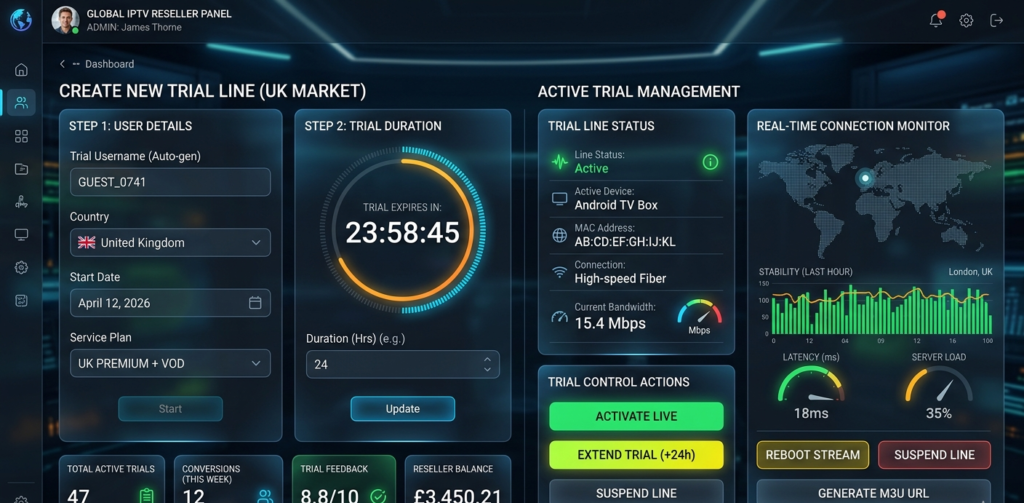
Why IPTV Trials Exist and What They’re Actually For
Let’s be direct about this: an IPTV trial exists to remove purchase hesitation, not to provide free entertainment. That distinction sounds obvious, but a significant number of resellers completely lose sight of it the moment they start handing out access.
In the UK IPTV subscription market, customers are increasingly savvy. They’ve been burnt before — by unstable streams, disappearing providers, panels that went dark overnight. That scepticism is actually rational, and a well-structured trial addresses it directly. You’re essentially saying: “Don’t take my word for it. Test the service under real conditions and see for yourself.”
The operative phrase there is real conditions. A trial that only runs during quiet Tuesday afternoons tells your prospect nothing about how the service performs during a packed Premier League Saturday. If your infrastructure is solid, you should want them to test it during peak hours. If you’re nervous about that, the problem isn’t the trial policy — it’s the provider.
Pro Tip: Always encourage trial users to test during a high-demand evening rather than a quiet afternoon. If your streams hold up when it matters, that’s your most powerful sales argument. If they don’t, you’ve got a provider problem to solve before scaling.
The Real Cost of Offering a Free IPTV Trial
Here’s what most new resellers don’t calculate before launching a trial offer. Every trial line costs you credits. Credits cost money. And if your conversion rate is poor, you’re effectively subsidising strangers’ viewing habits at your own expense.
Let’s put some honest numbers around it:
Trial Cost Per Conversion=Credits Used on Trials×Cost Per CreditNumber of Conversions\text{Trial Cost Per Conversion} = \frac{\text{Credits Used on Trials} \times \text{Cost Per Credit}}{\text{Number of Conversions}}
If you issue twenty 48-hour trials in a month, each consuming 0.1 credits at £0.50 per credit, and you convert five of those into paying subscribers, your actual customer acquisition cost from trials alone is £1.00 per converted customer. That’s manageable.
But if your conversion rate drops to 10% — two conversions from twenty trials — your acquisition cost doubles without your retail price changing. At scale, with hundreds of trials issued monthly and a weak follow-up process, this becomes a genuine drain on margin.
The industry average conversion rate for unqualified IPTV trials sits somewhere between 15–25%. Qualified trials — where the prospect has been through even a basic conversation before receiving access — consistently convert at 40–60% in my experience. The qualification step isn’t bureaucracy. It’s money.
How to Structure a Trial That Actually Converts
The structure of your trial offer matters as much as the service quality itself. Here’s the framework I eventually landed on after considerable trial and error — no pun intended.
Duration: 24 Hours, Not 48
Counter-intuitive, but shorter trials convert better. A 48-hour trial gives prospects too much time to procrastinate, get distracted, and forget to follow up with you. A 24-hour window creates genuine urgency. They need to test it today, during an evening when they’d actually be watching — and then make a decision while the experience is still fresh.
Timing: Align With Peak Viewing
If a prospect contacts you on a Thursday, issue the trial to start Thursday evening. They get to experience the service during a realistic use case — not a quiet midday period that tells them nothing about weekend performance.
Device Compatibility: Test What They’ll Actually Use
Before issuing the trial line, ask what device they’re running. MAG box, Firestick with a player app, Android TV, STBEmu on an older handset — each has slightly different setup requirements. Sending a trial link to someone who then can’t get it working on their device is a lost conversion that had nothing to do with your stream quality.
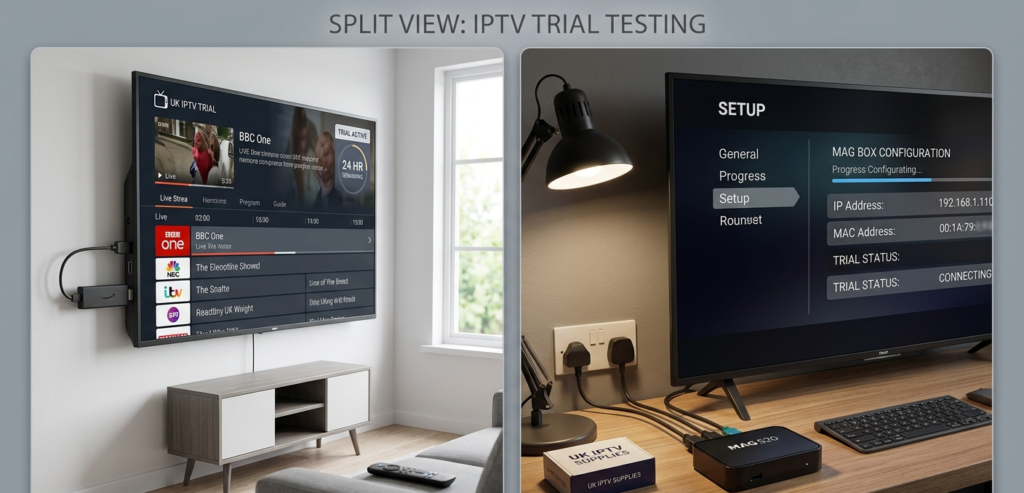
Pro Tip: Create a simple one-page setup guide for each major device type. Send it alongside the trial credentials. Customers who get set up without friction are far more likely to subscribe — and far less likely to blame connection issues on your service when the problem is their own router.
Technical Setup: What Your Trial Lines Need to Include
A trial line that doesn’t represent your full service accurately is pointless. If you throttle the trial to reduced stream quality or limit the content package, you’re not giving the prospect a genuine picture of what they’re paying for. In the UK market especially, where football viewership is the primary driver of IPTV demand, your trial needs to perform under the same conditions as a paid subscription.
The non-negotiables for a properly configured trial line:
Full server access: Trial lines should sit on the same server infrastructure as your paid subscribers. Putting trials on a separate, lower-quality server is dishonest and produces misleading results — both for the customer and for your own understanding of how your service performs.
EPG included: A trial without an accurate Electronic Programme Guide looks amateurish. UK viewers expect to see programme schedules. Missing or broken EPG data is one of the most common reasons for trial abandonment, and it’s entirely avoidable.
Anti-freeze enabled: If your panel provider offers anti-freeze or adaptive bitrate streaming, it must be active on trial lines. A trial that freezes during a high-demand moment won’t convert — and the prospect will assume that’s standard performance.
Connection limit set to one: Trial lines should allow only a single simultaneous connection. This prevents abuse and reflects real subscription terms.
Qualifying Your Trial Leads Properly
This is the single change that improved my trial conversion rate more than anything else. Before issuing any trial, I ask three questions:
What device are you planning to use? What’s your broadband speed roughly? And what are you mainly looking to watch — sport, general entertainment, or both?
That’s it. Those three questions do several things simultaneously. They filter out tyre-kickers who can’t be bothered to reply. They give you the information you need to set the trial up correctly. And they begin a conversation that makes the follow-up feel natural rather than like a cold sales call.
The resellers I’ve spoken to who complain that “trials don’t work” almost universally skip this step. They post a link, hand out credentials to anyone who asks, and wonder why nobody converts. Qualification isn’t gatekeeping — it’s professionalism.
Pro Tip: Anyone who won’t answer three basic questions before receiving a free trial almost certainly won’t pay for a subscription either. Your time has value. Spend it on prospects who demonstrate basic engagement.
Trial to Subscription Conversion: The Follow-Up Framework
The trial itself is only half the equation. What you do in the 24 hours after issuing access determines whether it converts.
Send a check-in message roughly six hours into the trial — not to sell, just to confirm everything is working. This single touchpoint dramatically reduces technical drop-off and positions you as responsive before the customer has even paid you anything.
At the 20-hour mark, send a brief follow-up asking how they’re finding it and whether they have questions. Include your subscription options clearly, with pricing. Keep it conversational rather than transactional.
If they don’t respond within 48 hours of trial expiry, one final message is appropriate. After that, move on. Chasing unresponsive trial users is a time sink with almost no return.
For panel management that makes trial line creation, expiry, and conversion tracking genuinely straightforward, britishseller.co.uk is worth looking at seriously. Having clean trial management built into the panel workflow makes this entire process considerably less manual — and that matters when you’re running trials at volume.
Protecting Yourself From Trial Abuse
It happens. Some people will request trials repeatedly under different contact details, or share trial credentials with others. A few common-sense protections:
Never issue more than one trial per verified contact method. If someone contacts you on WhatsApp, that number is the identifier — not the name they give you.
Restrict trial lines to a single connection and set hard expiry timers through your panel. Most decent panels allow automatic line deactivation at the 24-hour mark without manual intervention.
If you’re active in any reseller communities, share known abuser contact details with other operators. The UK IPTV reseller space is smaller than it appears, and the persistent abusers tend to be the same people circulating across multiple providers.
Pro Tip: Keep a simple log of every trial issued — contact method, device type, issue date, and outcome. After thirty days, review the data. Your conversion patterns will tell you exactly which acquisition channels produce genuine buyers and which attract serial trial abusers.
✅ IPTV Reseller Success Checklist
1. Qualify before you issue. Three questions minimum before any trial line goes out. No reply, no trial. It’s that simple.
2. Match trial conditions to paid service conditions. Same servers, same EPG, same anti-freeze settings. If your service is good, let it prove itself honestly.
3. Use 24-hour trials, not 48. Shorter windows create urgency and produce faster decisions. Longer trials mostly produce more procrastination.
4. Follow up at six hours and twenty hours. Two touchpoints within the trial window. Not to sell — to support. The sale follows naturally from good service and availability.
5. Track everything and review monthly. Conversion rate, credit spend on trials, and which channels produce buyers. Data-driven trial management is what separates a professional operation from a hobby.
The IPTV trial, when handled with even moderate discipline, is one of the most effective customer acquisition tools available to UK resellers. When handled carelessly, it’s an expensive way to entertain strangers for free. The difference between those two outcomes is almost entirely process — and process is something you can fix starting today