IPTV Customer Lifetime Value for Resellers is best worked out by dividing average revenue per customer by your churn rate, not by multiplying one month’s profit by a number you have simply guessed. That churn based version of the metric tells you something a one off profit calculation cannot: how long a typical customer actually sticks around before they stop paying, and what that pattern is quietly worth across your whole customer base.
Why a Single Profit Calculation Undersells the Real Number
A quick profit calculation answers a narrow question. Take what a customer pays, subtract the credit cost, and you get a monthly margin figure. That number is accurate as far as it goes, but it treats every customer as though they will stay exactly as long as everyone else, which almost never holds true in practice.
Churn rate fixes that gap. Instead of assuming a retention period, it derives one from the percentage of customers who actually leave each month. A reseller with 5 percent monthly churn is, mathematically, retaining customers for roughly 20 months on average. A IPTV panel reseller with 10 percent churn is retaining them for around 10 months. Feed either figure into the value calculation and the resulting number reflects real customer behaviour rather than an assumption typed into a spreadsheet.
This distinction matters most when two resellers charge identical prices but see very different results. Same price, same credit cost, same apparent monthly profit, yet one business is worth roughly double the other once churn is factored in. A calculator built around a single month cannot show that difference. A churn based view can.
Working Out the Formula With a Real Example
The calculation itself needs three inputs: average revenue per user, the cost to serve that user in credits, and your monthly churn rate expressed as a decimal.
| Metric | Example Value |
|---|---|
| Average monthly price charged | £10 |
| Average credit cost per month | £2.20 |
| Monthly profit per customer | £7.80 |
| Monthly churn rate | 8% |
| Average customer lifespan (1 ÷ churn) | 12.5 months |
| Customer lifetime value | £97.50 |
Divide 1 by 0.08 and you get an average lifespan of 12.5 months. Multiply that by the £7.80 monthly profit and the result is £97.50 per customer, considerably higher than the figure most IPTV panel resellers keep in their head after a single renewal. Run the same maths across a base of 60 active customers and the total expected value of that base, assuming churn stays roughly flat, sits close to £5,850.
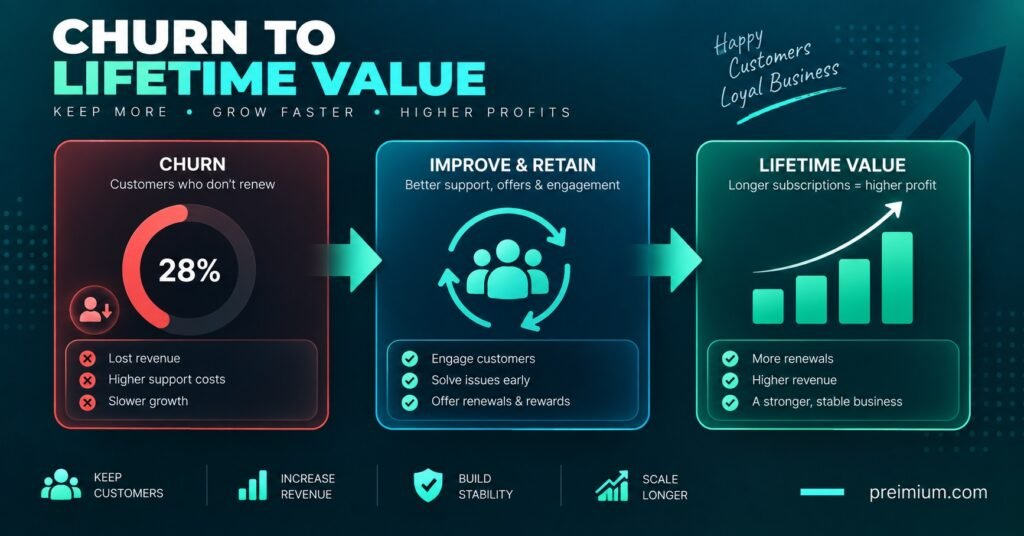
Pro tip: Recalculate churn rate monthly rather than quarterly. A shift from 6 percent to 9 percent churn looks small on paper but cuts average customer lifespan by almost a third, and catching that early gives you time to act before it compounds across the whole base.
Where Resellers Get the Numbers Wrong
The formula is simple. Feeding it bad inputs is where most of the error creeps in.
| Mistake | Better Approach |
|---|---|
| Using sign ups as the churn denominator instead of active paying customers | Base churn on customers who were active at the start of the period, not everyone ever signed up |
| Averaging churn across all pricing tiers | Calculate churn separately for each tier, since a £6 tier and a £15 tier rarely behave the same way |
| Treating a single bad month as the new baseline | Smooth churn over a rolling three month window before recalculating lifetime value |
| Ignoring trial to paid conversion drop off | Track conversion separately from churn so the two figures don’t distort each other |
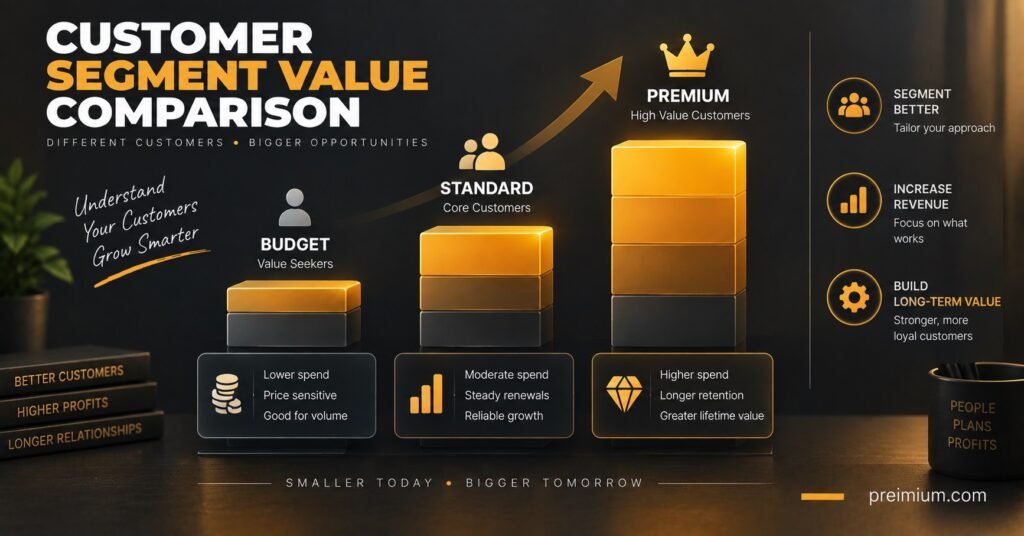
Blending tiers together is probably the most common of these. A reseller running a budget tier and a premium tier at the same time will often see the premium tier’s low churn mask serious problems in the budget tier, right up until the budget customers make up a shrinking share of total revenue and nobody can explain why.
Segmenting IPTV Customer Lifetime Value for Resellers by Acquisition Source
Not every customer is worth calculating the same way. Where a subscriber came from often predicts how long they will stay, and treating the whole base as one blended figure hides that pattern.
Customers who arrive through a personal referral from an existing subscriber tend to churn more slowly, since they already trust the service before they have watched a single stream. Customers acquired through a cold social media post, by contrast, often convert quickly off a short trial and churn just as quickly once the novelty wears off. Running lifetime value separately for each acquisition channel usually reveals that referred customers are worth noticeably more than the blended average suggests, and paid acquisition customers are often worth less.
This has a direct practical use. If referral customers show meaningfully higher lifetime value, it justifies spending more time or offering a modest incentive to generate referrals, since the return on that effort is measurable rather than assumed. If a particular acquisition channel consistently produces low value customers, that is a reason to scale it back even if the initial trial to paid conversion rate looks perfectly healthy.
Pro tip: Tag each new customer with their acquisition source at the point of sign up. Retrofitting that data later from memory is almost always inaccurate, and the segmentation only works if the tagging happens from day one.
Turning the Number Into a Support and Pricing Decision
Calculating lifetime value is only useful if it changes what you actually do. A figure sitting unused in a spreadsheet has no effect on the business.
One practical use is deciding how much support time a given customer segment deserves. A tier with a churn based lifetime value of £120 can reasonably absorb more support attention than a tier sitting at £35, because the return on that time is proportionally larger. Resellers who spread support effort evenly across every customer regardless of segment often end up over serving low value accounts while under serving the ones actually worth protecting.
Pricing decisions benefit the same way. If raising a tier’s price by £2 causes churn to rise from 8 percent to 11 percent, the resulting lifespan drop can easily wipe out the extra revenue per month, even though the headline price increase looks like straightforward extra profit. Running the churn based calculation before and after a proposed price change catches that trade off before it happens rather than after a quarter of lost renewals.
Forecasting credit purchases against expected renewal volume, covered in more detail in IPTV reseller credit forecasting, works best once you know which segments are worth prioritising when credits run tight. A customer relationship tracking system that flags renewal dates by segment makes this considerably easier to act on in practice, rather than treating every renewal date as equally urgent.
Pro tip: Review lifetime value alongside your churn rate every month, not the other way round. Churn moves first and lifetime value moves second, so watching churn gives you an earlier warning than waiting for the lifetime value figure to drift.
Frequently Asked Questions
Is this the same calculation as a standard profit calculator?
No. A profit calculator usually shows margin on a single month or a single transaction. The churn based version described here derives an expected lifespan from actual customer behaviour and multiplies that by monthly profit, which produces a genuinely different and generally more reliable figure.
How much churn data do I need before the formula is reliable?
Three to four months of active customer numbers is usually enough for a rough figure. Anything shorter tends to be skewed by a handful of early cancellations that may not represent the wider pattern once the base grows.
Should I recalculate this every month?
Monthly recalculation is worth doing once you have at least 20 to 30 active customers, since the churn percentage becomes noisy with very small numbers. Below that, a rolling quarterly figure is usually more stable.
Does this replace tracking individual customer support tickets?
No, the two serve different purposes. Lifetime value tells you which segments deserve more attention in aggregate. Individual support tracking, covered separately in IPTV reseller panel customer support, tells you what is actually going wrong for a specific customer right now.
IPTV Customer Lifetime Value for Resellers, calculated through churn rather than a single month’s profit, gives a far more honest picture of which customers, tiers, and acquisition channels are genuinely worth the effort behind them. The formula itself takes minutes to run once churn is tracked properly, and the real work lies in tagging acquisition sources and separating tiers rather than blending everything into one average. Start by pulling your last three months of active customer counts this week, work out churn per tier, and let that number, not a rough guess, decide where support time and pricing attention go next.
Metric Tracking Checklist
- Calculate churn separately for each pricing tier rather than as one blended figure
- Base churn on customers active at period start, not total sign ups ever recorded
- Tag every new customer with acquisition source from the point of sale
- Recalculate lifetime value monthly once the active base passes roughly 20 to 30 customers
- Compare lifetime value before and after any proposed price change
- Review churn rate and lifetime value together, with churn checked first