IPTV Reseller Customer Support is the everyday job of answering customer messages, sorting out account and playback problems, and working out which issues you can fix yourself versus which ones belong to your panel provider. It sounds simple until the first busy Saturday night, when three customers message at once about buffering, one wants a password reset, and a fourth is asking why their subscription stopped working after they changed routers. Handling that mix well, and handling it quickly, is what separates resellers who keep customers for years from resellers who lose half their list within a few months.
What IPTV Reseller Customer Support Actually Involves
Most new IPTV Panel resellers assume support means answering the occasional message. In practice it splits into two very different categories of work. The first is account level support: activating subscriptions, resetting logins, extending renewals, answering pricing questions, and explaining how to install the app on a new device. This is entirely within your control and depends on how quickly you check your panel and your messages.
The second category is service level support: buffering, channel dropouts, poor picture quality, and server downtime. These issues usually originate on the provider’s infrastructure, not on your end, and no amount of goodwill from you will fix a congested server or a delayed EPG feed. Understanding this split matters because it shapes how you communicate. Telling a customer “I’ve flagged this with my provider” is honest and reasonable. Pretending you can personally fix a server-side outage, or staying silent until it resolves itself, tends to do more damage than the outage itself.
The Support Tickets You’ll See Most Often
A handful of issue types account for the bulk of reseller support traffic. Recognising the pattern before it happens means you can respond faster and with more confidence.
| Ticket type | Likely cause | Who typically resolves it |
|---|---|---|
| Buffering or freezing | Provider server load, customer’s home broadband | Provider, sometimes customer’s ISP |
| Login not working | Expired credit, typo in credentials, device app issue | Reseller |
| Missing channels or wrong EPG | Provider feed update, app cache | Provider, occasionally app reinstall by customer |
| Payment or renewal confusion | Unclear pricing communication, missed reminder | Reseller |
| App won’t install on new device | Device compatibility, outdated app version | Reseller, occasionally provider-side app link |
Pro tip: Keep a short saved-reply document with your standard answers to the five ticket types above. It cuts your average response time dramatically and stops you writing the same explanation from scratch every night.
Where Reseller Responsibility Ends and Panel Support Begins
A lot of frustration in this business comes from resellers assuming they’re on the hook for problems that sit with the provider, or conversely offloading things onto the provider that were actually their own account setup mistakes. Before you promise a customer anything, ask yourself whether the issue lives on their account (something you control) or on the streaming infrastructure itself (something the provider controls).
If a customer reports the same buffering issue across multiple devices and multiple locations, that’s a strong signal the problem sits upstream with the provider. If only one customer on one device is affected, it’s far more likely to be a local network issue, an outdated app, or an account setting. Learning to ask two or three diagnostic questions before escalating anything saves you from forwarding every message to your provider and waiting on replies that were never necessary.
Response Time Expectations That Keep Customers Calm
Customers rarely cancel because something went wrong. They cancel because something went wrong and nobody told them what was happening. A buffering issue that gets acknowledged within twenty minutes, even with no immediate fix, feels far less serious to a customer than the same issue met with silence for six hours.
You don’t need to promise instant replies around the clock to run this well. What matters more is consistency. If customers know you typically reply within an hour during the evening, when most viewing happens, they’ll wait patiently. If your response time is unpredictable, every delay reads as abandonment rather than a busy night. Setting a realistic support window and sticking to it beats promising 24/7 availability you can’t actually maintain alongside a day job or other commitments.
Building a Support Workflow Without Full-Time Staff
Most IPTV Panel resellers start out handling support alone, often from a phone, between other responsibilities. That’s workable at a small scale, but it needs some structure or it collapses the moment your customer count grows past a few dozen.
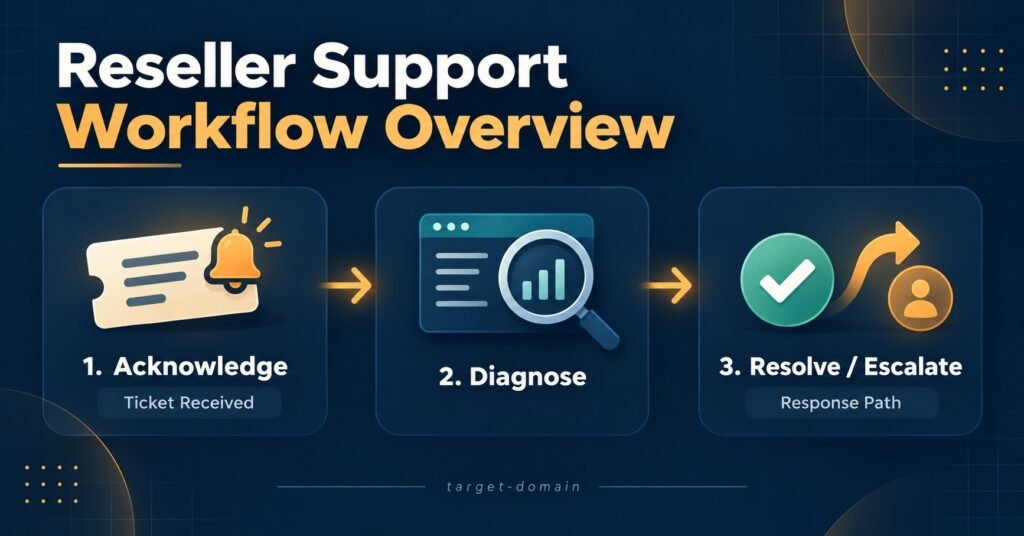
A simple three-step workflow covers most situations. First, acknowledge the message immediately, even with a short holding reply. Second, run a quick diagnostic: is this account-side or provider-side, and is it affecting one customer or several. Third, resolve it directly if it’s within your control, or pass it to your provider with clear details if it isn’t, and follow up with the customer once you hear back. Writing this down, even informally, means you handle problems the same way every time rather than reinventing your approach under pressure.
Pro tip: If you’re using a group chat platform for support, create a pinned message with your typical response hours and a short list of what to check before messaging (router restart, app reinstall, correct login details). It filters out a meaningful share of tickets before they’re even sent.
Common Mistakes That Turn Small Issues Into Cancellations
Several habits repeatedly show up among resellers who struggle with retention. Going quiet during an outage instead of sending a brief update is one of the most damaging, because customers assume the worst when they hear nothing. Promising a fix timeline you can’t verify is another; it’s better to say you’re waiting on the provider than to guess at a resolution time and be wrong.
Treating every complaint as an isolated event rather than tracking patterns is a subtler mistake. If the same customer reports buffering every Friday night, that’s worth investigating properly rather than resetting their session each time and hoping it doesn’t recur. And undercharging to the point where support becomes unaffordable time-wise is a business problem as much as a support one; pricing needs to account for the time support genuinely takes.
Sub-Reseller Support Considerations
If you’re operating with sub-resellers underneath you, support responsibility needs to be explicit from day one. Decide clearly whether sub-resellers handle their own customers’ first-line support or whether everything routes back to you, because ambiguity here creates delays exactly when customers are already frustrated. Give sub-resellers the same diagnostic questions and saved replies you use yourself, so the standard of support stays consistent regardless of who’s answering.
Reseller Support Checklist
- Set a realistic daily response window and communicate it to customers
- Keep saved replies ready for the five most common ticket types
- Ask diagnostic questions before deciding whether to escalate to your provider
- Send a short update during any outage, even without a fix yet
- Track recurring complaints from the same customer instead of treating each as new
- Agree support responsibilities clearly with any sub-resellers before onboarding them
- Review your pricing periodically to ensure it still covers the time support takes
Frequently Asked Questions
Do I need 24/7 support to run an IPTV reseller business?
No. Consistency matters more than constant availability. A clearly stated response window that you reliably meet works better than an unrealistic promise of round-the-clock replies.
What is the difference between reseller support and panel provider support?
Reseller support covers account level issues you control directly, such as logins, renewals and pricing questions. Panel provider support covers infrastructure issues like server load, EPG feeds and channel availability.
How fast should I respond to customer support messages?
There’s no fixed industry figure, but replying within an hour during peak evening viewing hours is a reasonable benchmark that most customers find acceptable.
Can I run reseller support through WhatsApp alone?
Many resellers do, especially at smaller scale. It works well as long as you have saved replies ready and a clear process for escalating provider-side issues, since informal channels can get chaotic without structure.
What should I do when a customer reports buffering?
Ask whether it happens across multiple devices or locations. If it does, it’s likely provider-side and should be escalated. If it’s isolated to one device, check the app version, login details and the customer’s home connection first.
Bringing It Together
IPTV Reseller Panel Customer Support isn’t complicated in principle, but it does need structure to hold up once your customer base grows beyond a handful of people. Knowing which issues sit with you and which belong to your provider, responding consistently rather than instantly, and keeping a simple workflow for the tickets you’ll see most often will save you far more time than trying to fix everything yourself as it comes in. Start with the reseller onboarding checklist if you’re still setting up your process, and keep an eye on your churn rate as a signal of whether your support is actually working. Good support, applied consistently, is one of the clearest ways to protect customer lifetime value and keep renewals coming in without a fight.