An IPTV Outage Communication Guide matters most in the first ten minutes, because that is when your customers decide whether you are managing the problem or hiding from it. The short answer is this: acknowledge the fault quickly, state plainly what you do and do not know, give a specific time for your next update, and never promise a restoration time your upstream provider has not given you. Customers forgive downtime. They rarely forgive silence, and they almost never forgive a fix time that comes and goes without a word.
Why Silence Costs More Than the Outage Itself
A dropped stream is an interruption. An unanswered message is a judgement about you.
UK IPTV pane Resellers often underestimate this because they are busy doing the sensible thing during an outage, which is checking the panel, testing lines on a second device, and messaging their supplier. All of that is necessary work. The trouble is that it happens invisibly, so from the customer’s side nothing is happening at all. They message once, wait, message again, then start telling other people the service is dead.
The gap between “I am working on it” and “I have not replied yet” is roughly thirty seconds of typing. It is the highest return activity available to you during a fault, and it costs nothing but attention.
There is a second reason to speak early. When you say nothing, customers fill the silence with their own theory, and the most common theory is that they have been scammed. Once that idea takes hold, a refund request follows even if the service returns an hour later. Early contact stops the story before it forms.
The IPTV Outage Communication Guide Every Reseller Should Have Ready
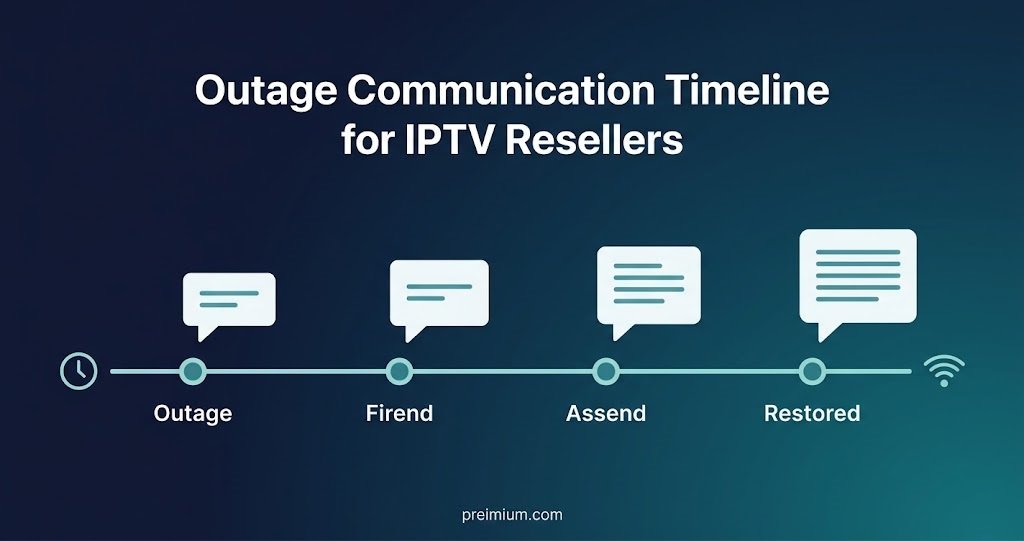
Outages have a rhythm, and your messages should follow it. What works at minute five is wrong at hour four, and the reassurance that calms someone in the first hour sounds hollow by the second evening. Break it into phases and write the messages before you need them.
Minutes 0 to 15: confirm and acknowledge
Before you announce anything, confirm the fault is real and understand its shape. Test two or three lines on different devices, ideally on a connection that is not your home broadband. Check whether the problem affects everyone or a subset of accounts, whether it is total or limited to certain streams, and whether the panel itself is reachable.
Then send something short. At this stage you are not explaining, you are signalling presence. Something on the level of: “Aware of a fault affecting streams from around 20:40. Checking with the server side now, I will update by 21:10.”
That single message converts a flood of individual queries into a queue that can wait.
The first hour: give shape to the problem
By now you should know roughly what you are dealing with, even if you cannot fix it. Tell customers which parts are affected and which are not, because partial information is genuinely useful to them. If catch-up and recordings still work while live streams do not, say so. If one server is down and you have the ability to move accounts, tell them that migration is underway rather than leaving them to guess why their line suddenly changed.
Avoid technical detail that you cannot stand behind. “Upstream network issue” is honest and vague. “Router failure at the London node” is a claim you may have to retract.
Hours two to six: switch from updates to expectations
Repeating “still working on it” every twenty minutes stops reassuring people after the third time. Move to scheduled updates at longer intervals and say when the next one is coming. Consistency now matters more than frequency.
This is also the point where you should decide, internally, what your threshold is for offering compensation, so that you are not making that decision under pressure at midnight.
Beyond six hours or into a second day: change the conversation
A long outage is no longer a technical event, it is a commercial one. Customers stop asking what is wrong and start asking what they are getting for the money they paid. Address that directly rather than waiting to be asked. Explain what has been done, what is still outstanding, and what you are offering by way of extension or credit.
Pro tip: Write all four phase messages now, while nothing is broken, and keep them in a note on your phone. Judgement is worse at 21:00 on a busy evening than it is on a quiet afternoon.
Choosing the Right Channel for Each Type of Update
Where you send the message shapes how it is received.
Direct messaging apps are where most reseller communication already happens, and they are ideal for individual reassurance. They are poor for broadcasts, because sending the same text to forty people one at a time is slow, and using a broadcast list often reads as impersonal at exactly the wrong moment.
A pinned status update on a group, a channel, or a simple page on your own site is better for the general announcement. It gives you one place to point at, which means you answer once instead of forty times. It also creates a record, which is useful later when someone claims they were never told anything.
Email works for the post-outage summary and for anything involving credits or extensions, because customers keep it and can refer back to it.
Whichever combination you use, pick it before the fault and tell customers in advance where outage notices will appear. A communication channel nobody knows about is not a communication channel.
Pro tip: Add a single line to your welcome message for every new customer stating where service notices are posted. It takes one sentence and saves hours later.
Phrases That Make Outages Worse
Certain replies are common, well intentioned, and quietly damaging.
| Common reply | Why it backfires | Better version |
|---|---|---|
| “It should be back soon” | Sets an expectation you cannot control, and gets repeated back to you when it is not | “No confirmed restoration time yet. Next update from me at 22:00.” |
| “It is working fine on my end” | Reads as a denial of their experience, even when technically true | “Working here on a test line, so it may be regional. Which device and connection are you on?” |
| “It is the server provider, not me” | Customers bought from you, so the distinction sounds like blame shifting | “The fault is upstream of my panel. I am chasing it and will pass on what I get.” |
| Long silence, then a fix | Removes any credit you would have earned for handling it well | Short acknowledgement, scheduled updates, brief closing summary |
The pattern across all four is the same. Vagueness and deflection feel safer to write, but they transfer anxiety to the customer instead of absorbing it.
Message Templates Worth Adapting
Templates are useful as long as you edit the specifics each time. Copying an identical message into two different outages is noticed quickly.
Initial notice: “There is a fault affecting live streams that began around [time]. I am in contact with the server side. Recordings and catch-up appear unaffected. Next update by [time].”
Extended outage: “Still unresolved as of [time]. The issue is upstream and being worked on. I am holding off moving accounts until I have confirmation the alternative route is stable, as switching twice would make things worse. Update by [time].”
Restoration: “Streams are back as of [time]. If yours has not returned, restart the app fully rather than just closing it, and message me if it is still down after that. Details on the extension I am applying to affected accounts below.”
Notice that the middle template explains a decision rather than just reporting status. That single sentence of reasoning does more for credibility than three status updates.
Deciding on Compensation Before Anyone Asks
Set your own thresholds in advance and apply them consistently. Something like: under two hours, no action. Two to twelve hours, a short extension applied automatically. Beyond a full day, a longer extension plus a direct message to each affected customer.
The exact numbers are yours to choose and will depend on your pricing and margins. What matters is that the rule exists before the outage, because compensation negotiated one customer at a time under pressure produces wildly inconsistent outcomes, and customers do compare notes.
Offering it before it is requested is worth more than the credit itself. It signals that you were tracking the impact rather than hoping nobody noticed.
Where you sit on this is closely tied to how your supply arrangement works. If you are operating on prepaid credits and thin margins, generous extensions are expensive, which is one practical argument for understanding yourIPTV reseller paneland its cost structure properly before you build a customer base on top of it.
What to Say When You Genuinely Do Not Know
Resellers sit in an awkward position during infrastructure faults. You are responsible to your customers but dependent on someone above you, and that supplier may tell you very little.
Say that honestly, without making it sound like an excuse. “I have raised it and I am waiting on a response. As soon as I have something concrete, you will have it too” is a complete and acceptable answer. What is not acceptable is inventing a cause to fill the gap, because if the real explanation surfaces later and contradicts you, every future update you send is discounted.
If your supplier routinely goes quiet during faults, that is information about your supplier rather than about your communication skills. Response behaviour under pressure is one of the more revealing things to test before committing, and it is a recurring theme in practical guidance on running an IPTV reseller business in the UK.
Closing the Loop After Service Returns
Most resellers stop communicating the moment streams come back. That is a wasted opportunity.
A short closing message costs little and does three things. It confirms restoration, so customers who have not checked stop worrying. It gives them one clear troubleshooting step, which reduces the tail of “still not working for me” messages caused by cached sessions. And it states what you are doing about the disruption, which closes the commercial question before it reopens later as a refund request.
Keep it brief. Nobody wants a post-incident report from a reseller. Two or three sentences and a note about any extension applied is enough.
Pro tip: Log the date, duration, cause, and your response for every outage. After six months you will have a factual record of your supplier’s reliability, which is far more useful than a vague sense that things have been rough lately.
Frequently Asked Questions
How quickly should I tell customers about an outage?
Within roughly fifteen minutes of confirming it is real. Confirm first on at least two lines so you are not announcing a fault that turns out to be your own connection, then send a short acknowledgement with a time for your next update.
Should I explain the technical cause to customers?
Only at a level you can defend. Broad accuracy such as “server side issue upstream” is fine. Specific claims about hardware, routing, or particular nodes create problems if they turn out to be wrong.
Do I tell customers the fault is my supplier’s, not mine?
You can describe where the fault sits, but avoid framing it as an escape from responsibility. Customers paid you, so the accountability stays with you regardless of where the technical failure occurred.
Is it worth offering credit for a short outage?
For anything under a couple of hours, a clear explanation usually matters more than compensation. For longer disruptions, applying an extension automatically rather than waiting to be asked tends to preserve renewals better than the equivalent value in refunds.
How do I stop the same outage generating fifty separate messages?
Post one status update in a place customers already know to check, then reply to individual messages with a short line pointing there. Establishing that location when customers first sign up is what makes it work.
What if an outage happens during a busy viewing period?
Expect higher message volume and shorter patience. Acknowledge faster than usual, update more often during the first hour, and be conservative about promising restoration times, because that is exactly when unrealistic estimates do the most damage.
Where This Leaves You
Treat this IPTV Outage Communication Guide as an operating routine rather than a set of phrases. The technical fix is usually out of your hands. The response is entirely in them, and it is the part your customers actually experience.
Write your phase messages this week, decide your compensation thresholds now, and tell every customer where service notices will appear. When the next fault arrives, and one will, you will be executing a plan instead of improvising while your phone fills up. If you are still setting up your operation, building these habits alongside a properly configured IPTV reseller panel is considerably easier than retrofitting them onto an existing customer base.
Reseller Outage Communication Checklist
- Two or more test lines confirmed on different devices and connections before any announcement goes out
- A single agreed location for service notices, communicated to every customer at sign-up
- Four pre-written phase messages saved and ready to adapt
- Compensation thresholds decided in advance and applied consistently
- Update times promised as specific clock times, never as “soon”
- No restoration time given unless your supplier has confirmed it in writing
- Restoration message includes one troubleshooting step and any extension applied
- Date, duration, cause, and response logged for every incident