An IPTV Reseller Refund Reserve Calculator works out how much cash you should leave untouched each month, so that refunds, pro-rata cancellations and chargebacks come out of money set aside for them and not out of next month’s credit budget. The sum itself is simple. For each type of refund, multiply the revenue at risk by your real refund rate and by the share you usually give back, then hold that amount for as long as the payment route lets a customer come back. On the illustrative figures used below, a reseller taking £2,370 a month would hold about £225 in a normal month and close to £530 after one bad service week.
Most IPTV panel resellers underestimate time, not the percentage. A 4% refund rate sounds harmless until you remember that a card dispute can arrive months after the sale, long after that money has gone on new IPTV credits. So the reserve isn’t a slice of this month’s takings. It’s several overlapping windows added together, and the longest window usually belongs to the payment method, not to your own refund policy.
The Formula Behind an IPTV Reseller Refund Reserve Calculator
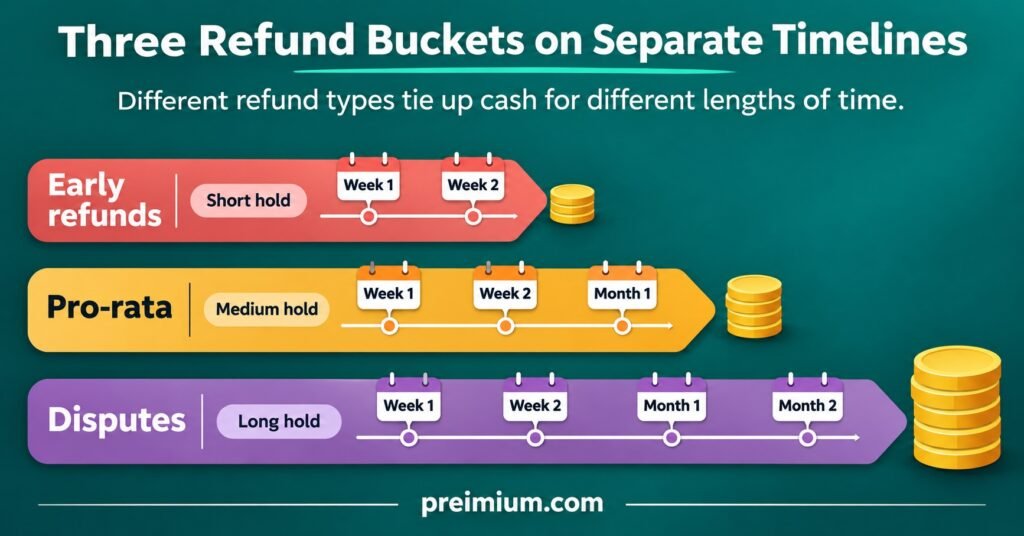
Split refunds into three buckets, because each one behaves differently and clears on a different timetable.
Early refunds are the requests that come in during the first days of a subscription: a setup that never worked, a device the customer couldn’t configure, or a cancellation within the cooling-off period. They are usually full refunds and they settle quickly.
Pro-rata refunds come from longer plans. A customer on a twelve-month line cancels in month five and you agree to return part of the price. These are smaller per case but can turn up at any point in the term.
Chargebacks and payment disputes are the expensive bucket. You lose the order value, pay a processor fee on top, and the customer can raise the dispute long after the sale.
The calculator applies the same pattern to each bucket:
Bucket reserve = monthly revenue (or orders) exposed × refund rate × average share refunded (plus any fee) × months the risk stays open
Add the three buckets together and you have your reserve target. The multiplication isn’t the hard part. What matters is that every input comes from your own records, and that the holding period matches how long money can actually be clawed back.
Inputs You Have to Pull From Your Own Records
Your refund rate should come from your payment processor’s statements, not from the reseller dashboard. The panel shows lines created, extended and deleted. It doesn’t show which customers got their money back, or how much. Take the last three months, count refunds by type and divide by orders or revenue for the same period. If you’ve been trading for less than three months, use a deliberately cautious placeholder and replace it as soon as you have real data.
Average share refunded matters most for longer plans. A full refund on a monthly line is 100%. A pro-rata refund on an annual line might average 40% or 60% depending on when people tend to cancel. Your history decides the number, not a rule of thumb.
Dispute fees come straight from your processor’s pricing. Stripe’s UK pricing update, for example, raised the dispute fee from £15 to £20, and some processors charge again if you contest a dispute. Use whatever your own account is billed today.
The holding period depends on the payment route. These are the windows the calculator uses:
| Payment route | When refunds or disputes can arrive | Holding period in the calculator |
|---|---|---|
| UK distance sale cancellations | 14 days from the contract for services, under the Consumer Contracts Regulations 2013 | 1 month |
| Card payments | Up to 120 calendar days from processing for most consumer dispute conditions, as quoted from Visa’s rules in this Financial Ombudsman decision | 4 months |
| PayPal (UK accounts) | Item Not Received disputes up to 180 days from payment | 6 months for the PayPal share |
| Bank transfer | No chargeback scheme, but statutory refund duties still apply | 1 month, plus pro-rata |
Card schemes do allow longer windows for some fraud cases, so treat four months as a working assumption, not a legal ceiling. If a third of your sales go through PayPal, run that third through the calculator separately with a six-month hold, rather than averaging it into the card figure.
A Worked Example With Illustrative Numbers
The figures below are hypothetical. They aren’t market prices or anyone’s real trading results. They are there to show the arithmetic, so swap in your own figures before relying on the result.
Picture a UK IPTV reseller business that, in a typical month, sells 60 one-month lines at £12, 25 three-month lines at £30 and 10 twelve-month lines at £90. That’s 95 orders and £2,370 of revenue, an average order of about £24.95. All payments go through a card processor that charges £20 per dispute.
The normal month
The reseller’s records show early refunds running at 4% of revenue, nearly always refunded in full and settled within the month. That gives £2,370 × 4% = £94.80, held for one month.
Pro-rata refunds affect the annual plans. About 5% of annual buyers cancel mid-term and receive roughly half the price back. That’s 10 × 5% × £90 × 50% = £22.50 a month. The reseller holds two months of it (£45.00), on the assumption that agreeing and paying a pro-rata request often takes a billing cycle.
Chargebacks run at 0.5% of orders. Each one costs the order value plus the fee, so 95 × 0.5% × (£24.95 + £20) = £21.35 a month. Since card disputes can arrive for about four months, the reserve holds four months of that exposure: £85.40.
Reserve target: £94.80 + £45.00 + £85.40 = £225.20, or roughly 9.5% of one month’s revenue.
The month after a bad week
Now suppose the upstream IPTV provider has a rough week, with buffering complaints, failed logins and a support queue that won’t clear. Early refunds jump to 15% of that month’s revenue. Annual cancellations double to 10% for the month. Chargebacks double to 1% of orders, but only for the affected month. The three months before it stay at the normal rate.
| Bucket | Normal month | After a bad week |
|---|---|---|
| Early refunds (1 month held) | £94.80 | £355.50 |
| Annual pro-rata (2 months held) | £45.00 | £67.50 |
| Chargebacks (4 months held) | £85.40 | £106.75 |
| Reserve target | £225.20 | £529.75 |
The stressed figure is about 22% of monthly revenue, more than double the normal one. Early refunds drive almost all of the jump, which is good news in one way: that bucket is the one you can influence most, through faster IPTV support and clear setup help in the first 48 hours. The chargeback bucket barely moves because one bad month is diluted across a four-month window. But that also means it stays elevated for four months after the problem is fixed.
When you set the reserve, many operators work to the stressed figure, not the normal one. The normal figure tells you what refunds usually cost. The stressed figure tells you whether a single bad week forces you to stop buying credits.
The Number the Reserve Cannot Cover
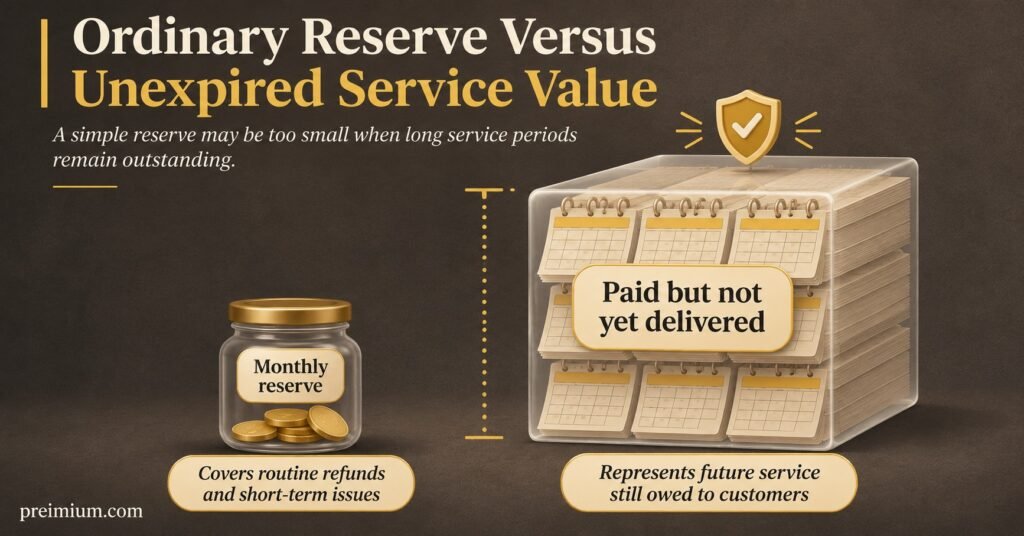
The calculator has a blind spot, and it’s better to see it clearly than to pretend it isn’t there. It models ordinary refund behaviour. It does not model a provider failure, where every customer with time left on their line asks for money back at once.
In the same example, at steady state there would be roughly 120 active annual customers, 75 quarterly and 60 monthly, each with on average about half their paid period remaining. That’s about £5,400 + £1,125 + £360, or close to £6,900 of service already paid for and not yet delivered. That’s around thirty times the normal reserve.
No sensible refund reserve holds that much, and trying to would freeze most small operations. This risk is handled through supplier choice and written commitments, not cash. Checking who actually operates the service, and what happens to active lines if they stop, is covered in this guide to IPTV reseller supplier verification. Agreeing what counts as an outage, and what compensation flows back to you, belongs in a written agreement like the one set out in this worked IPTV reseller service level agreement.
What the calculator can do is tell you how much of that liability sits on long plans. If annual lines make up most of your unexpired value, a provider problem hurts far more than the same revenue on monthly lines, and that may be a reason to keep long-term plans a smaller share of sales.
Where UK Consumer Law Sets the Floor
IPTV is a delivery technology, and all of this assumes a service legitimately licensed for the market you sell into. With that in place, consumer law sets a minimum that your refund policy can’t go below, whatever your terms say.
For UK consumers buying at a distance, the Consumer Contracts Regulations give a 14-day right to cancel a service contract. Where the customer expressly asks for the service to start within that period, regulation 36 allows you to charge a proportionate amount for what was supplied before cancellation. Digital content follows a separate rule: under regulation 37, the right to cancel is lost once supply begins, but only if the consumer gave express consent and acknowledged they would lose it. Refunds after a valid cancellation are generally due within 14 days.
Whether a particular streaming subscription is treated as a service or as digital content can change the answer, so ask a qualified adviser before relying on either reading. This article isn’t legal advice, and the rules differ in other English-speaking markets. The practical point for the calculator is that your early-refund bucket can never safely be zero. Your published terms, such as those on the site’s policies page, should match what the checkout actually records about consent.
Credits Are the Hidden Variable
Cash refunds and IPTV credits don’t move together. When you refund a customer, the cash leaves your account in full. The credit you spent creating that line may or may not come back, depending on how your provider’s reseller dashboard treats deleted or shortened lines. Some panels return credits within a short window and many treat consumed credits as spent, so check your provider’s own rules instead of assuming either.
This changes what a refund actually costs you. If credits are not returned, a £12 refund on a line that cost you, say, £6 in credits is a £12 cash outflow, not a £6 loss of margin. Your reserve has to cover the cash. Any credit that does come back should be treated as a bonus, not counted into the reserve.
The same logic applies to sub-resellers. If you refund their customers or reverse credits you’ve allocated, the cash and credit flows need recording separately. Moving credits between accounts with a second approval, as described in this guide to IPTV reseller panel credit transfer, leaves a clear trail when you later reconcile refunds against credits.
Turning the Sheet Into a Monthly Habit
A spreadsheet version needs only a handful of input cells: monthly revenue, order count, average order value, the early refund rate, the annual pro-rata rate and share, the chargeback rate, the dispute fee, and a holding period for each bucket. Put each bucket on its own row using the formula above, then add a final row for the total. Add a second column with your stressed assumptions so both figures sit side by side.
Run it on the same day each month, after your processor statement closes, and change the inputs only from real data. Three rules keep the reserve honest:
- Raise the reserve as soon as the calculation says so, even mid-month if a service problem is unfolding.
- Release surplus only after the relevant window has passed. Money held against March card sales stays put until roughly July.
- Keep the reserve in a separate account from the one you use to buy credits, so it isn’t spent by accident during a busy week.
Pro tip: Refund promptly when a customer clearly has a valid complaint. With Stripe, for example, the dispute fee is charged once a chargeback is filed, even if you refund afterwards, so a quick voluntary refund is usually cheaper than a dispute you’ll probably lose.
Watch the ratio between your normal and stressed figures over time. If the gap keeps widening, your business is becoming more sensitive to provider problems, usually because long plans are growing faster than short ones or because support response times are slipping.
Questions Resellers Ask About Refund Reserves
Can I just hold a flat percentage of revenue?
You can, but a flat figure hides which bucket is driving the risk. In the example, 10% of revenue would roughly cover a normal month and fall well short after a bad week. Working out the buckets once tells you what percentage actually fits your sales mix, and you can simplify from there.
If I only take bank transfers, do I need a reserve at all?
Yes, though a smaller one. There is no card chargeback scheme, but cooling-off refunds and pro-rata agreements still cost cash. Drop the chargeback bucket and keep the other two.
My processor already holds a rolling reserve. Does that count?
Money your processor holds does cover disputes on those transactions, so subtract it from the chargeback bucket rather than holding the same exposure twice. It won’t cover early or pro-rata refunds you pay voluntarily, and the processor sets its own release dates, so read your account terms.
How often should the assumptions change?
Update the rates monthly from actual statements. Review holding periods whenever you add a payment method or your processor changes its dispute terms, because the windows come from them, not from you.
Closing the Loop
An IPTV Reseller Refund Reserve Calculator gives you two useful numbers: what refunds normally cost, and what a bad week would cost. Hold cash against the second, and release it only once each window has closed. It won’t protect you from a provider failure, which is a matter of supplier checks and written agreements. But it does stop ordinary refunds and chargebacks from quietly eating the money meant for next month’s credits. Start with three months of your own processor data and the two-column sheet described above. The first real calculation usually shows which bucket deserves your attention.