Hotel IPTV System Cost by Room Count, and What Really Moves the Number
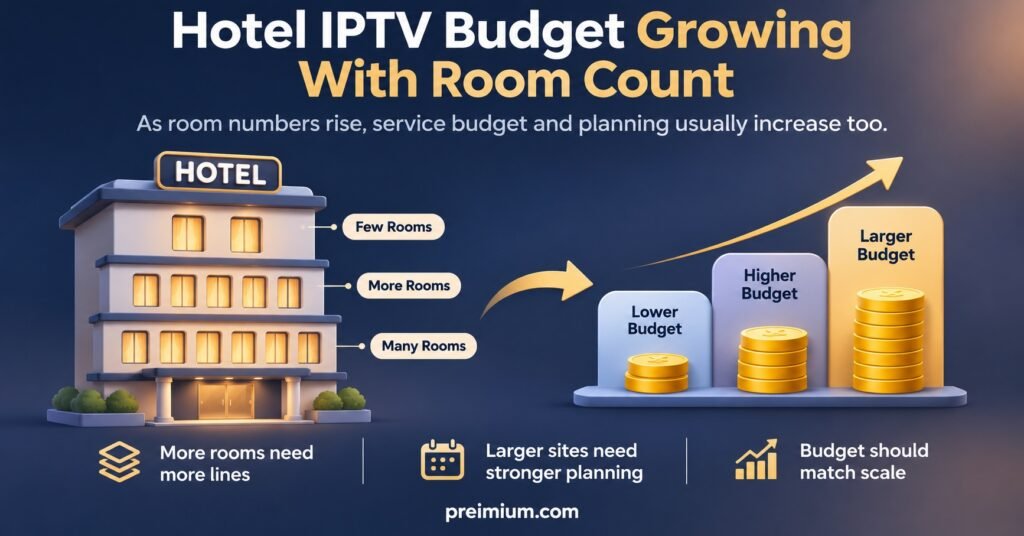
Hotel IPTV System Cost comes down mostly to two things you can check today: how many rooms need a screen, and whether the televisions and cabling already in those rooms can be reused. As a working guide, published industry ranges put an on-premise system at roughly $200 to $500 per room upfront. That works out at about $10,000 to $25,000 for a 50-room property before any content licensing. Cloud-managed systems move most of that into a monthly fee, commonly quoted at $3 to $5 per room.
That per-room figure hides an uneven split. Encoders and the headend scale with the number of channels you carry, not the number of rooms. A 20-room guesthouse and a 150-room hotel showing the same line-up may therefore buy almost identical encoding hardware. What grows with every room is the in-room device, the network port behind it and the labour to install and test both. That’s also why two quotes for the same building can sit thousands apart: one supplier has assumed your TVs can run a hospitality app and your switches handle multicast, and the other has assumed they can’t.
Indicative Budgets for 20, 50 and 150 Rooms
The table below applies those published per-room ranges to three common property sizes. Treat it as a planning bracket, not a price list. Figures are in US dollars because most hospitality TV hardware is listed that way. None of them include content licensing, which is a separate cost covered further down.
| Rooms | Upfront, on-premise system | Monthly, cloud-managed system |
|---|---|---|
| 20 | $4,000 to $10,000 | $60 to $100 |
| 50 | $10,000 to $25,000 | $150 to $250 |
| 150 | $30,000 to $75,000 | $450 to $750 |
At 20 rooms, the encoder and headend take a large share of the budget because that equipment costs much the same whatever the room count. Small properties often find a cloud plan easier to justify for exactly this reason. Even so, check whether “no upfront hardware” really includes the in-room devices and the local encoder for any channels you feed in yourself.
At 50 rooms the two models start to compete properly. The fixed equipment is now spread across enough rooms to bring the per-room figure down, and the monthly fees are large enough to add up over a typical five-year contract.
At 150 rooms the network usually becomes the deciding factor. Five years of cloud fees at $3 to $5 per room comes to roughly $27,000 to $45,000, which sits inside the on-premise bracket. Whichever model looks cheaper on paper, a building with old switches or coax-only wiring will pull the real figure toward the top of its range.
Where Your Hotel IPTV System Cost Actually Goes
A quote that shows one total figure is hard to judge. Ask for it broken into the four areas below, because each one responds to different decisions you can make.
The headend and encoders
The headend is the equipment rack that takes in your television sources and turns them into streams on the hotel network. Encoders do the conversion: each HDMI input from an authorised receiver becomes one channel that every room can tune to. For a clearer picture of how the components fit together before you speak to suppliers, this overview of an IPTV headend and how it is built is a useful starting point.
This part of the budget depends on channel count. A hotel carrying 12 channels and one with 30 will spend very differently on encoding, even with the same number of rooms.
Middleware and the guest interface
Middleware is the software layer that produces the welcome screen, the channel guide, hotel information pages and any on-demand menu. It may be sold as a one-off licence, a yearly IPTV subscription or a per-room monthly fee. Integration with your property management system (for names on the welcome screen or charges to the room bill) often appears as a separate line, so check whether it’s included.
In-room devices
Every room needs something to receive the stream. That’s either a hospitality set-top box connected to the existing TV or a hospitality-grade smart TV that runs the IPTV app directly. Published list prices for hospitality set-top boxes commonly fall around $100 to $170 per unit, so at 150 rooms the boxes alone can reach five figures.
Compatible smart TVs remove the box, the extra power supply and one more remote. They cost more per screen, though, and only make sense if the televisions are due for replacement anyway. Many hotels end up with a mix: boxes in rooms with newer consumer TVs, and hospitality sets wherever screens are being replaced.
Installation and commissioning
Labour covers fitting the rack, configuring switches, mapping channels, installing a device in every room and testing each one. Room access is the hidden variable here. When rooms have to stay sellable during the work, installers can only reach a few at a time, which stretches the job over more days. Ask suppliers to state their installation time in days and how many rooms they expect to complete per day.
Choosing an IPTV Encoder Box by Channel Count
Start by counting sources rather than rooms. Each channel you want to show needs an encoder input, plus one more for a hotel information channel if you plan to run your own. Add a couple of spare inputs so a new channel next year doesn’t mean buying another unit.
| Encoder type | Typical published price | Usually suits |
|---|---|---|
| Single-channel HDMI encoder | From about $500 | One extra source or an in-house information channel |
| Budget 8 to 24 channel rack unit | About $1,500 to $2,400 | Small and mid-size line-ups |
| Professional 4 to 16 channel rack encoder | From about $3,600 | Larger hotels needing H.265, redundancy and vendor support |
The price gap between the second and third rows isn’t only about picture quality. Professional units tend to offer better H.265 support, cooler running under continuous load and firmware updates you can rely on. H.265 roughly halves the bitrate of H.264 at the same 1080p quality, which matters when the network is already busy. The catch is that it asks more of the encoder, and the in-room devices must be able to decode it.
Heat is the failure that catches budget units out. An encoder that copes on a test bench can drop channels after weeks inside a warm comms cupboard. This guide to choosing a multi-channel encoder for hotel IPTV systems looks at sustained capacity, cooling and when two smaller encoders beat one overloaded unit.
Every source feeding the encoders must also be authorised for commercial display. A receiver on a domestic subscription isn’t a lawful source for a hotel, however good the encoder is. IPTV is only the delivery method. The right to show each channel to guests has to come from the content provider or a licensed distributor.
Pro tip: Ask every supplier to price encoders against your actual channel list and to price in-room devices per room as separate lines. You can then compare quotes line by line instead of guessing which one has quietly left something out.
Network Work That Changes the Quote Most
IPTV runs on the same kind of network as your guest Wi-Fi, which is why the network survey often changes a quote more than any hardware choice. Live channels are normally sent as multicast, meaning one copy of each channel travels across the network no matter how many rooms are watching it. That only works properly if the switches support IGMP snooping. Without it, switches can flood every stream to every port, and a system that looked fine during a demonstration starts freezing once the hotel fills up.
Expect a supplier to check three things. First, whether your switches are managed, support IGMP snooping and have enough ports for every room device. Second, whether television traffic can sit on its own VLAN, separate from guest internet traffic, so a busy evening on the Wi-Fi doesn’t affect the picture. Third, how much bandwidth each room can actually receive. A conservative planning estimate is 8 to 15 Mbps per room for HD content, and on-demand viewing adds individual streams on top of the multicast channels.
The wiring to each room is the biggest swing factor. A building with Cat5e or Cat6 cabling to every room can usually reuse it. A building with coax only has two routes. One is new structured cabling, which is disruptive and expensive. The other is a hybrid approach that carries IP or modulated channels over the existing coax. The hybrid route usually costs less upfront but limits some interactive features, so ask the supplier what will and won’t work before you choose it.
Older switches that fail the survey are a common reason a quote rises after the site visit. It’s far better to learn that before a budget has been approved than after.
Running Costs After Installation
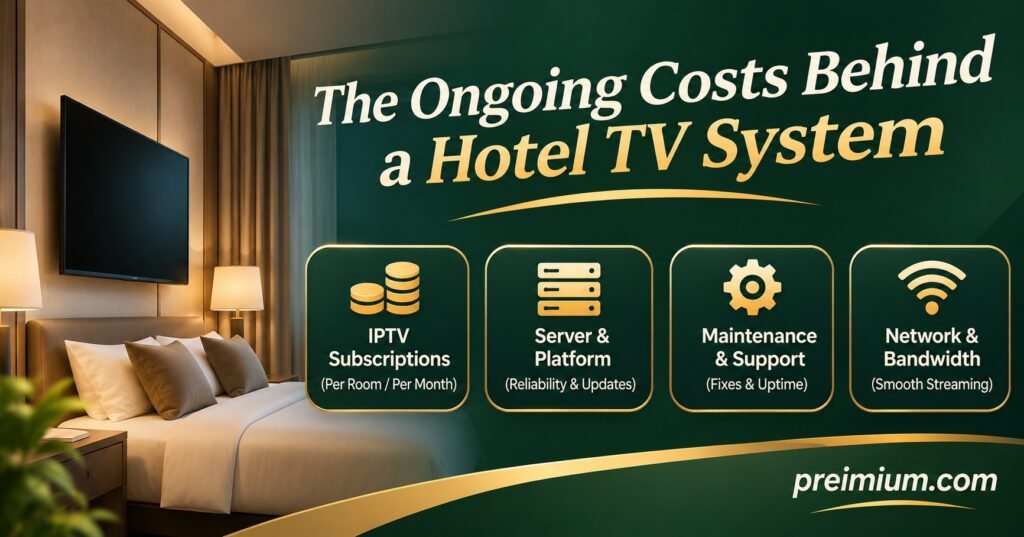
The purchase price is only part of what the system costs you over five years. Content licensing is often the largest ongoing cost, and hardware quotes usually leave it out. You’ll need commercial rights for every channel you distribute, and some countries add their own requirement on top. In the UK, for example, hotels need a specific TV licence whose cost is linked to the number of rooms with a television. Neither appears on an equipment invoice, so budget for them separately.
The other recurring costs are smaller but easy to forget:
- A support and maintenance contract, often priced per room per year, covering remote monitoring, fault response and replacement parts.
- Middleware or software subscriptions, if the guest interface isn’t a one-off licence.
- Per-room monthly fees on a cloud-managed plan, which replace much of the upfront spend.
- A small stock of spare set-top boxes and remotes, so a faulty unit can be swapped the same day rather than leaving a room without TV.
- Firmware updates for encoders and room devices, which some suppliers include and others charge for.
To compare an on-premise quote with a cloud one, put both on a five-year view that includes licensing, support and replacements. An on-premise system with no support contract can look cheaper until the first encoder fails during a full week.
Ask for a Hotel System Quote
A quote is only as accurate as the information behind it. Suppliers who receive a room count and nothing else will fill the gaps with assumptions, and those assumptions are where prices drift after the site survey. Before you request pricing, gather the following:
- The total number of guest rooms, plus any public screens in the lobby, bar, gym or meeting rooms.
- The make, model and rough age of your current televisions.
- The cabling type to each room: network cable, coax only or a mix.
- The model of switch in each comms cupboard, if you know it.
- Your intended channel list and the commercial rights you already hold for each channel.
- Any extras you want, such as on-demand content, property management integration or guest casting.
- Whether you prefer to buy the system outright or pay a monthly cloud fee.
- Your installation window, and whether rooms must stay sellable during the work.
Send that alongside your room count and you’ll receive quotes that can be compared fairly, with fewer surprises once an engineer has walked the building.
Common Questions Before You Request Hotel IPTV Quotes
Can we keep our existing televisions?
Usually, yes. Most TVs with an HDMI input can work with a hospitality set-top box, so replacing screens isn’t compulsory. Very old sets may lack a suitable input or struggle with HD. For those, hospitality TVs that run the IPTV app directly can be more sensible than buying a box for each one.
Is cloud hotel IPTV cheaper than buying the system?
It’s cheaper upfront and often simpler for smaller properties. Over five years at larger room counts, the monthly fees can approach or exceed the on-premise purchase price. A fair comparison includes support, licensing and replacements on both sides, and whether the cloud plan still needs local equipment and in-room devices.
Does the system cost include the channels?
Normally not. Equipment and software quotes cover the technology that delivers channels around the building. The rights to show those channels to guests come from licensed content providers or distributors, and any national TV licence requirement is separate again. Ask each supplier to state plainly what is and isn’t included.
A Simple Rule for Setting Your Budget
If your rooms already have network cabling, your switches pass the survey and your televisions can be reused, budget toward the lower end of the per-room range. When the building is coax only, the switches need replacing or every room needs a new device, plan toward the upper end and book the site survey before you finalise anything. In both cases, keep licensing and support on a separate line so the equipment figure isn’t mistaken for the full Hotel IPTV System Cost.
The next step is the same for every property: send your room count, your current TV and cabling details and your channel list, and ask for a hotel system quote that prices each part separately.