IPTV CDN & Load Balancing Explained: How Streams Stay Smooth
IPTV CDN and load balancing is the system that copies your video content across many servers in different locations, then automatically sends each viewer to the server that can serve them fastest. The CDN part is the network of servers holding copies of the content. The load balancing part is the traffic cop deciding who goes where. Together they stop one server from getting overwhelmed, which is the single biggest reason streams buffer, freeze, or drop during busy hours. If you run a reseller business, this is the machinery quietly working underneath every subscription you sell.
That sounds technical, but the idea is simple once you see it in everyday terms. Think of one popular restaurant with a single chef. When ten people order, food comes out fine. When two hundred people order at once, everyone waits, the chef burns out, and the kitchen falls apart. A CDN is like opening branches of that restaurant in every city, each with its own chef and kitchen. Load balancing is the host at the door sending you to the branch with the shortest queue. Nobody waits, nothing burns, and every customer gets served at the same speed.
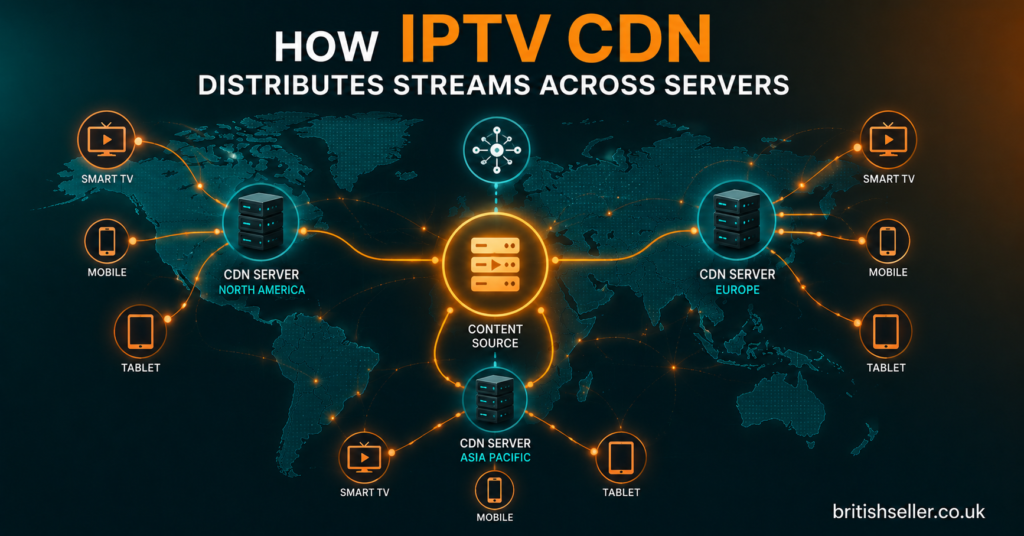
What IPTV CDN & Load Balancing Explained Really Means
A CDN stands for Content Delivery Network. It is a group of servers spread across different cities and countries, each holding a copy of the same video streams. Instead of every viewer pulling content from one central machine far away, they pull from a copy sitting close to them. Closer means faster. Faster means the video starts quickly and keeps playing without that spinning loading circle nobody wants to see.
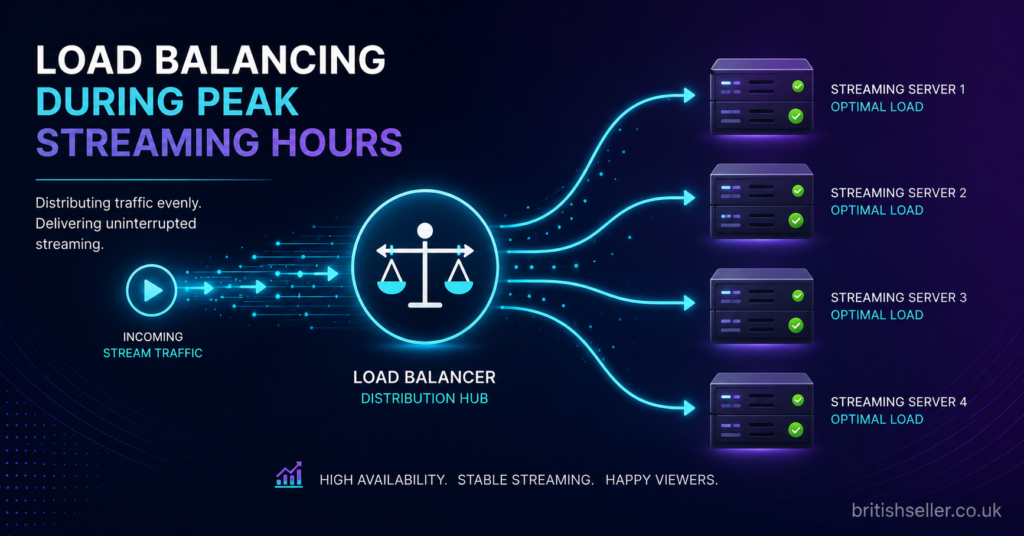
Load balancing is the second half of the story. Having many servers is useless if everyone still piles onto the same one. Load balancing watches every server in real time and spreads incoming viewers evenly across them. When one server starts filling up, new viewers get routed to a quieter server instead. The whole point is that no single server ever carries more than its fair share, so performance stays steady even when thousands of people watch at the same moment.
Putting both together gives you a delivery system that is fast and stable. This matters enormously if you operate an IPTV reseller panel, because your customers judge you on one thing above all else: does the picture play smoothly. They do not care how the technology works. They care that it works. CDN and load balancing is what makes that promise keepable rather than a hopeful guess.
Why IPTV CDN & Load Balancing Explained Matters for Resellers
Here is the honest truth most reseller guides skip. You can have the best pricing, the friendliest support, and the cleanest dashboard in the market, and still lose customers in a single weekend if your streams buffer during a busy evening. Reliability is not a feature people notice when it works. It is the only thing they notice when it fails. CDN and load balancing is the difference between a customer renewing quietly and a customer demanding a refund.
Demand for IPTV is not flat across the day. It spikes hard at predictable moments, usually evenings and weekends when most people are home and watching. During those peaks, a poorly built system buckles under the crowd. A system built on a proper CDN with load balancing absorbs the same crowd without flinching, because the load is shared across many servers rather than dumped on one. Your customers experience the smooth version. Your competitors’ customers experience the frozen version.
Pro Tip: When evaluating any supplier, ask directly how many delivery servers sit behind their network and whether failover is automatic. A supplier who answers clearly understands their own infrastructure. A supplier who dodges the question is usually running everything on a single point of failure, and you will feel it the first busy night.
This is also where the reseller model becomes attractive rather than risky. You are not building any of this yourself. When you buy into a managed panel and stock up on IPTV reseller credits, the CDN and load balancing already exists behind the scenes, maintained by people whose full-time job is keeping it healthy. You focus on selling and supporting customers. The heavy engineering is somebody else’s problem, which is exactly how it should be.
How IPTV CDN & Load Balancing Explained Works Step by Step
Let me walk through what actually happens the moment a customer presses play, because seeing the sequence makes the whole concept click. None of it is magic. It is just a series of quick, automatic decisions happening in under a second, every single time.
First, the customer’s app sends a request to watch. That request hits the network and asks, essentially, “where should I get this stream from.” The system checks the customer’s location and the current health of every available server. It then picks the best match: usually the nearest server that also has spare capacity. The customer never sees any of this. They just press play and the video appears.
Second, the chosen server begins delivering the stream. Meanwhile, the load balancer keeps watching. If that server starts getting crowded as more viewers join, the balancer steers new arrivals elsewhere. Existing viewers keep their smooth stream while new viewers land on fresher servers. The crowd stays evenly spread no matter how many people show up.
Third, and this is the safety net, if a server fails completely, the system reroutes affected viewers to a working server automatically. A good network does this in a few seconds, fast enough that most viewers barely notice a brief flicker before playback resumes. This automatic recovery is called failover, and it is one of the most important IPTV reseller panel features you should expect, because servers do fail, and what matters is how invisibly the system handles it.
The Core Pieces Inside an IPTV Delivery Network
It helps to name the moving parts so the bigger picture stops feeling abstract. Each piece does one clear job, and they only become powerful when they work together.
The edge servers are the copies sitting close to viewers in various regions. The origin is the main source the edge servers pull from. The load balancer is the decision-maker routing traffic. Health checks are constant automatic pings testing whether each server is alive and responsive. Failover is the automatic switch that kicks in when something breaks. Read those one more time and you essentially understand the architecture that powers every serious streaming operation.
Here is how those pieces compare in plain terms:
| Component | What It Does | Why It Matters |
|---|---|---|
| Edge Servers | Hold local copies of streams near viewers | Closer servers mean faster startup, less buffering |
| Load Balancer | Routes each viewer to the best server | Stops any single server from overloading |
| Failover System | Switches viewers off broken servers automatically | Keeps streams alive when hardware fails |
Notice that none of these pieces is glamorous on its own. The strength is entirely in the combination. An edge server with no load balancer floods. A load balancer with no failover collapses the moment a server dies. The reason managed panels feel reliable is that someone has already assembled all of these correctly so you do not have to.
What Happens to IPTV CDN & Load Balancing Explained Under Heavy Load
Busy nights are the real test. Anyone can deliver a stream to ten viewers at 3pm on a Tuesday. The question is what happens when thousands of viewers arrive within the same fifteen minutes, all wanting high quality at once. This is the moment that separates a network that was built properly from one that was thrown together cheaply.
Under heavy load, a well-balanced network spreads those thousands of viewers across all of its servers so each one carries a comfortable slice. No server hits its ceiling, so no server starts dropping quality or freezing. The viewer experience stays identical to a quiet afternoon. They have no idea anything intense is happening behind the scenes, and that ignorance is the whole goal.
A poorly built network does the opposite. Viewers pile onto a handful of servers, those servers max out, and quality collapses for everyone connected to them. Buffering spreads like a traffic jam. This is why some services are flawless most of the time but fall apart at exactly the moments customers care about most. Capacity that exists only on paper is worthless. Real capacity is proven under real pressure, which is why testing a service during a genuinely busy period tells you more than any sales page ever could.
Bandwidth, Buffering, and the Honest Limits
It would be dishonest to pretend CDN and load balancing solves everything. It does not. removes the bottleneck on the delivery side, but cannot fix problems that live somewhere else entirely. Being clear about this saves you from making promises to customers that no infrastructure can keep.
The most common culprit is the customer’s own internet connection. If their home broadband is slow or unstable, even a perfect network on the supplier side cannot push smooth high quality video through a pipe that is too narrow. Their device matters too. An old, underpowered streaming box struggles to decode high quality video no matter how cleanly it arrives. And local Wi-Fi interference, where the signal weakens between the router and the TV, causes buffering that looks like a stream problem but is really a household problem.
Pro Tip: When a customer reports buffering, run through their setup before blaming the service. Ask them to test a wired connection, check their actual broadband speed, and try a different device. A large share of complaints trace back to the customer side, and walking them through it calmly builds trust while saving you from chasing a fault that was never on your end.
Understanding this protects your reputation. A reseller who blindly blames the supplier for every issue ends up frustrated and looks unprofessional to customers. A reseller who can calmly diagnose where the problem actually lives, whether it is delivery, connection, or device, comes across as genuinely competent. That competence is what turns a one-month customer into a multi-year one, and it costs nothing but a little knowledge.
Choosing a Supplier With Serious Infrastructure
Since you are unlikely to build a CDN yourself, the real decision is which supplier’s infrastructure you build your business on top of. This choice quietly determines whether your reseller venture thrives or constantly fights fires. A few honest questions reveal far more than any marketing claim.
Ask about server count and locations, because a network with servers near your target customers will always outperform one routing everyone across the world to a single distant cluster. Ask about uptime and how failover is handled, since automatic recovery is the feature that protects you on the nights things break. And ask whether the network was built for the regions you actually sell into, because infrastructure optimised for your market beats generic global infrastructure every time.
When you stock up to buy IPTV credits from a supplier, you are really buying access to their entire delivery system, support structure, and reliability. The credits are just the visible part. The invisible part, the CDN and load balancing keeping streams alive, is what you are genuinely paying for. Judge suppliers on that invisible part, and you will pick the ones whose customers stay rather than the ones whose customers churn. A supplier like britishseller.co.uk is one illustrative example among several worth comparing on exactly these infrastructure terms before you commit.
The Legal Grey Area, Stated Honestly
It is worth being straight about something the industry often skirts around. The technology of CDN and load balancing is completely neutral. It is the same engineering that powers lawful video platforms, software updates, and major websites worldwide. The architecture itself carries no legal weight in any direction.
What does carry legal weight is the content being delivered and whether the people delivering it hold the rights to do so. That responsibility sits with content providers and rights holders, and the rules vary by country and by what is being streamed. Anyone operating in this space should understand the difference between the delivery technology, which is simply infrastructure, and content licensing, which is a legal matter that exists independently of how files are transported. Pretending that line does not exist helps nobody. Acknowledging it openly is the more honest and ultimately safer footing for any long-term business.
Wrapping Up: Why This Knowledge Pays Off
IPTV CDN and load balancing explained comes down to one core idea worth holding onto. Spreading content across many servers and intelligently routing viewers to the best one is what keeps streams smooth when it counts. The CDN provides the copies close to viewers. The load balancer shares the crowd so no server drowns. Failover quietly rescues everyone when hardware inevitably fails. Master that mental model and the entire reliability conversation stops being mysterious.
For a reseller, this understanding is a genuine edge. It helps you choose a supplier wisely, set honest expectations with customers, and diagnose problems calmly instead of panicking. You do not need to engineer any of it yourself. You simply need to recognise good infrastructure when you see it and build your business on top of it. That single piece of judgement, knowing that CDN and load balancing is the real engine under every subscription, will quietly carry you further than any clever marketing ever could.
Quick Checklists Before You Launch
Three short checklists, one for each role in the chain. Save these and tick through them before you commit money or take on customers.
Subscriber Checklist
Subscribers want one thing: a stream that just works. Before you pay, confirm these.
- Test the service during a genuinely busy evening, not a quiet afternoon
- Check your own broadband speed is fast enough for high quality video
- Try the stream on the actual device you plan to watch on
- Use a wired connection if possible, or sit close to your router
- Confirm there is real support to contact if something stops working
Reseller Checklist
Resellers are building a business, so the supplier’s infrastructure is everything. Verify these first.
- Ask the supplier how many delivery servers they run and where
- Confirm that failover is automatic and recovers within seconds
- Check uptime history rather than trusting a headline uptime figure
- Make sure the network is optimised for the regions you will sell into
- Test the service yourself thoroughly before selling it to anyone
- Keep clear records and issue proper invoices to your own customers
Sub-Reseller Checklist
Sub-resellers sit one layer down, so you depend on the reseller above you. Check these before joining.
- Confirm the reseller above you has a stable, proven supplier behind them
- Ask how credit top-ups and support requests are handled day to day
- Understand your margin clearly before committing to volume
- Make sure you can reach support quickly when a customer has an issue
- Start with a modest credit batch and scale once reliability is proven