It was a Saturday evening. Premier League fixtures were live, my phone was lighting up like a Christmas tree, and my provider’s panel had gone completely dark. No streams. No dashboard. No response from support.
That was the night I learned that selling IPTV subscriptions in the UK isn’t just about finding a cheap panel and flipping credits. It’s about infrastructure, trust, and knowing exactly how the whole ecosystem works before a single subscriber logs in.
If you’re exploring how IPTV subscriptions work — whether as a buyer trying to understand what you’re paying for, or as a reseller trying to build a proper business — this guide is written from real operational experience, not theory.
Table of Contents
- How Does an IPTV Subscription Actually Work?
- What Resellers Need to Understand First
- Are IPTV Subscriptions Legal in the UK?
- How to Get an IPTV Subscription (The Right Way)
- The Real Costs Behind Running IPTV Subscriptions
- What Separates Good Providers from Disaster
- Scaling Your IPTV Subscription Business in 2026
- IPTV Reseller Success Checklist
How Does an IPTV Subscription Actually Work?
At its core, an IPTV subscription delivers television content over an internet connection rather than through a satellite dish or cable. The subscriber gets a set of login credentials — usually a username, password, and server URL — which they enter into an IPTV player app like TiviMate, IPTV Smarters Pro, or STBEmu on a MAG box or Fire Stick.
From that point, the app connects to a middleware or streaming server, authenticates the line, and pulls the content through. Simple in concept. Complicated in practice.
What most people glossing over blog posts miss is that there are multiple layers between the content source and the end viewer. There’s the main provider’s server infrastructure, the CDN (Content Delivery Network) that distributes load, the reseller panel sitting in the middle, and finally the subscriber’s device and internet connection. Any one of those layers can fail — and when it does, it’s always the reseller who gets the angry message at midnight.
Pro Tip: Always ask a potential provider how many active connections are running on their servers. A panel with 50,000 active lines and budget infrastructure will buffering constantly during peak hours. Numbers matter.
What Resellers Need to Understand First
If you’re coming into the IPTV subscription space thinking it’s a passive income machine, let me reset those expectations early.
The reseller model works like this: you purchase a block of credits from a panel provider. Each credit typically represents one month of access for one subscriber line. You then sell those credits on to customers under your own brand, at your own pricing. The margin between what you pay per credit and what you charge per subscription is your gross profit.
In my experience, resellers who burn out within six months are almost always the ones who underpriced to compete, oversold beyond their credit supply, or chose a provider based purely on cost without testing reliability during peak demand — specifically Premier League matchdays, which in the UK IPTV market are the single highest-stress period for any streaming infrastructure.
Monthly Profit=(Active Subscribers×Price per Sub)−(Credits Cost+Support Time+Refunds)\text{Monthly Profit} = (\text{Active Subscribers} \times \text{Price per Sub}) – (\text{Credits Cost} + \text{Support Time} + \text{Refunds})
That formula looks clean on paper. The “support time” and “refunds” variables are where most new resellers get blindsided.
Are IPTV Subscriptions Legal in the UK?
This question comes up constantly, and it deserves an honest answer rather than a vague non-response.
In the UK, streaming copyrighted content without authorisation from the rights holder is illegal under the Copyright, Designs and Patents Act 1988. IPTV services that redistribute premium content without licensing agreements operate in legally questionable territory. Trading Standards and rights holder organisations have pursued both providers and resellers in the UK courts.
The landscape in 2026 has become notably stricter. IP blocking, server seizures, and domain takedowns have accelerated. Resellers operating panel-based businesses need to be fully aware of the legal environment they’re entering.
What is clearly legal is the reseller management software itself — a panel system that allows you to create and manage subscription lines is a tool, in the same way that billing software is a tool. What matters is what content those lines deliver.
Pro Tip: If you’re running a reseller operation, document your business model clearly. Separate your software/panel business from content decisions. Many panel-based reseller businesses position themselves explicitly as subscription management platforms.
How to Get an IPTV Subscription (The Right Way)
For buyers: the process of getting an IPTV subscription typically involves contacting a reseller, selecting a package duration (monthly, quarterly, or annual), and receiving login credentials for your chosen player app. Most reputable resellers offer a short trial line before committing to a full purchase — if a provider refuses to offer a trial, that’s an immediate red flag.
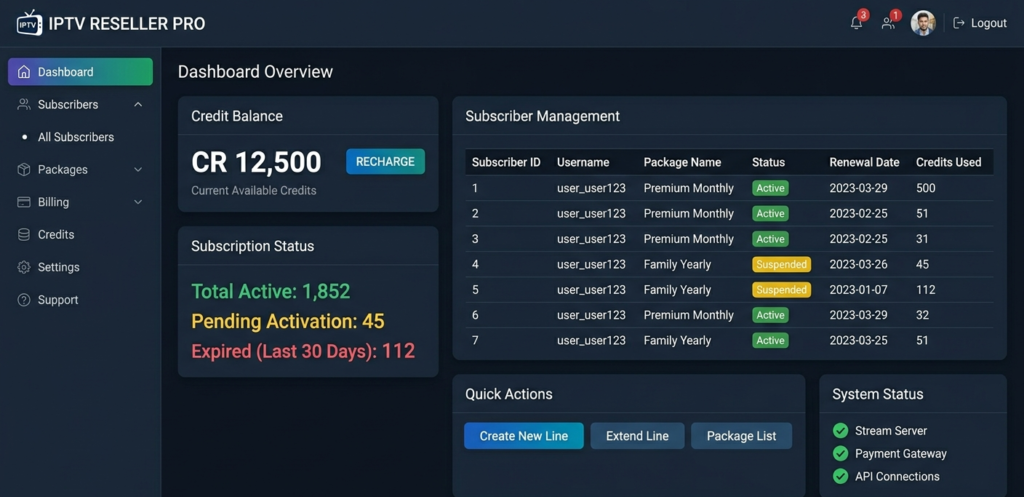
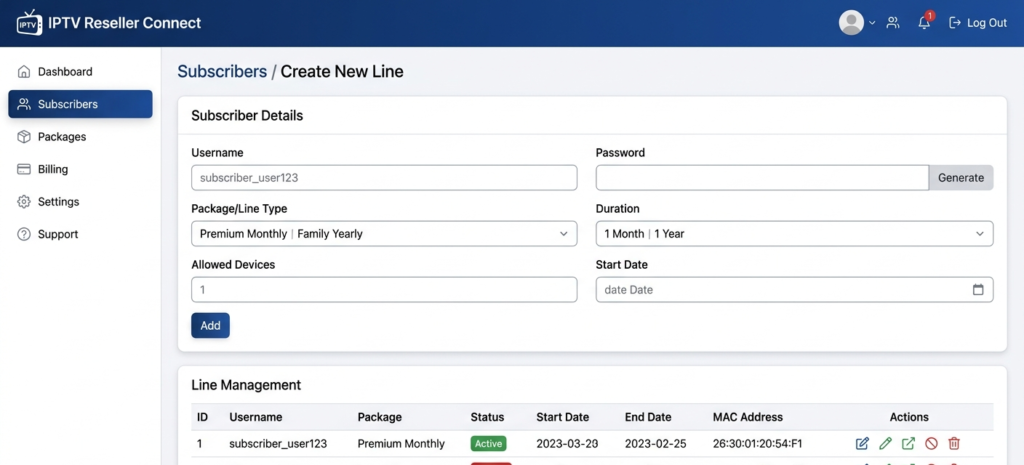
For resellers starting out: getting your first IPTV subscription panel set up requires finding a reliable wholesale provider, purchasing a reseller credit package, and configuring your storefront. The panel itself — typically accessed through a web dashboard — lets you generate subscriber lines, set expiry dates, manage renewals, and monitor active connections.
One thing I wish someone had told me early on: test your own lines across different devices before selling a single subscription. Test on a Fire Stick. Test on a MAG box. Test on STBEmu. Connection issues that only appear on certain devices will absolutely generate support tickets at scale.
The Real Costs Behind Running IPTV Subscriptions
New resellers almost always underestimate the true cost structure. Credits are the obvious expense, but they’re rarely the largest one once you factor in the full picture.
Consider these operational costs:
Credit wholesale cost — typically the largest line item, ranging considerably depending on panel quality and provider reputation.
Refund rate — in my experience, a well-managed reseller operation running stable infrastructure sees refund requests in the 3–7% range. A poorly chosen provider can push that north of 20%, which obliterates margins.
Support overhead — if you’re handling 50 active subscribers manually, that’s manageable. At 200+, you need a ticketing system, templated responses, and clear SLAs or you’ll spend your evenings answering “why is it buffering?” messages.
Domain and hosting — your storefront, your brand, your trust signals. Skimping here signals to customers that you’re not serious.
A realistic realistic operating margin for a well-run UK IPTV reseller business sits between 40–60% gross margin, with net margin dropping considerably once support costs and churn are factored in. Anyone promising you 80%+ consistently is either skipping the refund maths or running at a scale where bulk pricing changes the equation entirely.
Pro Tip: Track your churn rate monthly. If more than 15% of your subscribers aren’t renewing, the problem is almost always stream quality — not price. Dropping your prices to retain churning customers is a death spiral.
What Separates Good Providers from Disaster
I’ve tested more panels than I care to count. The difference between a provider that lasts and one that disappears isn’t always obvious upfront, but there are consistent warning signs.
Green flags: Dedicated UK server infrastructure, transparent uptime data, responsive support with real response times (not just a Telegram bot), anti-freeze technology that handles buffering during congestion, and a reseller dashboard that gives you actual visibility into line status.
Red flags: No trial lines offered, uptime claims with no verifiable data, pricing that seems too far below market rate (this always means oversold infrastructure), support that disappears after you’ve paid, and panels that go down every Premier League weekend — which, in the UK market, is essentially a stress test that runs on a fixed schedule.
The 3pm blackout on Saturdays during the football season is a genuine market dynamic for UK IPTV. Demand spikes sharply between 3pm and 5:30pm every Saturday during the season. Any provider whose infrastructure can’t handle that window is going to generate your worst support days of the year.
Scaling Your IPTV Subscription Business in 2026
Scaling past 100 active subscribers is where most UK resellers hit their first real operational wall. The model that worked at 20 subscribers — manual onboarding, WhatsApp for support, spreadsheet tracking — completely breaks down.
The resellers I’ve seen scale successfully share a few habits. They automate subscriber onboarding from day one, even when it feels unnecessary. They invest in a proper panel that separates their brand from the underlying provider. They build a renewal system with automated reminders rather than chasing lapsed customers manually.
The platform I point people toward when they’re ready to operate at a proper scale is britishseller.co.uk — not because it’s a flashy product, but because it’s built around the actual operational requirements of a UK reseller: credit management, line creation, subscriber tracking, and the kind of stability that doesn’t collapse the moment a Premier League fixture kicks off.
Pro Tip: Never rely on a single provider line. Even the best infrastructure has downtime. Resellers who survive long-term always have a backup panel ready to migrate subscribers to within hours, not days.
✅ IPTV Reseller Success Checklist (5 Points)
1. Test before you sell. Run your own trial lines across Fire Stick, MAG box, and STBEmu before onboarding a single paying subscriber. Discover the problems yourself before your customers do.
2. Track your refund rate monthly. If refunds are climbing above 7–8%, your provider is the problem, not your pricing. Act on it before churn compounds.
3. Build your renewal system on day one. Manual renewal reminders do not scale. Set up automated expiry notifications from the start, even if it feels like overkill at 10 subscribers.
4. Separate your brand from your provider. Your customers should know your brand, not your upstream supplier. Panel branding, your own domain, and your own support channels protect your business if you ever need to switch providers.
5. Stress-test during peak demand. Premier League Saturdays are your benchmark. If your streams hold up between 3pm and full-time on a busy fixture weekend, your infrastructure is solid. If they don’t, fix it before the season intensifies.
Running an IPTV subscription business in the UK in 2026 is more competitive and more scrutinised than it was three years ago. The resellers who thrive are the ones treating it as a real operation — with proper infrastructure, honest margins, and a platform built for scale. If you’re at the stage of setting that up properly, britishseller.co.uk is worth a serious look