I remember the exact moment I realised this business could either make me decent money or completely embarrass me in front of people I’d personally sold to. It was a Tuesday evening — Champions League night — and my provider’s panel had gone completely dark. No streams. No support response. Thirty-two customers, most of whom I’d onboarded through word of mouth, were messaging me simultaneously. I had no answers, no backup, and no plan. That night cost me eleven cancellations and a reputation hit I spent three months recovering from.
If you’re researching how to become a reseller for IPTV in the UK, that story is the most useful thing I can give you upfront. The opportunity is real. The margin is there. But the difference between a reseller who builds something sustainable and one who burns out in six months comes down almost entirely to the decisions made before the first subscription is sold.
Table of Contents
- What It Actually Means to Be a Reseller for IPTV
- How the Credit and Panel System Works
- Choosing the Right Provider — The Non-Negotiables
- The Technical Side You Can’t Ignore
- Profit Margins and Realistic Expectations
- UK Market Specifics Every Reseller Must Understand
- The Mistakes That Kill New Resellers
- Scaling From 10 Customers to 200+
- IPTV Reseller Success Checklist
What It Actually Means to Be a Reseller for IPTV
Let’s get this straight from the outset, because there’s a lot of vague information floating around. Being a reseller for IPTV means you purchase access to a wholesale streaming infrastructure — in the form of reseller credits — and then distribute individual subscriptions to end users at a retail markup. You are not building servers, not managing encoding, and not responsible for the content delivery network itself. You are the distribution layer.
That sounds simple. And operationally, it is — once you have the right setup. The complexity is in selecting a provider whose infrastructure won’t let you down, configuring your panel correctly, and managing your customer base professionally enough that people actually stay subscribed month after month.
The IPTV reseller model in the UK is genuinely one of the more accessible digital businesses you can start with low capital. But “accessible” doesn’t mean “easy,” and the people who treat it as passive income without doing the groundwork are the ones flooding forums with complaints six months later.
Pro Tip: Before you sell a single subscription, run the service yourself as a customer for at least two to four weeks across different device types — MAG boxes, STBEmu, mobile, Smart TV. You cannot sell something you haven’t properly tested, and customers will ask questions you won’t be able to answer.
How the Credit and Panel System Works
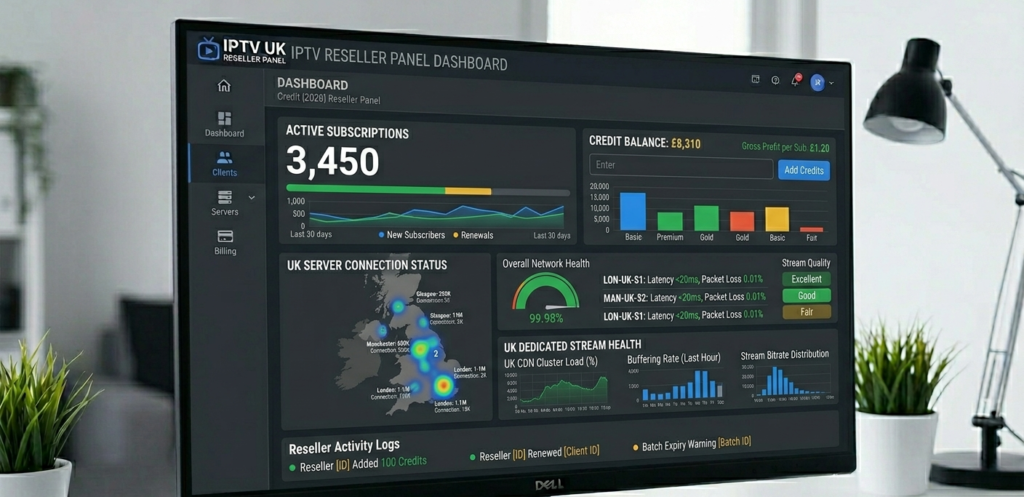
Every IPTV reseller operation runs through a panel. This is your control centre — the interface through which you create subscriptions, manage renewals, monitor connection counts, and track your credit balance. Understanding this system thoroughly is non-negotiable if you want to run a professional operation.
Credits are the unit of currency in the wholesale IPTV world. You buy a block of credits from your provider at a wholesale rate. Each credit typically equates to one month of one subscription for one customer. When a customer subscribes, credits are deducted from your balance. When they renew, more credits are used.
Your panel will also let you set connection limits per account. This is critically important. A customer sold a single-connection subscription who then runs it across four devices simultaneously will degrade stream quality for themselves and, depending on your server allocation, potentially affect other customers too. Set your limits, enforce them, and be clear with customers about the terms upfront.
Most panels in the UK market support Xtream Codes API, which means your customers can use a wide range of apps — IPTV Smarters Pro, TiviMate, GSE Player — alongside device-specific setups for MAG boxes and STBEmu. The broader your device compatibility, the fewer support headaches you’ll have.
Choosing the Right Provider — The Non-Negotiables
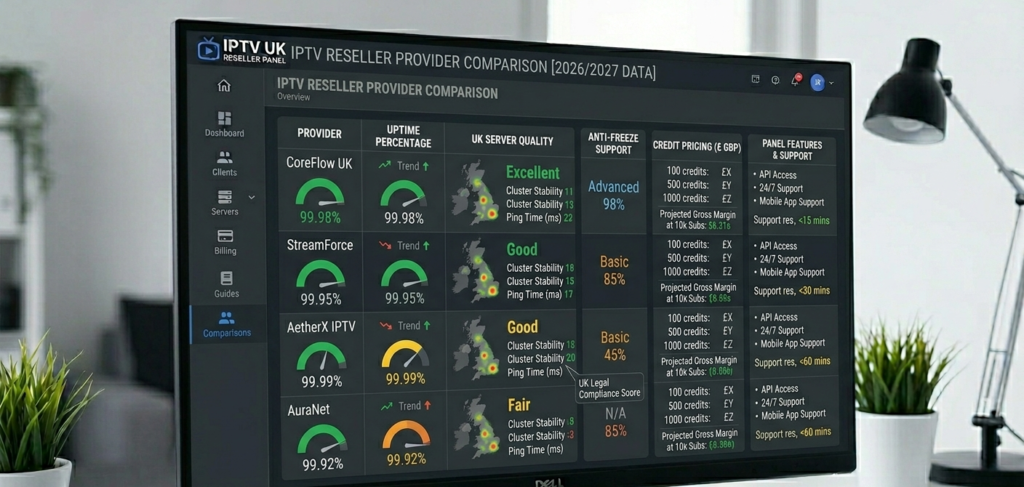
This is where most new resellers go wrong. They find a provider offering the lowest credit price and sign up without asking the right questions. I’ve been there myself — it took losing customers during a Premier League weekend to understand that cheap wholesale credits are almost always cheap for a reason.
Here’s what actually matters when evaluating a provider:
UK-Dedicated Server Infrastructure — Not European servers with UK IPs painted on top. Genuine UK-based server capacity that holds up during Saturday afternoon demand spikes. Ask specifically about this. If they’re vague, that’s your answer.
Anti-Freeze System Quality — A competent provider will have buffer management built into stream delivery that reduces visible stuttering during live sport. Test this during actual live events, not VOD content. The difference is stark.
Panel Transparency and Real-Time Data — You need to see connection counts, stream health, and credit usage in real time. Flying blind on your own infrastructure is how you find out about problems from angry customers rather than from your own monitoring.
Support Response Window — When something goes wrong on a Tuesday evening or Saturday afternoon, you need a response within minutes. Test their support before committing real money. Send a query during a known high-traffic period and time the response.
Pro Tip: Ask any prospective provider for uptime statistics from the previous 90 days, specifically covering weekend afternoons. A credible provider will have this data readily available. One who deflects or gives you vague reassurances is telling you something important.
The Technical Side You Can’t Ignore
Running a reseller IPTV operation in 2026 means having at least a working understanding of the technology your customers are using. You don’t need to be a network engineer, but you do need to understand the basics.
Bandwidth and Stream Quality — The quality of a stream is directly tied to the bitrate allocated to it. A 4K stream requires significantly more bandwidth than a standard HD stream. If your provider is over-selling server capacity, the first thing to degrade is bitrate under load, which manifests as pixelation and buffering for your customers.
Bandwidth Required=Number of Concurrent Streams×Average Bitrate per StreamBandwidth\ Required = Number\ of\ Concurrent\ Streams \times Average\ Bitrate\ per\ Stream
For a reseller managing 100 active customers with an average concurrent usage rate of 40% and HD streams at 8Mbps each, the infrastructure needs to comfortably handle 40 simultaneous streams at 8Mbps — that’s 320Mbps of sustained throughput as a minimum baseline. Good providers provision well beyond their peak estimates. Bad ones don’t.
Device Compatibility — MAG boxes require a slightly different provisioning approach than Xtream Codes-based apps. STBEmu emulates the MAG environment on Android devices. Know how to set up each one, because customers will need guidance and “I don’t know, Google it” is not a support strategy.
Profit Margins and Realistic Expectations
The margins in IPTV reselling are genuinely attractive, but only if you go in with honest numbers rather than best-case projections.
Monthly Net Profit=(Active Subscribers×Retail Price)−(Credits Used×Wholesale Cost)−Refunds−Operational CostsMonthly\ Net\ Profit = (Active\ Subscribers \times Retail\ Price) – (Credits\ Used \times Wholesale\ Cost) – Refunds – Operational\ Costs
In realistic terms for a UK reseller: buying credits at £3–£4 wholesale and selling subscriptions at £8–£12 retail gives you a gross margin of £4–£8 per customer per month. At 100 active customers, that’s £400–£800 gross monthly. After factoring in a realistic 5–7% refund rate, panel or hosting costs, and your time for customer support, net margins settle around £300–£650 at that scale.
At 200 customers, the fixed costs become proportionally smaller and margins improve. The business scales well — the support load doesn’t grow as fast as the revenue does, assuming your provider’s service quality is strong enough to keep churn manageable.
Pro Tip: Track your monthly churn rate from day one. If you’re losing more than 8% of your customer base each month, your provider’s quality is almost certainly the issue — not your customer service. Address the root cause, not the symptom.
UK Market Specifics Every Reseller Must Understand
Operating as a reseller for IPTV in the UK means understanding the demand patterns that define this market. The UK isn’t a generic audience — it has specific, predictable pressure points that will test your infrastructure repeatedly throughout the year.
Saturday Afternoons — The single highest-demand window in the UK IPTV calendar. Concurrent connections spike sharply across the entire market. Your provider either holds up during this window or they don’t. There’s no middle ground.
Midweek European Match Nights — Tuesday and Wednesday evenings from September through May create secondary demand spikes that catch under-resourced providers off guard. These are the sessions that expose overselling.
3pm Blackout Awareness — Certain domestic matches fall under broadcast restrictions during the traditional 3pm Saturday slot. This is worth understanding so you can manage customer expectations accurately rather than having them discover limitations mid-match.
Bank Holidays and Festive Period — Boxing Day fixture congestion, in particular, is a brutal test. Customers are home, expectations are high, and patience is minimal.
The Mistakes That Kill New Resellers
I’ve watched genuinely capable people fail at this business because of avoidable errors. These are the ones I see most consistently:
Onboarding too fast — Taking on 50 customers before you’ve properly stress-tested your provider means one bad weekend can generate 50 simultaneous complaints with no good answers.
No written terms with customers — If a customer expects unlimited connections and you’ve sold them a single-connection subscription, that dispute will happen. Document your terms clearly from the first sale.
Ignoring renewals — Subscriptions that expire without prompt create involuntary churn. A simple renewal reminder process — even manual messages — significantly improves retention.
Backing a single provider with no contingency — I now always maintain a tested secondary provider relationship, even if I’m not actively selling through them. When your primary goes down, having a backup ready is the difference between a bad evening and a business-ending event.
Pro Tip: Build a simple FAQ document for new customers covering device setup, connection limits, what to do if buffering occurs, and how to request support. Send it with every new subscription. It cuts your inbound support volume by 30–40% almost immediately.
Scaling From 10 Customers to 200+
The path from a handful of customers to a genuinely profitable operation is less about marketing and more about operational tightening. Getting to 10 customers is easy — word of mouth, a few posts in the right places. Getting from 10 to 50 requires a repeatable onboarding process and a provider that won’t embarrass you. Getting from 50 to 200 requires the right panel infrastructure.
At that scale, the panel you’re working with matters enormously. You need granular visibility into your account base, clean credit management, and the ability to handle renewals efficiently without it consuming your entire week. The panel I’ve landed on for my own operation — and the one I point other UK resellers towards when they ask — is britishseller.co.uk. It’s not a flashy recommendation; it’s a practical one. The UK server performance holds up during the sessions that matter, the credit structure is transparent, and the support is there when things get difficult. That last point is worth more than any feature checklist.
✅ IPTV Reseller Success Checklist
- Test before you sell — Run the service personally across MAG boxes, STBEmu, and mobile apps for a minimum of two to four weeks before onboarding a single paying customer.
- Stress-test during live sport — Evaluate your provider specifically during Saturday afternoon and midweek evening windows. Off-peak performance tells you almost nothing useful.
- Set and enforce connection limits — Single or double connections, configured at panel level from day one. Never leave this open-ended.
- Build a refund buffer into your pricing — Assume 5–7% monthly refund rate and price your subscriptions accordingly. Being caught short on margins is demoralising and avoidable.
- Track churn monthly without fail — A simple record of cancellations and stated reasons will surface provider quality issues before they become business-threatening. If churn is climbing, your provider is usually the culprit