The first time someone asked me “what is IPTV?” I gave them a technically accurate but completely useless answer. Something about internet protocol television, data packets, server infrastructure. Their eyes glazed over within about eight seconds. What they actually wanted to know was simpler: how does it work, is it reliable, and can I make money from it?
That was years ago. Since then I’ve answered that question hundreds of times — to potential clients, to curious friends, to people who’d been burned by a dodgy provider and wanted to understand what had actually gone wrong. And I’ve learned that explaining IPTV properly isn’t about the technology. It’s about the experience, the business model, and the reality of operating in the UK market where demand is enormous and the margin for error is razor thin.
So here’s the honest answer — no jargon overload, no Wikipedia-style definitions, no fluff.
Table of Contents
- What Is IPTV — The Actual Answer
- How IPTV Works Under the Hood
- IPTV vs Traditional Broadcasting — What’s Different
- The IPTV Reseller Model Explained
- What Makes UK IPTV Demand So High
- The Technology Behind a Stable IPTV Service
- What Goes Wrong — And Why
- Is the IPTV Reseller Business Worth It in 2026
- Where to Start as a UK Reseller
- IPTV Reseller Success Checklist
What Is IPTV — The Actual Answer
IPTV stands for Internet Protocol Television. Strip away the acronym and it means this: television content delivered through an internet connection rather than through a satellite dish, aerial, or cable line.
That’s it. That’s the core of what IPTV is.
Instead of a signal coming through a physical cable or bouncing off a satellite, the video content travels as data — the same way a YouTube video or a Netflix film reaches your screen. The difference is in how that data is sourced, managed, and delivered. IPTV services operate through dedicated servers, content delivery networks, and subscriber management systems rather than through the broadcast infrastructure that traditional television relies on.
For a client sitting on their sofa in Manchester or Birmingham, the experience is simple: they open an app, their channels appear, they watch. The complexity — the servers, the panel, the stream delivery — is entirely invisible to them. Which is exactly how it should be.
Pro Tip: When explaining IPTV to a potential client who isn’t technically minded, use this comparison: “It’s like Netflix, but for live television.” That one sentence lands better than any technical explanation and gets you to the actual conversation — whether they want to subscribe — much faster.
How IPTV Works Under the Hood
For resellers, understanding the mechanics matters — not because you need to explain it to clients, but because it helps you diagnose problems, evaluate providers, and have informed conversations about infrastructure quality.
Here’s the simplified flow of how an IPTV stream reaches a viewer’s screen:
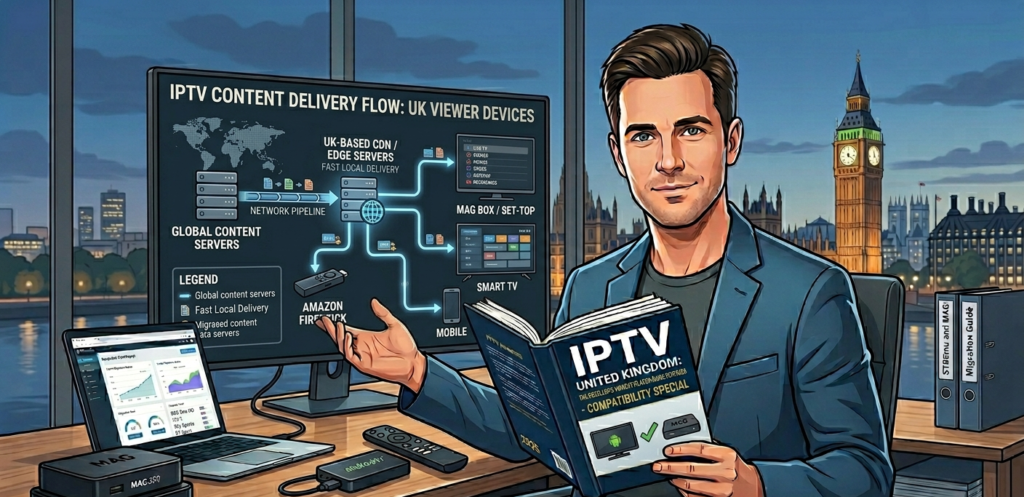
A content source — a live broadcast feed — is ingested by a server. That server encodes and compresses the video into a streamable format. The encoded stream is then distributed through a Content Delivery Network, or CDN, which routes the content to servers positioned geographically close to the end viewer. The viewer’s IPTV player — whether that’s IPTV Smarters Pro, TiviMate, STBEmu, or another application — requests the stream from the nearest CDN node and plays it back in real time.
The entire process happens in seconds. When it works well, it’s seamless. When any link in that chain has a problem — server overload, CDN routing failure, player compatibility issue — the viewer sees buffering, freezing, or a dead stream.
As a reseller, you sit between the provider who manages that infrastructure and the client who’s watching the output. Your panel — the reseller management system — is what lets you create subscriber lines, manage credits, monitor active connections, and control your client base. You don’t manage the servers. You manage the subscriptions.
IPTV vs Traditional Broadcasting — What’s Different
Understanding the distinction helps you articulate value to potential clients — particularly those who are used to traditional television and are considering making the switch.
Traditional broadcast television — whether delivered by satellite, aerial, or cable — operates on a fixed infrastructure with regulated content licensing. The broadcaster controls what’s available, when it’s available, and through which devices it can be accessed. The viewer has no flexibility beyond what the platform offers.
IPTV operates on a fundamentally different model. Content is delivered on demand through internet infrastructure. Device compatibility is broad — Firestick, Android boxes, MAG devices, smartphones, smart TVs, tablets. The channel selection is typically far wider than any conventional package. And the cost, from the subscriber’s perspective, is significantly lower than a comparable traditional television subscription.
For the UK market specifically, this cost differential is striking. The monthly cost of a comprehensive traditional sports and entertainment television package through conventional providers runs into significant figures. An IPTV subscription offering comparable or broader content access costs a fraction of that. That price gap is a large part of why IPTV demand in the UK has grown consistently year on year.
Pro Tip: Never position IPTV as a replacement for traditional television in your marketing — position it as an addition or alternative that gives the viewer more flexibility for less money. The “why pay more for less control?” angle resonates particularly well with UK clients who are already frustrated with rising subscription costs.
The IPTV Reseller Model Explained
This is the part most “what is IPTV” articles skip entirely — and it’s the part that matters if you’re reading this as someone considering the business side.
An IPTV reseller operates through a panel — a web-based management system provided by a wholesale supplier. The panel gives the reseller the ability to create subscriber lines, set connection limits, manage renewals, and monitor usage. The reseller purchases credits at wholesale prices, uses those credits to create subscriber lines, and sells those subscriptions to end clients at a retail markup.
The business model is straightforward:
Monthly Profit=(Active Subscribers×Retail Price)−(Credits Used×Wholesale Cost per Credit)−Panel Fee\text{Monthly Profit} = (\text{Active Subscribers} \times \text{Retail Price}) – (\text{Credits Used} \times \text{Wholesale Cost per Credit}) – \text{Panel Fee}
In practical UK market terms: buying credits at £2.50 per line and retailing at £7–£8 per month per subscriber generates a gross margin of approximately 64–69%. At 100 active subscribers, that’s £450–£550 monthly gross profit from a relatively modest client base.
The reseller doesn’t manage servers, handle content delivery infrastructure, or deal with encoding. That responsibility sits entirely with the wholesale provider. The reseller’s job is client acquisition, client service, and choosing a provider whose infrastructure is reliable enough to keep those clients renewing month after month.
What Makes UK IPTV Demand So High
In my experience, no market in the world generates IPTV demand quite like the United Kingdom — and there are specific structural reasons for that.
Football is the obvious one. The Premier League is the most-watched domestic football league on the planet, and the UK audience is its most passionate. Match days — particularly Saturdays — generate enormous concurrent viewing demand. The 3pm Saturday blackout, which restricts live domestic football broadcast through conventional channels at that specific window, pushes a significant portion of that demand toward alternative viewing options. That’s a recurring, calendar-driven acquisition opportunity that UK resellers can plan around.
Beyond football, the UK has a high concentration of sports fans across multiple disciplines — boxing, rugby, cricket, motorsport. Each of these generates its own peak demand moments. A reseller operating in the UK is never short of events that motivate clients to seek out and pay for reliable streaming access.
The UK’s fibre broadband rollout has also accelerated considerably. A large proportion of UK households now have the connection quality to support stable HD and 4K IPTV streams without any technical compromise. The infrastructure barrier that limited IPTV adoption five years ago has largely disappeared.
The Technology Behind a Stable IPTV Service
When clients ask me why some IPTV services are rock solid and others buffer constantly, I explain it in terms of three things: server capacity, CDN quality, and anti-freeze technology.
Server capacity is about whether the provider has provisioned enough server resources to handle peak concurrent demand. A provider who has undersold their capacity relative to their infrastructure runs smoothly. A provider who has oversold — taken on more subscribers than their servers can comfortably handle — buffers every time demand peaks. Saturday lunchtimes expose overselling immediately.
CDN quality determines how efficiently streams are routed to viewers. UK-optimised CDN infrastructure routes content through nodes physically close to UK viewers, reducing latency and improving stability. Providers without UK CDN presence route traffic through less efficient paths, and the viewer feels it.
Anti-freeze technology is the system that maintains stream stability during traffic spikes by managing buffer allocation and stream switching at the server level. Without it, a sudden increase in concurrent viewers on a particular stream causes immediate quality degradation. With it, the stream holds even as demand rises sharply.
Pro Tip: When evaluating a new provider, ask specifically: “How do you handle simultaneous connection spikes on popular streams during peak hours?” A provider with genuine anti-freeze infrastructure will answer this question confidently and technically. A provider without it will give you a vague reassurance. Those are very different conversations.
What Goes Wrong — And Why
Understanding failure modes is part of operating in this space honestly. IPTV services can fail for several reasons, and as a reseller you need to be able to distinguish between them.
Provider infrastructure failure — Server downtime, CDN issues, or capacity overruns at the provider level. This affects all your clients simultaneously and is outside your control. Your response is provider-side communication and, if it’s chronic, changing providers.
Overselling — The most common cause of consistent weekend buffering. Your provider has sold more connections than their infrastructure supports. The fix is finding a provider who doesn’t do this.
Client-side issues — Poor broadband connection, wrong IPTV player, device compatibility problems, or local network congestion. These affect individual clients rather than your whole base and are diagnosable through basic troubleshooting.
Panel management errors — Expired lines, incorrect connection limits, or credit shortfalls on your end. These are entirely within your control and entirely avoidable with basic panel monitoring habits.
Is the IPTV Reseller Business Worth It in 2026
Honestly? Yes — with clear eyes about what it requires.
The margin is real. The demand in the UK is genuine and growing. The barrier to entry, through a proper reseller panel, is low. The ability to scale without proportional increases in workload — because you’re managing subscriptions, not infrastructure — makes it an efficient side business or primary income stream.
What it requires is choosing the right provider, operating through a reliable panel, and treating client service seriously. The resellers who fail in this market are almost always the ones who cut corners on provider quality in pursuit of margin, or who treat client communication as an afterthought.
The platform I consistently point new UK resellers toward is britishseller.co.uk — not because it’s the flashiest option, but because the panel is stable, the credit system is transparent, and the support infrastructure is actually there when you need it. For someone starting out or looking to migrate from a less reliable panel, that combination of reliability and operational clarity is genuinely valuable.
✅ IPTV Reseller Success Checklist
1. Understand the difference between provider failures and client-side issues before contacting support — accurate diagnosis saves time and preserves your credibility with both your provider and your clients.
2. Choose a reseller panel that gives you full visibility into your subscriber base — connection monitoring, credit tracking, and renewal management are non-negotiable at any scale.
3. Build your client acquisition calendar around UK sporting events — Premier League season start, major boxing events, and European football nights are your highest-converting windows.
4. Never oversell the service — set honest expectations with clients about what IPTV is and how it works, and you’ll generate referrals; oversell it and you’ll generate refund requests.
5. Evaluate your provider’s anti-freeze capability specifically during peak hours — a provider that holds up on a full Saturday of football is worth paying more for at wholesale.