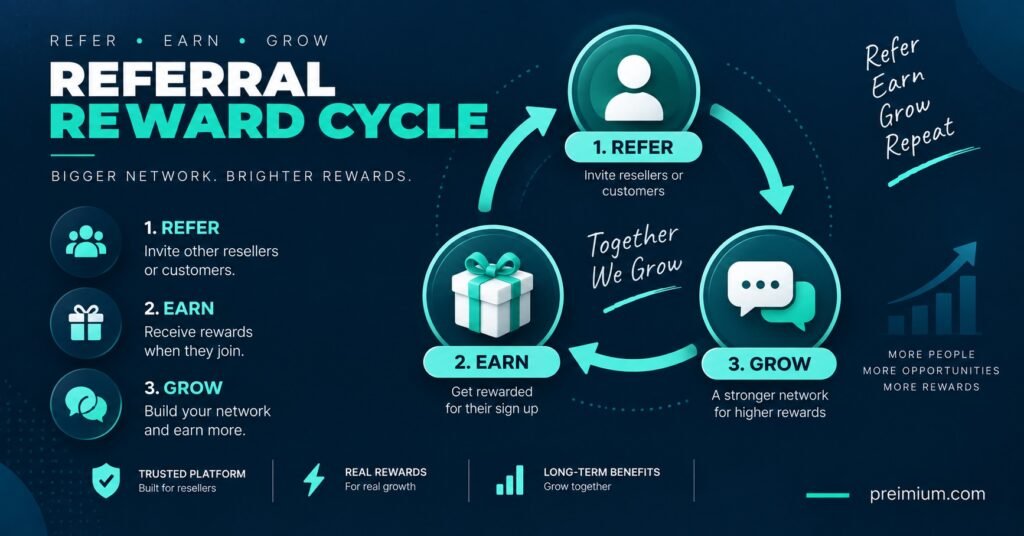
An IPTV Reseller Referral Program rewards existing customers for bringing in new ones, turning word of mouth into something you can plan around rather than something that just happens occasionally. Instead of hoping a happy subscriber mentions you to a friend, you give them a specific reason to do it and a specific way to claim the benefit. Done properly, it becomes one of the cheapest ways to grow a customer base, because you’re only paying out once someone has actually converted, not for every click or impression along the way.
Why an IPTV Reseller Referral Program Works Better Than Ads
Most UK IPTV panel resellers start out selling to people they already know. Friends, family, a coworker who asks about the price after seeing a match on your phone. That first wave of customers is easy because trust already exists. The problem shows up once that initial circle runs dry and you’re left trying to convince strangers on Facebook groups or WhatsApp communities to take a chance on a service they’ve never tested.
A referral programme keeps that original trust dynamic going long after your personal network is exhausted. Your existing customer becomes the trusted introducer, not you. They’re the one telling a neighbour or colleague it actually works, which carries far more weight than anything you could say yourself. You’re effectively renting their credibility, and paying for it only when it produces a result.
This matters more in a subscription business than a one off sale. A referred customer tends to arrive with fewer doubts, having already heard from someone they trust that the service is reliable, which shortens the gap between a free trial and a paid subscription. If you’ve read about IPTV Trial Conversion Rate, you’ll know that trust going into the trial period is one of the biggest levers on whether it converts at all.
Reward Structures Worth Considering
There’s no single correct way to structure the incentive. What matters is that both sides feel the reward is worth the effort, and that paying it out doesn’t quietly erode your margin on every deal.
A credit based reward is the simplest option if you’re already running a credit system. When a referred customer subscribes, the referrer receives a set number of free credits, which they can either use themselves or pass on as a discount to someone else. This keeps the cost internal rather than requiring a separate cash payout, and it ties the reward directly to something they already understand.
A discount based reward works differently. Instead of giving the existing customer something extra, you reduce what they owe on their next renewal. This can feel more tangible to some customers than credits, particularly ones who don’t fully understand how the credit system works behind the scenes.
A double sided reward gives something to both the referrer and the new customer, often a discounted first month for the person joining. This tends to convert better because the new subscriber has an immediate reason to say yes rather than just trusting a recommendation on faith.
| Reward Type | Best suited to | Limitation |
|---|---|---|
| Credit based | Resellers already running credit packs | Referrer must understand how credits convert to value |
| Discount on renewal | Customers who dislike unfamiliar systems | Delays the benefit until the next billing cycle |
| Double sided (referrer plus new customer) | Growing a customer base quickly | Slightly higher cost per acquisition |
Pro tip: Whichever structure you choose, cap how many referral rewards a single customer can claim in a month. Unlimited rewards invite people to game the system rather than genuinely recommend the service.
Keeping Rewards From Eating Your Margin
The maths only works if the reward stays smaller than the profit a new customer generates over time, not just in their first payment. A referral reward that costs you the equivalent of one month’s profit is easy to justify if that customer goes on to renew for a year. It’s a much harder sell if most referred customers churn within a couple of months.
This is where it helps to understand your numbers properly rather than guessing. Anyone who has worked through IPTV Customer Lifetime Value for Resellers will already have a rough figure for what an average customer is worth over their full subscription life. Set your referral reward as a fraction of that figure, not as a fixed number you picked because it sounded reasonable.
Resellers who skip this step tend to make one of two mistakes. Either the reward is so small that nobody bothers referring anyone, or it’s generous enough to attract referrals but leaves almost nothing behind once support time and platform costs are factored in.
Tracking Who Actually Referred Whom
A referral programme without tracking is really just a vague promise. You need a reliable way to connect a new signup back to the person who sent them, otherwise you’ll end up paying out on guesswork or, worse, not paying at all and losing the trust of customers who did the work of bringing someone in.
The simplest method for a smaller operation is a unique referral code or a short custom link per customer, noted against their account inside your panel. For anyone managing more than a handful of active referrers, a proper log becomes worthwhile, similar in principle to what’s covered in IPTV Reseller Panel CRM UK, where every customer record carries enough context to answer questions quickly instead of digging back through old messages.
Pro tip: Ask the new customer directly who referred them during onboarding, even if they’ve already used a code. People forget to mention codes, and a quick question at signup catches referrals that would otherwise go untracked.
Common Mistakes That Quietly Kill Referral Programs
A programme that looks reasonable on paper can still fail in practice, usually for reasons that have nothing to do with the reward amount.
Paying out too slowly is one of the most common. If a customer has to wait weeks to see their credit or discount applied, the enthusiasm that made them refer someone in the first place has usually faded, and they’re unlikely to bother a second time.
Making the process complicated is another. If referring someone requires filling in a form, remembering a code, and following up manually, most customers simply won’t do it, no matter how good the reward is. The easier it is to refer someone, the more people will actually follow through.
Not mentioning the programme at all is the quietest failure of them all. A referral scheme that only lives on a page nobody visits produces almost nothing. It needs to appear somewhere customers naturally see it, such as a message after a successful renewal or a short note during onboarding.
Treating every customer the same regardless of how long they’ve stayed is a smaller but real issue. A customer who has renewed for a year has earned more trust in the service than one who joined last week, and some IPTV panel resellers offer a slightly better reward to longer standing customers as a way of recognising that.
Setting One Up Without Overcomplicating It
You don’t need custom software to start. A basic version can run entirely through your existing panel and a messaging app.
Decide on one reward structure first rather than offering several options that confuse people. Set a clear reward amount, tied loosely to your customer lifetime value figure rather than a guess. Create a simple way to track referrals, even if it’s just a spreadsheet at the start. Tell every customer the programme exists, ideally at a moment when they’re already happy, such as right after a smooth renewal. Pay out promptly once a referral converts, and review the numbers every month or two to check the reward is still worth what it costs you.
If you already have a structured process for bringing new customers on board, folding a referral mention into that flow costs almost nothing extra. Anyone following Build an IPTV Reseller Customer Onboarding Checklist already has a natural point in the sequence to introduce it.

Does This Reduce Churn Too
There’s a secondary benefit worth mentioning. Referred customers tend to stick around longer than customers acquired through cold outreach, because they arrived with realistic expectations set by someone they trust rather than marketing copy. If churn is already a concern for your business, the patterns covered in How to Calculate & Lower Your IPTV Reseller Churn Rate are worth comparing against your referred customers specifically. Many resellers find their referred base churns noticeably less than customers found through ads or cold messages, which makes the referral reward look even better once you measure it properly rather than assuming.
Frequently Asked Questions
How much should a referral reward be worth?
A reasonable starting point is somewhere between five and fifteen percent of what an average customer is worth to you over their full subscription life, adjusted once you see how many referrals actually convert.
Should the reward go to the referrer, the new customer, or both?
A double sided reward usually produces the best results, since it gives the new customer an immediate reason to say yes rather than relying purely on trust in the recommendation.
What if a customer refers themselves under a different name to claim the reward twice?
Capping monthly rewards per account and checking new signups against existing payment details or device identifiers catches most attempts at this without needing anything sophisticated.
Does a referral program work for a very small reseller business?
Yes, arguably more so, because a smaller operation benefits disproportionately from every genuine recommendation, and the informal nature of a small customer base makes referrals easier to track by hand.
How long should a referral reward take to appear?
As close to immediate as your panel allows. Delays of more than a few days noticeably reduce how often existing customers bother referring someone a second time.
Conclusion
An IPTV Reseller Panel Referral Program isn’t complicated to set up, but it does need a reward that’s actually worth someone’s effort, a way to track who sent whom, and a habit of mentioning it at the moments customers are most satisfied. Base the reward on what a customer is genuinely worth to you rather than a number that simply sounds fair, pay it out quickly, and review it periodically as your customer base grows. Start with the simplest version you can manage this week, even a spreadsheet and a referral code, and refine it once you can see which reward structure actually brings in customers who stay.