It was a Saturday afternoon. Twelve clients messaging simultaneously. Half of them watching football — or trying to. The streams had frozen solid. Not buffering. Frozen. My supplier’s server had gone down right at kick-off, and I had absolutely nothing to offer except apologies and refunds I hadn’t budgeted for.
That day cost me roughly £340 in refunds and three clients I never got back.
If you’re researching how to become an IPTV service provider, that story isn’t meant to scare you off. It’s meant to tell you what nobody else will — this business is real, it’s profitable, but it will test you. And if you don’t build it properly from the start, you’ll learn the hard way like I did.
Let me walk you through the actual process.
Table of Contents
- What Does an IPTV Service Provider Actually Do?
- Understanding the Reseller Model
- Choosing a Reliable IPTV Panel and Supplier
- Setting Up Your Business Structure in the UK
- Pricing Your Subscriptions for Profit
- Managing Credits and Scaling Up
- Avoiding the Most Common Mistakes
- Is Becoming an IPTV Service Provider Legal?
- Where to Start Without Losing Money
What Does an IPTV Service Provider Actually Do?
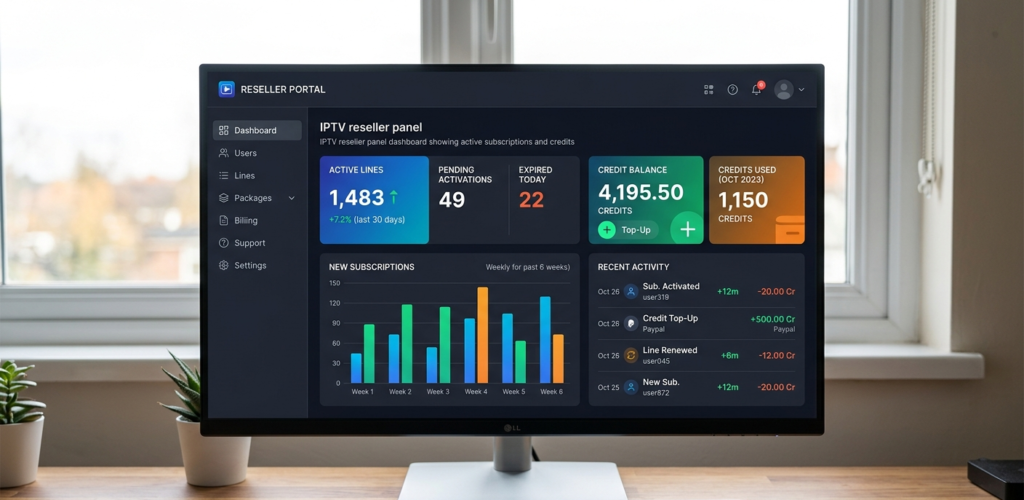
When most people hear “IPTV service provider,” they picture a massive operation with server racks and a technical team. In reality, the majority of providers operating in the UK today are resellers — individuals or small businesses who purchase access to a panel, buy credits, and use those credits to create and manage subscriptions for their clients.
You are, in essence, a distributor. You don’t stream the content yourself. You manage the lines, handle the customer relationships, set your own pricing, and keep the margin between what you pay wholesale and what your clients pay retail.
It’s a genuine business model, and in 2026, demand has never been higher.
Understanding the Reseller Model
The reseller model works like this: you purchase a block of credits from a panel provider. Each credit typically represents one month of one active line. You sell subscriptions to clients, activate their lines through your panel, and pocket the difference.
Profit=(Credits Sold×Retail Price)−(Credits Purchased×Wholesale Cost)−Operating ExpensesProfit = (Credits\ Sold \times Retail\ Price) – (Credits\ Purchased \times Wholesale\ Cost) – Operating\ Expenses
In practical terms: if you buy credits at £2.50 each and sell monthly subscriptions at £8, your gross margin per line is £5.50. Run 100 active subscribers and that’s £550 gross per month — before any support time or incidentals.
Scale to 300 subscribers and you’re looking at over £1,600 monthly gross from a laptop. That’s why people are asking how to become an IPTV service provider.
Pro Tip: Never calculate profit on credits alone. Factor in your time for support, refund rate (budget 5–8% for a new operation), and any tools you’re paying for monthly. Real margin is always lower than your first estimate.
Choosing a Reliable IPTV Panel and Supplier
This is where most beginners get burned — and where I made my worst early mistakes.
There are panels and then there are reliable panels. The difference isn’t always obvious from a sales page. What you need to look for:
Uptime track record: Any serious panel provider should be able to show you uptime data. Anything below 99.5% is a red flag. During Premier League weekends and major events, demand spikes dramatically — your panel needs to hold under pressure.
Anti-freeze technology: Buffering kills clients. Anti-freeze systems — which dynamically re-route streams when a source degrades — are non-negotiable for UK subscribers watching live sport. If your supplier can’t explain their anti-freeze setup, keep moving.
UK-optimised servers: Latency matters. A server routed through a distant data centre adds delay that shows up as buffering during fast-action content. UK-based or UK-edge servers make a measurable difference.
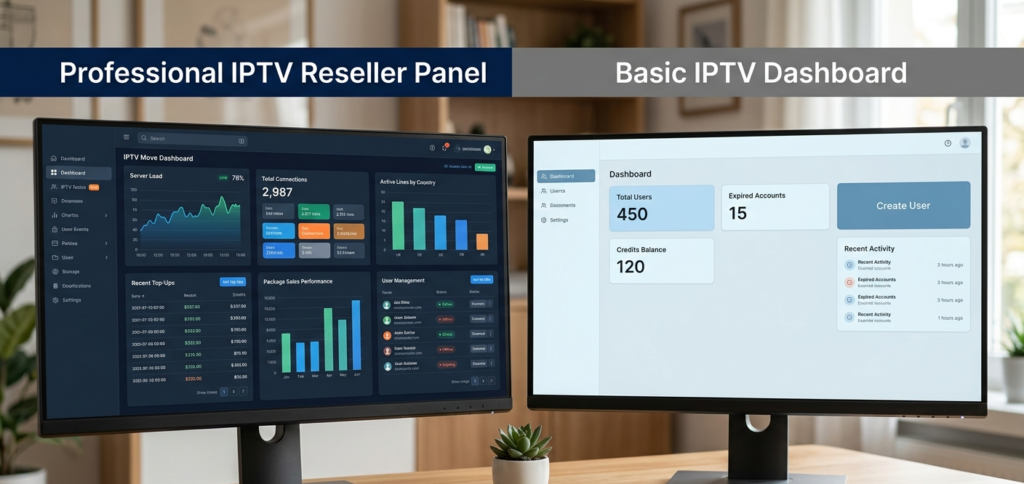
Panel features: Look for a clean management interface, the ability to create sub-resellers, trial line management, and detailed usage reporting. These features let you run the business properly rather than guessing.
Setting Up Your Business Structure in the UK
I’m not a solicitor, so take this as practical observation rather than legal advice — but here’s what I’ve seen work among UK-based operators.
Most start as sole traders. It’s the lowest friction option — register with HMRC, keep records of income and expenses, file a self-assessment return. Simple.
As you scale past 100 subscribers, a limited company starts making more sense for tax efficiency and credibility. Clients, particularly business clients, respond better to an invoice from a Ltd company than a personal name.
Either way, keep your income records clean. IPTV reselling is a legitimate software distribution business when structured correctly — you’re selling access to subscription management software, not hosting or distributing content yourself.
Pro Tip: Open a dedicated business bank account from day one, even as a sole trader. Mixing personal and business income is a headache you don’t want at tax time, and it makes your operation look less professional to anyone who asks.
Pricing Your Subscriptions for Profit
Pricing in the UK IPTV market is competitive but not a race to the bottom — at least, not if you position yourself correctly.
The mistake new providers make is underpricing to win clients, then realising they can’t sustain the margin when they need to buy more credits or deal with refund requests.
A realistic UK pricing structure in 2026:
- 1 Month: £8–£10
- 3 Months: £22–£28
- 6 Months: £40–£50
- 12 Months: £70–£90
The 12-month plan is your most valuable product. It locks in cash flow, reduces churn, and means fewer support touchpoints per client. Incentivise it with a small discount and the majority of serious clients will take it.
Managing Credits and Scaling Up
Credits are your stock. Managing them properly is the difference between a profitable operation and constant cash flow anxiety.
Buy in sensible volumes — enough for 30–45 days of activations at your current pace. Don’t over-buy early. Supplier relationships can change, panels can get updated, and tying up capital in credits you won’t use for three months is poor cash management.
As you grow, negotiate. Suppliers will offer better rates at volume. At 200+ active lines, you should be getting a meaningfully better per-credit price than when you started. If your supplier won’t discuss pricing at that level, find one who will.
Break Even Point=Fixed Monthly CostsRetail Price−Wholesale Cost Per LineBreak\ Even\ Point = \frac{Fixed\ Monthly\ Costs}{Retail\ Price – Wholesale\ Cost\ Per\ Line}
Know your break-even number. Mine was 47 active subscribers when I started. Everything above that was profit. Knowing that number kept me focused on growth rather than just activity.
Pro Tip: Set aside 15–20% of monthly revenue into a separate account from the start. This covers refunds, quiet months, and reinvestment — and stops you spending margin you’ll need later.
Avoiding the Most Common Mistakes
I’ve watched resellers make the same errors repeatedly:
Choosing suppliers based on price alone. The cheapest panel is almost never the most reliable. A supplier saving you £1 per credit who goes down every weekend will cost you far more in refunds and lost clients.
No trial process. Always offer short trials before selling longer subscriptions. It filters out problem clients and gives you a chance to confirm the service works on their specific device — MAG box, STBEmu, Smarters, whatever they’re running.
Ignoring the 3pm blackout. If your UK clients are expecting to watch live football during the Saturday 3pm slot, you need to manage expectations clearly. This is a UK-specific quirk that catches new providers off guard.
No written terms. A simple terms of service document, even a basic one, protects you from refund demands and sets expectations. Clients who agree to clear terms before purchase are dramatically less likely to dispute.
Is Becoming an IPTV Service Provider Legal?
This is the question everyone asks and nobody wants to answer directly. Here’s my honest take.
Operating as a reseller of subscription management software — where you are facilitating access to a panel that clients use to manage their own IPTV lines — sits in a different legal category from hosting or distributing content yourself. The platform provides the infrastructure; you distribute access to it.
That said, the UK legal landscape around IPTV is not static. Enforcement has historically targeted large-scale operators and device sellers rather than individual resellers. But the risk exists, and you should be aware of it.
Build your business with proper terms, clear disclaimers, and structure it transparently. The operators who get into serious trouble are usually the ones operating with no paper trail and no legitimate framing around what they’re actually selling.
Where to Start Without Losing Money
If I were starting fresh today, this is what I’d do:
Get access to a vetted, UK-focused reseller panel with a real support structure and a demonstrated uptime record. Don’t try to build your own infrastructure — the margin doesn’t justify it until you’re operating at serious scale, and the technical complexity will bury you.
BritishSeller.co.uk is where I’d point anyone serious about starting properly. The panel is set up for UK and US market resellers, the credit system is straightforward, and the infrastructure is built around the kind of demand spikes that UK sport generates. It’s the kind of starting point I wish I’d had instead of learning through expensive mistakes.
✅ IPTV Reseller Success Checklist (5 Points)
- Vet your supplier on uptime, not price — test during a high-demand period before committing to volume purchases.
- Know your break-even number — calculate exactly how many active lines you need to cover costs before you spend a penny on marketing.
- Offer trials, but control them — a 24–48 hour trial line is enough to qualify a serious client; anything longer attracts freeloaders.
- Document everything — terms of service, refund policy, and activation confirmation messages protect you when disputes arise.
- Reinvest margin deliberately — scale your credit volume as your subscriber base grows, negotiate rates, and don’t spend margin before you’ve set aside your refund buffer.