I remember the first time a client rang me at 10:47pm on a Saturday night. Premier League match. Sixty-three minutes in. His stream had frozen solid. He wasn’t calm about it.
That moment taught me more about IPTV services than any YouTube tutorial ever could. Because understanding what IPTV services actually are — not just the marketing definition, but the mechanical reality behind them — is the difference between running a profitable reseller operation and fielding abuse calls on a Saturday evening.
If you’re new to the space, or you’ve been reselling for a while but feel shaky on the fundamentals, this guide is for you. No fluff. No generic definitions you could’ve Googled in thirty seconds. Just real clarity, from someone who’s been operating in the UK market for years.
Table of Contents
- What IPTV Services Actually Are (Beyond the Textbook Definition)
- How IPTV Services Work Under the Hood
- The Three Types of IPTV Services Resellers Deal With
- What Makes a Good IPTV Service vs a Bad One
- Why the UK Market Has Unique Demands
- The Technical Numbers You Need to Understand
- Choosing the Right IPTV Service to Resell
- IPTV Reseller Success Checklist
What IPTV Services Actually Are (Beyond the Textbook Definition)
Most people define IPTV as “television delivered over the internet.” Technically accurate. Practically useless.
Here’s a better definition for anyone in the reseller world: an IPTV service is a subscription-based access system that delivers live and on-demand streams to an end device — be that a Firestick, MAG box, smart TV, or phone — through a structured panel, usually managed via Xtream Codes or a similar middleware.
The “service” part matters. You’re not just selling a stream. You’re selling reliability, uptime, and the promise that it won’t freeze when it matters most. That’s the product. That’s what clients are paying for.
When I first started, I made the mistake of thinking all IPTV services were essentially the same. They’re not. The difference between a well-optimised UK server and a cheap overseas one becomes very obvious when demand spikes.
Pro Tip: Don’t evaluate an IPTV service during off-peak hours. Test it on a weekday evening between 7pm and 10pm — that’s when you’ll see the real picture. Better yet, test it during a high-demand sporting event.
How IPTV Services Work Under the Hood
This is where most reseller guides go quiet. Let’s not.
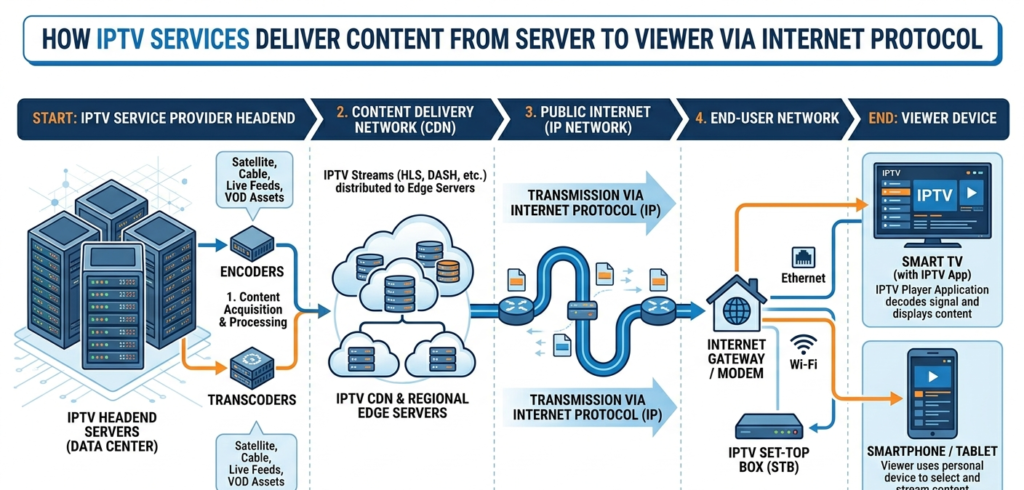
An IPTV service functions by pulling encoded video streams from a content source, processing them through a server infrastructure, and distributing them to subscribers via unique login credentials — typically a username, password, and server URL.
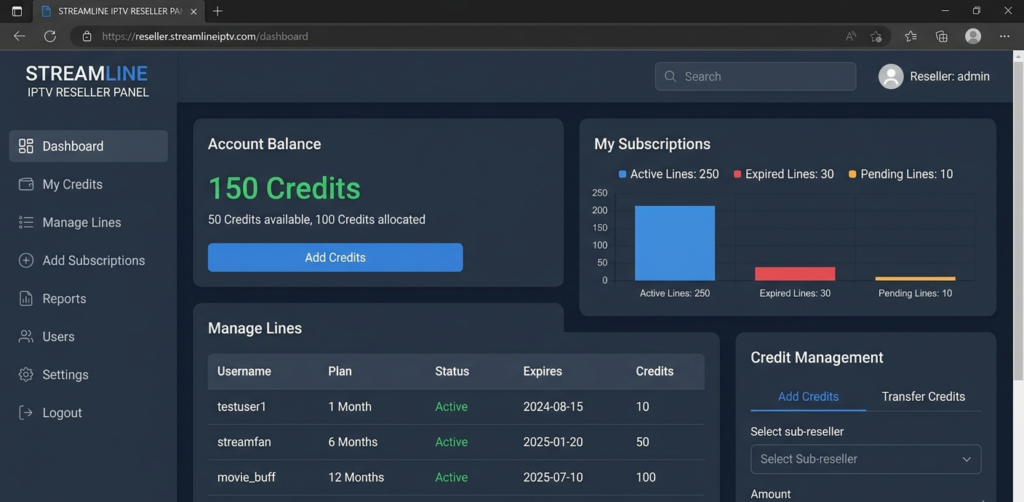
The panel (your management interface) sits in the middle. It handles line creation, subscription durations, connection limits, and often basic anti-freeze controls. When you create a line for a client, you’re essentially granting them access credentials that authenticate against the provider’s server.
The stream itself travels from server to device using one of three delivery formats: M3U playlist, Xtream Codes API, or MAG/STBEmu portal. Each has different compatibility considerations depending on what your client’s using.
The entire chain — source, server, panel, line, device — has to hold together simultaneously. Any weak link and your client’s watching a buffering wheel instead of a match.
The Three Types of IPTV Services Resellers Deal With
In practical terms, there are three categories you’ll encounter:
1. Reseller Panel Services These are backend infrastructures sold to resellers like you. You purchase credits, create lines, set your own pricing, and manage your own subscriber base. You’re effectively running your own branded IPTV business without owning the servers. This is the most scalable model for UK resellers.
2. Direct Subscription Services Consumer-facing services sold directly to end users. As a reseller, you’re less relevant here unless you’re white-labelling or acting as an affiliate. Margins are thinner and control is minimal.
3. Hybrid/White Label Services A step up from standard reseller panels. You get branding control, sometimes your own domain and app, and a more premium customer experience. Higher upfront cost, but significantly better for retention.
Most people reading this are in the first category or working towards the third. The panel model is where real reseller businesses are built.
Pro Tip: If a provider doesn’t offer a reseller panel with proper line management tools, walk away. Managing subscriptions manually through spreadsheets is how you lose clients and your sanity simultaneously.
What Makes a Good IPTV Service vs a Bad One
I’ve seen resellers lose thousands — not because they were bad at sales, but because they picked the wrong upstream provider. Here’s what separates a reliable IPTV service from a liability:
Uptime percentage — anything below 99.5% sustained uptime is a problem. Most decent providers advertise 99.9%. Ask for proof.
Anti-freeze technology — this is the mechanism that switches between stream sources when one drops. Without it, a single server hiccup means frozen screens across your entire subscriber base at the worst possible moment.
UK-based or UK-optimised servers — latency matters. A server physically closer to your subscribers means faster response, lower buffering, and happier clients. This is non-negotiable for a UK-focused operation.
Concurrent connection handling — during peak demand (think Saturday afternoon, multiple fixtures simultaneously), your provider’s infrastructure needs to handle the load without degradation.
Panel stability — the management interface needs to be reliable. If the panel goes down, you lose the ability to create lines, manage renewals, or troubleshoot. I’ve been in situations where the panel was down and clients were messaging me wondering why their subscription wasn’t working. Not a pleasant afternoon.
Why the UK Market Has Unique Demands
The UK IPTV market has specific pressure points that don’t exist to the same degree elsewhere.
The 3pm Saturday blackout rule means that live domestic football isn’t accessible through legitimate broadcast during that window — which drives a significant portion of demand toward alternative streaming. Any reseller operating in the UK knows the 3pm slot is your highest-traffic period of the week.
Beyond that, UK subscribers expect HD as standard. They’ve grown up with quality broadcast infrastructure. Anything below that feels broken to them, even if technically it’s functioning. Manage expectations accordingly.
Fibre broadband penetration in the UK is high, which means your clients generally have the bandwidth to handle higher-quality streams. That’s a positive for your service quality, but it also raises the bar for what “acceptable” looks like.
The Technical Numbers You Need to Understand
If you’re running an IPTV reseller operation, you need to understand your numbers — not just in terms of profit, but in terms of infrastructure cost relative to your subscriber base.
A rough profit model for a UK reseller looks like this:
Profit=(ActiveLines×MonthlySubscriptionPrice)−(CreditsUsed×CreditCost)−OperationalCostsProfit = (Active Lines × Monthly Subscription Price) – (Credits Used × Credit Cost) – Operational Costs
For example, if you have 50 active subscribers at £10/month, credits cost you roughly £2 per line per month, and your other operational costs (customer support time, tools, etc.) are approximately £50/month:
Revenue = £500 Credit cost = £100 Operational = £50 Net Profit = £350/month
Scale that to 200 subscribers and the numbers become genuinely interesting. But only if your churn rate stays low — which only happens if the service is reliable.
Pro Tip: Track your refund rate obsessively. If more than 5% of subscribers are requesting refunds in a given month, the problem isn’t your sales — it’s your upstream provider. Change it before it cascades.
Choosing the Right IPTV Service to Resell
This is the most consequential decision you’ll make as a reseller. The quality of your upstream service determines everything downstream — your reputation, your retention, your revenue.
When evaluating a provider, test before you commit at scale. Ask for a trial line. Stress test it. Check the panel interface. Look for how quickly their support responds when something breaks — because something always breaks eventually.
In my experience, the providers worth sticking with are the ones who are transparent about issues when they happen, communicate proactively, and have documented their anti-freeze and failover systems. Vague promises and flashy sales pages mean nothing at 10pm on a Saturday.
If you’re looking for a vetted starting point, britishseller.co.uk is a platform I’d point UK-based resellers toward. It’s built specifically for this market, with panel infrastructure that’s been stress-tested against UK peak demand. Worth exploring if you’re serious about building something sustainable rather than just dabbling.
✅ IPTV Reseller Success Checklist (5 Points)
1. Verify uptime before committing — Test your provider’s service during peak hours, not just a Tuesday afternoon. Your clients’ worst moments are your proving ground.
2. Understand your panel inside out — Know how to create lines, manage renewals, adjust connection limits, and handle troubleshooting. Your confidence here is your client’s reassurance.
3. Know your numbers — Track credits used, active lines, churn rate, and refund rate monthly. You can’t scale what you’re not measuring.
4. Position your service on reliability, not price — Competing on price alone attracts the worst clients and creates a race to the bottom. Reliability commands premium positioning and better retention.
5. Have a contingency plan — Know what you’ll do if your provider goes down unexpectedly. Have a backup option identified, a client communication template ready, and a refund policy that protects your reputation without destroying your margins.
The IPTV reseller space in 2026 is more competitive than it was three years ago — but it’s also more sophisticated. The resellers who understand the infrastructure behind the service, not just the sales side, are the ones building real businesses. The rest are just hoping their provider holds up on a Saturday afternoon.