It was a Saturday afternoon. Kick-off in 20 minutes. My phone was already buzzing with customers asking why their streams were frozen — and I hadn’t even opened my panel yet.
My provider had oversold their server capacity ahead of a high-demand weekend. No warning, no communication, just a wall of angry messages from paying customers and a support ticket that sat unanswered for six hours. I lost three reseller clients that weekend. Long-term ones.
That’s the moment I stopped picking IPTV providers based on price per credit and started evaluating them like a business partner — because that’s exactly what they are.
If you’re building a reseller operation in the UK, the provider you choose will either be the engine that drives consistent income or the landmine that ends your business. Here’s everything I now look for before I commit a single penny.
Table of Contents
- Why Your IPTV Provider Choice Defines Everything
- The Non-Negotiables: What a Reliable Provider Must Offer
- Server Infrastructure — The Technical Reality Nobody Talks About
- How to Test a Provider Before You Commit
- Red Flags That Should End Conversations Immediately
- Pricing, Credits, and Profit Margins Explained
- Recommended Route for UK Resellers
Why Your IPTV Provider Choice Defines Everything
Most new resellers assume the product they’re selling is the subscription. It isn’t. What you’re actually selling is reliability. Your customers don’t care what’s running behind the scenes — they care that it works on a Saturday at 3pm, during high-demand fixtures, without a single buffer.
Your provider is the foundation everything sits on. Panel management, customer retention, your reputation — all of it depends on upstream performance. A flashy reseller panel means nothing if the streams behind it are unstable.
In the UK market specifically, the pressure is intense. Demand spikes are predictable but extreme. Any provider that hasn’t built infrastructure to handle volume surges during peak viewing periods isn’t worth your time, full stop.
Pro Tip: Always ask a potential provider what their peak concurrent connection capacity is and how they handle server load during high-demand periods. If they can’t give you a straight answer, walk away.
The Non-Negotiables: What a Reliable Provider Must Offer
After working with a range of providers — good, mediocre, and outright dishonest — I’ve distilled it down to a short list of absolutes.
Uptime guarantee above 99.5%. Anything below this is a commercial liability. Even at 99%, that’s over 87 hours of potential downtime per year. For a subscription-based reseller business, that’s unacceptable.
Anti-freeze and anti-buffering technology. This is non-negotiable for the UK market. Adaptive bitrate streaming and proper CDN distribution are the difference between a smooth viewing experience and a refund request.
Multiple server locations. Providers relying on a single server cluster are one hardware failure away from taking your entire customer base offline. Geo-distributed infrastructure is the only sensible setup.
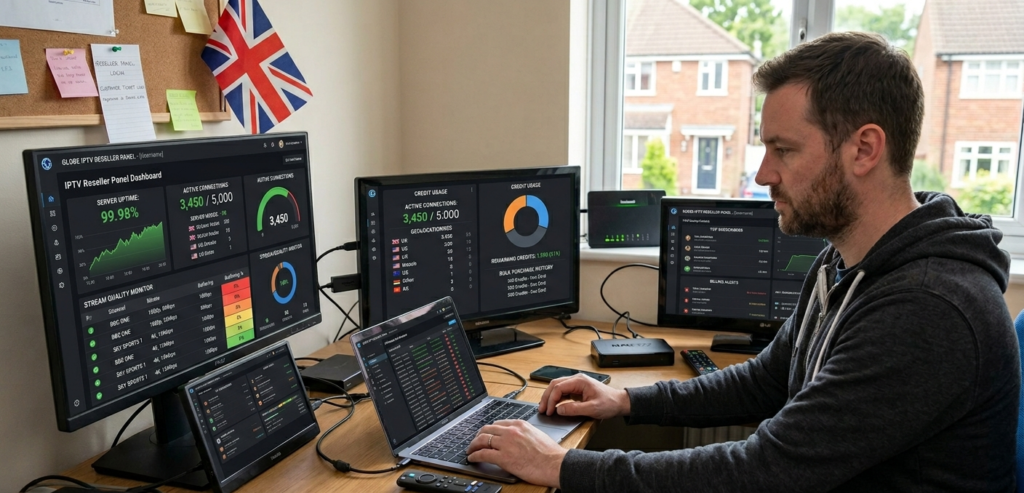
Panel access with real-time monitoring. You need visibility. If your provider doesn’t give you a proper reseller panel — one where you can see active connections, bandwidth usage, and credit status — you’re flying blind.
Responsive technical support. Not a chatbot. Not a Telegram group that goes quiet after 10pm. Actual human support with a reasonable response window, especially around peak periods.
Server Infrastructure — The Technical Reality Nobody Talks About
Most resellers don’t think about what’s physically delivering the streams. That’s a mistake.
The UK has specific bandwidth demands. A high-traffic provider serving thousands of concurrent connections needs serious infrastructure — load-balanced servers, CDN edge nodes, and ideally UK-based or EU-based data centres to minimise latency.
When a provider operates servers exclusively outside Europe and routes traffic through multiple hops before reaching a customer in Manchester or Birmingham, you’re going to see lag, buffering, and degraded picture quality. That’s physics, not a fixable bug.
Look for providers who can confirm their CDN setup and whether they use adaptive bitrate technology. ABR automatically adjusts stream quality based on a customer’s connection speed — it’s the reason professional streaming platforms rarely buffer, and it should be standard practice for any serious IPTV provider in 2026.
Effective Margin=(Credits Sold×Price Per Credit)−(Credits Purchased×Cost Per Credit)−Support Overhead\text{Effective Margin} = (\text{Credits Sold} \times \text{Price Per Credit}) – (\text{Credits Purchased} \times \text{Cost Per Credit}) – \text{Support Overhead}
Running this calculation honestly — including the time you spend on support when streams fail — often reveals that cheap providers are actually more expensive in real terms.
Pro Tip: Request a 24–48 hour trial before purchasing credits in bulk. Run it specifically during a high-demand period, not a quiet Tuesday afternoon. That’s when weak infrastructure exposes itself.
How to Test a Provider Before You Commit
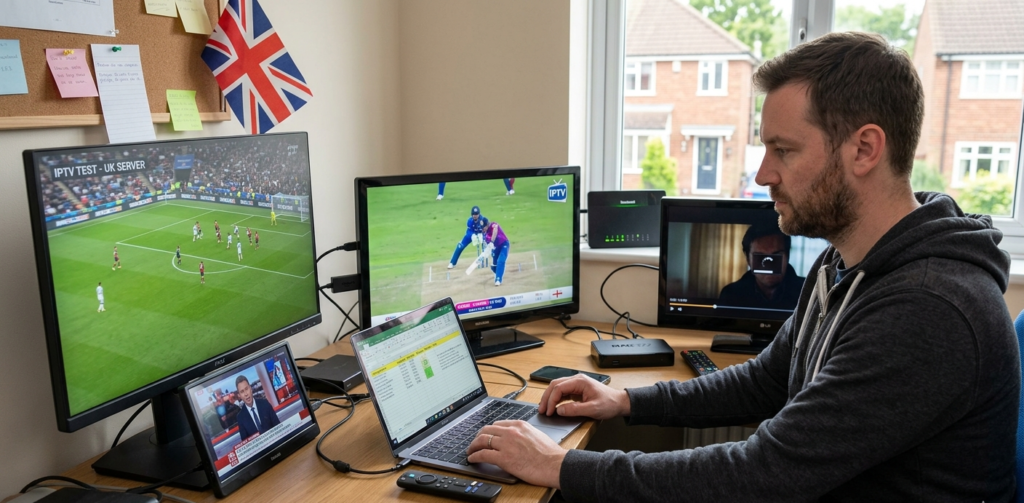
Testing isn’t optional — it’s due diligence. Here’s the process I use before working with any new provider.
Device testing. Run the trial on at least three different setups: Firestick with a player app like TiviMate or IPTV Smarters Pro, a MAG box using STBEmu or native middleware, and a mobile device. Providers that work well on one device type but poorly on another have compatibility issues that will generate support tickets.
Time-of-day testing. Test during evenings and weekends. Server performance at 11am on a Wednesday tells you almost nothing about how it will perform when actual demand hits.
Connection stress. If possible, connect multiple simultaneous streams on the same account to gauge how the provider handles concurrent connections. This simulates what happens when a customer tries to watch on two devices.
Support response time. Submit a test ticket during peak hours. The speed and quality of that response tells you exactly what you’ll be dealing with when something goes wrong — and something always eventually goes wrong.
Red Flags That Should End Conversations Immediately
I’ve made expensive mistakes so you don’t have to. These are the warning signs I now treat as hard dealbreakers.
No trial offered. Any legitimate provider is confident enough in their product to offer a test period. Refusing trials is either a sign of a scam operation or a provider who knows their streams won’t impress on first contact.
Credits-only payment with no refund policy. This is a classic structure in fraudulent operations. You buy credits, streams are terrible, and there’s no mechanism to recover anything.
Unverifiable uptime claims. “99.9% uptime” means nothing without evidence. Ask for monitoring logs or third-party uptime data. Most genuine providers can produce something — most scam operations cannot.
Disappearing support. If a provider’s Telegram channel goes quiet for hours during a football weekend, that’s your preview of what ongoing support will look like.
Overselling. The worst providers sell more connections than their servers can handle. You’ll notice this as performance that degrades precisely when it matters most — high-demand fixtures, evenings, weekends.
Pro Tip: Search the provider’s name alongside words like “scam,” “down,” or “review” before committing. Real user experiences surface quickly. Forums and reseller communities are goldmines of honest feedback that providers can’t control.
Pricing, Credits, and Profit Margins Explained
Understanding credit economics is essential to running a sustainable reseller operation. Most providers sell credits in bulk — each credit typically equates to one active IPTV line for a set period.
Your job is to price those lines at a margin that covers your costs, your support overhead, and generates genuine profit.
Monthly Profit=(Active Lines×Monthly Subscription Price)−(Credits Cost+Panel Fees+Support Time Cost)\text{Monthly Profit} = (\text{Active Lines} \times \text{Monthly Subscription Price}) – (\text{Credits Cost} + \text{Panel Fees} + \text{Support Time Cost})
At a typical UK reseller pricing structure — say £8–£12 per line per month — and with credits purchased at bulk rates, a reseller operating 100 active lines can realistically generate £400–£700 monthly profit after costs. Scale that to 300 lines and you’re looking at a serious income stream.
But those numbers collapse instantly if you’re haemorrhaging customers due to provider instability. Churn is the silent killer of reseller businesses, and poor provider performance is the primary driver of churn.
Pro Tip: Build a modest credit buffer — never let your panel run to zero. Running out of credits mid-month means customers experience service interruption, which triggers refund requests and cancellations that eat directly into your margin.
Recommended Route for UK Resellers
After years of trial and error, the panel and provider setup I consistently recommend to resellers starting or scaling in the UK is one that combines stable upstream infrastructure with a proper management layer.
For resellers who want a vetted, UK-market-ready panel setup without the headache of testing dozens of providers from scratch, britishseller.co.uk has become my go-to recommendation. The platform is built for the UK reseller market specifically — not a generic international panel awkwardly adapted for British customers. Onboarding is straightforward, the credit structure is transparent, and the infrastructure holds up during the periods that matter most.
It’s not a magic solution. You still need to manage your customers, handle support, and market your service. But it removes the biggest variable — provider reliability — from the equation.
✅ IPTV Reseller Success Checklist
1. Vet providers with a live trial during peak hours, not off-peak. Real performance only shows up under real demand.
2. Calculate your true margin including support time. Cheap credits that generate constant support work are never actually cheap.
3. Maintain a credit buffer at all times. Running dry mid-month is an avoidable own goal that costs you customers.
4. Test across multiple device types before committing. Compatibility issues are provider-side problems that your customers will blame on you.
5. Choose a panel that gives you real-time visibility. Blind operation is how resellers get caught off guard — dashboards, uptime stats, and active connection monitoring are essentials, not extras.
The difference between resellers who build genuine income and those who burn out after six months usually isn’t effort — it’s infrastructure. Get the provider right, and everything else becomes manageable. Get it wrong, and no amount of marketing will save you