I’d been with the same IPTV provider for four months. Stable, responsive, decent margins. Then February arrived — a week with three Premier League fixtures, a Europa League night, and a heavyweight boxing event on the Saturday. By Thursday evening my phone had become an instrument of torture. Buffering on the football. Complete outages during the boxing. A provider support channel that went from sixty-second response times to four-hour silences precisely when I needed them most.
By the following Monday I’d refunded eleven customers, lost six permanently, and spent an entire weekend managing a crisis that wasn’t my fault but was absolutely my problem. The provider’s explanation, delivered two days later via Telegram, was that they’d “experienced unexpected load.” In other words: they oversold their capacity, didn’t tell me, and left me to absorb the consequences in full.
Choosing the right IPTV provider in the UK is the single most consequential decision you make as a reseller. Everything else — your pricing, your branding, your customer service — sits on top of that foundation. Get it wrong and no amount of hustle rescues you. Get it right and the business practically runs itself during quiet periods.
Here is the unfiltered guide to evaluating UK IPTV providers that I wish had existed when I started.
Table of Contents
- Why Most UK Resellers Choose Their Provider Wrong
- What a Legitimate IPTV Provider Actually Looks Like
- The Infrastructure Questions That Separate Good From Bad
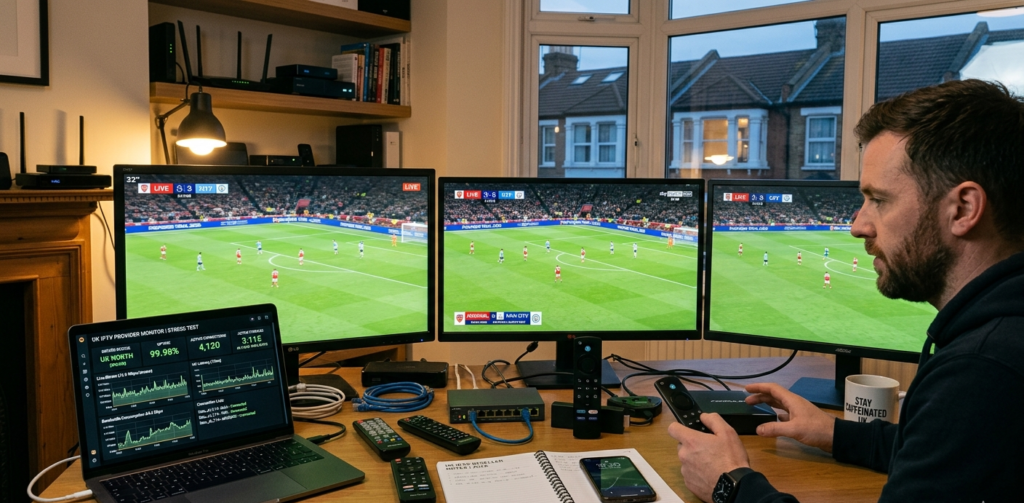
- How to Test a Provider Before Committing Serious Money
- Understanding the Credit Model and What Fair Pricing Looks Like
- Red Flags That Should End the Conversation Immediately
- The Overselling Problem and How to Detect It Early
- Support Quality — The Feature Nobody Talks About Enough
- Building Redundancy Into Your Provider Strategy
- Where UK Resellers Are Finding Reliable Infrastructure in 2026

Why Most UK Resellers Choose Their Provider Wrong
The selection process most new resellers use goes something like this: they join a few IPTV-related Telegram groups, they see someone advertising reseller panels with attractive credit prices and bold uptime claims, they buy a small test package, it works fine for a week, and they commit. Then the first major live event arrives and the wheels come off.
The fundamental problem is that providers are evaluated during quiet periods when almost any infrastructure looks acceptable. A server running at 20 percent capacity delivers clean streams. That same server at 85 percent capacity during a simultaneous Premier League and Champions League evening is a different proposition entirely.
In my experience, the resellers who end up locked into bad providers aren’t naive — they just didn’t know what to test for, when to test it, or what questions to ask before committing. This guide fixes that.
The UK IPTV provider landscape in 2026 spans everything from genuinely professional operations with dedicated UK server infrastructure and real technical teams, to individuals running a reseller panel they purchased wholesale and are subletting to other resellers with essentially no infrastructure of their own. The gap in reliability between these extremes is enormous, and it’s not always obvious from the outside which category you’re dealing with.
Pro Tip: Before evaluating any provider’s streams, evaluate their communication. Send a detailed technical question at 10pm on a Friday evening — ask about their concurrent stream capacity on UK servers specifically. How quickly they respond, and how specifically they answer, tells you more about their operational competence than any trial stream ever will.
What a Legitimate IPTV Provider Actually Looks Like
Legitimate, professionally operated IPTV providers share a consistent set of characteristics. None of these are guarantees on their own, but in combination they indicate an operation that’s built for longevity rather than a quick exit.
Verifiable operational history. Providers who have been running consistently for eighteen months or more, with a traceable presence in reseller communities, are categorically less risky than new entrants regardless of how impressive their panel looks. New providers can be excellent — but they haven’t been tested across a full Premier League season yet.
Transparent infrastructure details. A provider confident in their UK server setup will tell you where their infrastructure is located, how their CDN is structured, and approximately what concurrent stream capacity they maintain. Vague language about “premium servers” and “enterprise infrastructure” without specifics is marketing, not information.
A reseller panel with real functionality. The panel is your operational interface. A professional provider offers a panel with real-time stream monitoring, credit management, connection limit controls, multi-format credential generation — M3U, Xtream Codes, MAG portal — and a clean, functional interface. Panels that look like they were built in 2015 and haven’t been updated since are a reasonable indicator of the broader operational investment level.
Honest conversation about limitations. The best provider I’ve worked with told me upfront that their 4K capacity was limited to a specific concurrent stream count during peak periods and recommended I cap my 4K subscriptions accordingly until they expanded capacity. That honesty was worth more than any marketing claim. Providers who acknowledge limitations are providers who understand their own infrastructure.
The Infrastructure Questions That Separate Good From Bad
These are the specific questions I now ask every potential IPTV provider before committing a single credit purchase. The answers — and the evasions — are consistently revealing:
“Where are your primary UK servers physically located, and do you use UK-based CDN edge nodes?” UK viewers pulling streams from geographically local servers experience lower latency and more consistent quality, particularly during peak load. A provider routing UK traffic through infrastructure based outside the country is accepting an unnecessary performance compromise.
“What is your maximum concurrent stream capacity on UK servers, and what percentage of that capacity is currently committed to your reseller base?” This is the overselling question in disguise. A provider running at 40 percent capacity has genuine headroom. One running at 90 percent is a single viral event away from widespread failure.
“Do you have anti-freeze technology deployed on your stream delivery, and does it operate on both HD and 4K streams?” Anti-freeze systems detect stream interruptions and reroute delivery automatically. Without them, every server hiccup becomes a visible customer experience failure. Any professional provider has this. Many budget providers do not.
“What is your average uptime over the past three months, measured during Premier League peak hours specifically?” General uptime figures are almost meaningless — 99.5% uptime sounds impressive until you realise those failures are clustered during Saturday afternoons. Peak-hour uptime during live sport is the only metric that matters for UK resellers.
Effective Uptime=Peak Hours OnlineTotal Peak Hours×100Effective\ Uptime = \frac{Peak\ Hours\ Online}{Total\ Peak\ Hours} \times 100
A provider delivering 97% general uptime but dropping to 91% during Premier League peak hours is a worse operational partner than one delivering 98.5% consistently across all periods.
Pro Tip: Ask your potential provider for their incident log from the past ninety days. Any operation with serious infrastructure monitoring tracks outages, their duration, and their cause. A provider who says they’ve had zero incidents in three months either has extraordinary infrastructure or isn’t monitoring carefully enough to know when things go wrong.
How to Test a Provider Before Committing Serious Money
A trial is not a formality. It’s an intelligence-gathering exercise. Here’s how to run one properly:
Test during a live major event. The only test environment that matters for a UK IPTV provider is simultaneous high-demand content. Request your trial to overlap with a Premier League weekend or a midweek European fixture. Quiet Monday afternoon testing tells you almost nothing useful.
Test multiple simultaneous connections. If you’re planning to sell single-connection subscriptions, test with one connection. If you’re evaluating for multi-connection household packages, test two or three streams simultaneously on the trial line. Stress the connection deliberately.
Test across your target device range. UK customers use MAG boxes, Firesticks, Android TV boxes, Smart TVs, and STBEmu-equipped devices. A provider whose streams work perfectly on one device type but poorly on another creates device-specific support problems that are tedious to diagnose and frustrating to customers.
Test at different times of day. Morning, afternoon, and peak evening hours — particularly 7pm to 10pm — can show markedly different performance on infrastructure that’s undersized for its committed reseller base. Pattern variation across time periods is a warning sign.
Measure playlist and credential load times. When you load an M3U playlist or Xtream Codes connection, how long does the channel list take to appear? Slow panel response times during a trial — when the provider is presumably showing you their best performance — will be worse when you’re a committed reseller among hundreds of others.
Understanding the Credit Model and What Fair Pricing Looks Like
Credits are the currency of the reseller relationship with a provider. Understanding fair credit pricing prevents you from either overpaying for identical infrastructure or making the classic mistake of chasing cheap credits from oversold servers.
In the UK market in 2026, realistic wholesale credit pricing from a provider with genuine UK server infrastructure falls between £1.50 and £3.00 per credit for standard HD connections. 4K credits command a premium of 25 to 40 percent above HD pricing from providers who maintain dedicated 4K infrastructure.
Reseller Monthly Revenue=(Credits Sold×Retail Price)−(Credits Purchased×Wholesale Cost)Reseller\ Monthly\ Revenue = (Credits\ Sold \times Retail\ Price) – (Credits\ Purchased \times Wholesale\ Cost)
Credits priced below £1.00 from unknown providers should trigger immediate scepticism. The infrastructure required to deliver reliable UK IPTV streams — servers, CDN, bandwidth, anti-freeze systems, panel maintenance — has real costs. Providers offering credits at prices that don’t allow for those costs to be covered are either operating at a loss temporarily, overselling massively, or planning a short operational runway before disappearing.
Minimum credit purchase requirements are also worth examining. Legitimate providers with confidence in their product typically allow smaller initial purchases — 25 to 50 credits — to let resellers validate quality before committing to bulk. Providers demanding 200-credit minimum purchases from an unproven reseller relationship are either managing cash flow aggressively or making it difficult for you to walk away cleanly if quality disappoints.
Pro Tip: Negotiate a graduated credit arrangement with new providers — start with a small purchase at standard pricing, and agree on volume discount tiers at 100, 250, and 500 credits. This protects your capital during the validation period and gives you a clear incentive structure once you’ve confirmed quality.
Red Flags That Should End the Conversation Immediately
I’ve encountered every variant of these. Each one cost me either time, money, or both before I learnt to treat them as absolute disqualifiers:
Guaranteed 100% uptime. No honest provider operating in the real world makes this claim. Infrastructure fails. Content delivery networks have incidents. Providers who promise perfect uptime either haven’t operated long enough to know otherwise or are lying. Neither option is acceptable.
No trial option. A provider confident in their product allows trials. Full stop. Refusing trials — or offering “paid trials” as a standard practice — indicates awareness that the service won’t survive unbiased evaluation.
Anonymous operation with no verifiable presence. A provider with no website, no traceable operational history, and no presence beyond a Telegram account is a significantly elevated risk profile. Some anonymous operators run legitimate services. The inability to verify anything about them means you have no recourse if they disappear.
Pressure tactics on credit purchases. “This price is only available today” or “we’re almost at reseller capacity” language applied to credit purchases is manipulation, not information. Professional providers don’t need to pressure resellers into volume commitments.
Evasive answers to technical questions. When you ask about concurrent stream capacity and receive a response about “premium infrastructure” without numbers, the evasion is the answer. Providers who know their infrastructure answer technical questions specifically.
The Overselling Problem and How to Detect It Early
Overselling is the silent killer of UK reseller businesses. A provider sells more concurrent stream capacity than their infrastructure can actually support, everything appears fine during normal traffic periods, and the first major simultaneous demand event reveals the problem catastrophically.
The early indicators of overselling are subtle but consistent:
Performance that degrades predictably during known peak periods. If streams that work perfectly at 2pm on a Wednesday show consistent quality degradation at 7:45pm on a Tuesday during a Champions League night, the infrastructure is operating near capacity during high demand. This pattern, observed twice, is a reliable early warning.
Slow channel list loading times that worsen during evenings. Panel server performance under load is a proxy for overall infrastructure stress. If M3U playlists or Xtream Codes channel lists take noticeably longer to load during peak hours than quiet periods, the servers are under strain.
Support response times that lengthen during exactly the periods when support is most needed. A provider whose support response time doubles during major live events is either understaffed or managing a volume of simultaneous incidents that reveals their infrastructure situation.
Reluctance to discuss reseller base size. When I ask a provider how many total resellers they support and how many total active lines are on their UK infrastructure, a confident answer suggests controlled growth. Evasion suggests they either don’t track this carefully or don’t want you to know the number.
Support Quality — The Feature Nobody Talks About Enough
Infrastructure quality gets all the attention in provider evaluations. Support quality — how a provider behaves when things go wrong — is equally important and dramatically underweighted in most reseller decision-making.
In my experience, provider support quality predicts business outcomes more reliably than almost any other variable. A provider with slightly imperfect infrastructure who communicates honestly and quickly during incidents allows you to manage your customer relationships effectively. A provider with excellent infrastructure who goes silent during outages leaves you fielding customer complaints without any information to share.
The support evaluation I now run on every provider before committing:
Send a technical query at an unusual hour — late evening or weekend morning. Measure response time. Assess specificity of the answer. Then, during your trial period, deliberately raise a non-urgent issue and observe the process from initial contact through to resolution. The behaviour during a low-stakes trial query is a reasonable predictor of behaviour during a high-stakes live incident.
Providers who offer a dedicated reseller support channel separate from general customer support are indicating that they understand the reseller relationship is different — you’re not just a customer, you’re a business operator who needs faster access to infrastructure information during incidents that affect multiple people simultaneously.
Building Redundancy Into Your Provider Strategy
Single-provider dependency is an operational risk that every serious UK reseller should eliminate. Not because your primary provider will definitely fail — but because the consequences when any provider fails are severe enough that maintaining a backup is straightforward risk management.
A practical redundancy approach: maintain a primary provider relationship for 80 to 90 percent of your active subscriptions, and a secondary relationship with enough familiarity and tested performance to move a meaningful number of lines within a few hours if needed. The secondary provider doesn’t need to be cheaper or better — it needs to be tested, familiar, and ready.
The cost of maintaining a small secondary credit balance is trivial compared to the cost of a single weekend where your primary provider is down and you have no alternative. I’ve run this model for over two years and used the secondary provider twice — both times it saved me from the kind of mass refund situation that had previously set my business back by weeks.
Where UK Resellers Are Finding Reliable Infrastructure in 2026
After everything I’ve described — the evaluation criteria, the red flags, the testing methodology — the practical question is where to actually find providers that meet these standards consistently.
The honest answer is that the UK market has fewer genuinely reliable wholesale providers than the volume of Telegram advertisements would suggest. Many of the operations advertising aggressively are themselves resellers of resellers — adding a margin layer without adding any infrastructure. The further you are from the actual server infrastructure, the less control you have over quality and the less information you receive during incidents.
For UK resellers who want to build on infrastructure with a traceable record of performance, britishseller.co.uk is the panel I point people towards from my own operational experience. It’s not the loudest presence in the market, which in this industry is often a positive indicator. The UK server performance holds up during peak demand periods, the panel functionality covers everything a professional reseller operation needs, and the support relationship is functional rather than decorative. For a reseller who has been burnt by flashy-but-hollow providers before, the difference in operational reliability is immediately apparent.
✅ IPTV Provider Selection Success Checklist
- Test exclusively during live high-demand events — Premier League weekends and European football evenings reveal infrastructure reality in ways that quiet periods never will; if you can’t test during these windows, delay your decision until you can.
- Ask five specific technical questions before any credit commitment — server location, concurrent capacity, anti-freeze deployment, peak-hour uptime data, and incident history; evasive answers to any of these are disqualifying.
- Start with the minimum viable credit purchase — validate through at least two major live events before scaling your credit investment or your customer base on that provider’s infrastructure.
- Evaluate support response quality as rigorously as stream quality — a provider who communicates honestly during incidents is more valuable than one with marginally better streams who goes silent when you need information.
- Maintain a secondary provider relationship from the beginning — not as a backup you’ll set up eventually, but as an active, tested, familiar alternative you can migrate lines to within hours if your primary provider fails during a critical weekend.