IPTV Reseller Customer Segmentation means splitting your customer list into small groups that behave differently, then handling each group differently on pricing, renewal timing and support. Three or four groups is usually enough. Anything more and you stop acting on the data, which defeats the point.
The thing worth checking before you build anything is what your panel already stores. Creation date, expiry date, package length, number of renewals and connection count are normally all sitting there, and those five fields alone will separate a customer who renews quietly every twelve months from one who pays monthly and messages you twice a week. The common mistake is segmenting by where people live or which device they own. Neither predicts whether they will still be paying you in six months. Behaviour does.
Start With What Your Panel Already Records
You do not need a new tool to begin. Export your active and recently expired lines from your IPTV panel reseller dashboard and look at what comes back. Most panels give you some combination of username, creation date, expiry date, package duration, maximum connections and last activity. That is enough raw material for a first pass.
Add two columns yourself that the panel cannot know: what the customer actually paid you, and how many times they have contacted you. Those two are where the real differences show up. A customer paying your standard monthly rate who has never opened a conversation is a completely different proposition from one on a discounted annual price who needs help every time their device updates, even though both appear identical inside the panel.
Keep the export simple. A spreadsheet with one row per customer works perfectly well until you are managing several hundred lines, and even then the limiting factor is usually discipline rather than software. If you already run a structured system for tracking expiries, it is worth reading how resellers set up a customer record that tracks renewals properly before adding segmentation fields on top of it.
Pro tip: Record the price each customer actually paid, not your list price. Discounts, referral rates and legacy pricing distort every calculation you make later if they are hidden.
Four Groups That Change What You Actually Do
Segments only earn their place if they lead to a different action. Here are the four that tend to hold up in a real IPTV reseller business.
New accounts still inside their first cycle
Anyone in their first month or first quarter. They have not proved anything yet, and this is where most losses happen. Setup problems, mismatched expectations about device compatibility and simple confusion about how long their subscription runs all surface in this window. Treat this group as a support-first segment rather than a sales one.
Repeat renewers
Customers who have renewed at least twice without prompting. They are your most valuable group and the easiest to neglect, precisely because they never complain. They rarely need a discount to stay, but they do notice when service quality slips, and when they leave they usually leave silently.
Price-led buyers
People who arrived on a promotion, asked about cheaper options, or renew only after you offer something. They are not bad customers, but their margin is thinner and their loyalty is conditional. Knowing who sits here stops you offering blanket discounts to a list that includes people who would have paid full price anyway.
High-support accounts
A small number of customers generate a disproportionate share of your messages. Sometimes that is a device or network issue you can fix once and permanently. Sometimes it is a mismatch between what they expected and what a technology service can reasonably deliver. Either way, your time is a real cost, and this group is where it goes.
Notice that these four overlap. A repeat renewer can also be high-support. That is fine. Segments are lenses, not boxes, and the useful question is always which lens tells you something you can act on this week.
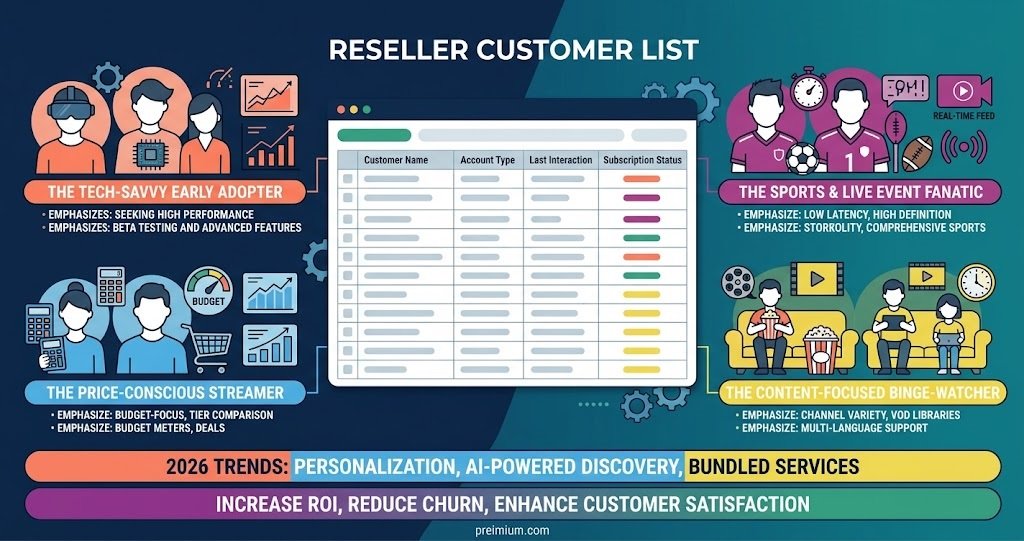
How IPTV Reseller Customer Segmentation Changes Your Pricing Decisions
The practical value of segmentation shows up fastest in pricing, because it stops you making one offer to a list of people who want different things.
Once you can see which customers came in on a promotion and which came in at full price, the discount question answers itself. You do not need to protect a repeat renewer with a price cut, because price is not why they are staying. Offering one anyway costs you margin on your safest income. Conversely, offering a small, time-limited move to a longer plan makes sense for price-led buyers, because their alternative is not paying more, it is leaving.
Package length is the other lever worth segmenting on. Annual plans improve your cash position and reduce the number of renewal conversations you have, but they also lock in whatever price you set today across a full year of IPTV credits you have not bought yet. A sensible approach is to push longer commitments towards customers who have already proved they stay, and keep newer accounts on shorter cycles until they have been through at least one clean renewal.
There is a limit here worth being honest about. Segmentation improves the odds of a pricing decision, it does not make the decision safe. Your credit costs, payment processing fees and refund rate still set the floor, and no amount of grouping raises a price the market will not bear. Work out what each group is worth over its full lifetime before you commit to a discount structure, otherwise you are optimising a number you have not measured.
Renewal Timing Belongs to the Segment, Not the Calendar
Most IPTV panel resellers send the same reminder, the same number of days before expiry, to everyone. Segmenting changes both the timing and the tone.
Repeat renewers generally need a short, plain notice close to the expiry date. They already intend to continue, and a long persuasive message aimed at someone who has renewed four times reads as slightly odd. New accounts need earlier contact and more context, because they may not remember exactly when their subscription started or what they bought. Price-led buyers need the earliest contact of all, since they are the group most likely to be comparing options, and the conversation you want to have with them happens before they start looking rather than after.
High-support accounts deserve a different call entirely. If someone has raised repeated issues, a renewal reminder that ignores the open problem lands badly. Resolve or acknowledge the issue first, then handle the renewal as a separate conversation. This is one of the clearest cases where segmentation prevents an automated process from damaging a relationship. If your reminder sequence is still uniform, it is worth reviewing how a renewal process is normally structured around expiry dates and then layering these differences on top.
Pro tip: Tag any customer whose renewal required a discount or an extra nudge. Two consecutive tags is a reliable signal that the account is price-led, regardless of what they told you at sign-up.
Reading Support Load as a Segment Signal
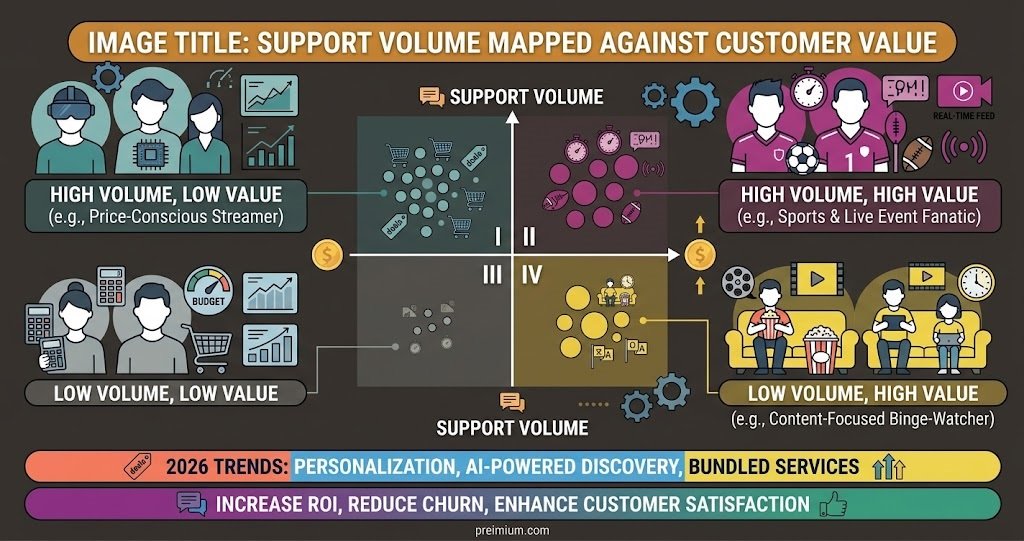
Support volume is the most underused segmentation input available to a reseller, because every message you receive carries information about the account that sent it.
| Signal | What it usually indicates | Practical response |
|---|---|---|
| Repeated buffering reports at the same time each evening | Home connection or peak-period capacity rather than the account itself | Check connection speed and device, then escalate to your supplier with timestamps |
| Frequent requests to reset or move connections | Account shared across more devices than the package allows | Clarify the connection limit, offer the correct package tier |
| Questions about basic navigation weeks after setup | Onboarding never completed properly | Resend setup guidance for their specific device, confirm it worked |
| Contact only when payment is due | Transactional relationship, low attachment | Treat as price-led, contact earlier before expiry |
The reason this matters commercially is simple. Time spent on IPTV support is unbilled, and a segment that consumes hours per month while paying a discounted rate is quietly unprofitable even though it never shows up as churn. Grouping by support load lets you see that before it becomes a pattern across dozens of accounts.
It also tells you where a one-off fix pays back repeatedly. If several customers in the same segment report the same device behaviour, the fix belongs in your setup instructions rather than in twenty separate conversations.
Where Segmentation Quietly Goes Wrong
The first failure is building too many groups. Eight segments feels thorough and produces nothing, because no IPTV reseller has the time to run eight different renewal sequences. If you cannot describe what you do differently for a segment in one sentence, delete it.
The second is segmenting once and never revisiting. Customers move between groups. A price-led buyer who has now renewed three times at full rate is no longer price-led, and treating them as such means offering discounts you did not need to offer. A monthly or quarterly review keeps the groups honest.
The third is confusing a segment with a judgement about the person. A high-support customer is not a difficult customer, they are usually a customer whose setup does not match their expectations. Fixing the mismatch often moves them straight into your most stable group.
The fourth is measuring segments without measuring the outcome. If you split your list and nothing changes in your renewal numbers over two or three cycles, the segmentation is decorative. Tracking how churn is calculated across your customer base per group rather than across the whole list is what turns segmentation from a filing exercise into something that affects income.
Reviewing Your Segments Without Turning It Into Admin
A review should take under an hour. Pull a fresh export, check which customers have moved, and look for groups that are growing faster than you expected. A price-led segment expanding month on month usually means your acquisition is running on promotions rather than on the service itself, which is worth knowing before it becomes the majority of your list.
Watch for segments that shrink for good reasons too. New accounts converting into repeat renewers is the movement you actually want, and it is the clearest evidence that your onboarding and your supplier quality are both holding up.
Monthly Segment Review Checklist
- Re-export active and expired lines from the reseller panel
- Move any customer who has completed a second unprompted renewal into the repeat group
- Flag accounts that needed a discount to renew for the second time running
- Count support messages per segment, not per customer
- Compare non-renewals in each group against the previous month
- Remove any segment you took no action on during the month
- Note any repeated technical issue appearing across more than two accounts
Frequently Asked Questions
How many customers do I need before segmentation is worth doing?
There is no hard threshold, but below roughly twenty or thirty active lines you already know each customer individually and formal segments add overhead without adding insight. The value appears when you can no longer recall a given customer’s history from memory.
Should I segment by device type?
Only as a support diagnostic, not as a commercial segment. Device type tells you which setup guide to send and which issues to expect, but it does not predict renewal behaviour or price sensitivity, which are the two things pricing decisions depend on.
What if a customer fits two segments at once?
That is normal and usually useful. Record both attributes rather than forcing a single label, then decide which one drives the action you are taking. For a renewal message, the payment behaviour matters more. For a support response, the ticket history matters more.
Can I use segmentation to justify charging different customers different prices?
You can vary offers by group, but be careful about how visible the difference is. Customers talk to each other, particularly when they were referred by someone already on your list. Time-limited offers and plan-length discounts are easier to explain than two customers paying different amounts for the same package indefinitely.
Does segmentation help with sub-resellers as well?
Yes, though the signals differ. For sub-resellers you are watching credit consumption rate, how often they request support escalation and whether their own customer base is growing or churning. A sub-reseller whose credit usage is flat for several months is a retention risk in the same way a dormant subscriber is.
Bringing It Together
IPTV Reseller Panel Customer Segmentation is worth doing because it replaces one generic approach to your entire list with three or four specific ones, each based on behaviour your panel and your inbox already record. Group by renewal history, price sensitivity and support load, act differently on each, and review the groups often enough that customers who have changed are not still being treated as who they were six months ago.
It will not fix a supplier problem, and it will not make an unprofitable price sustainable. What it does is stop you spending discount margin on customers who were never going to leave, and stop you losing customers who needed a conversation you did not know to have.
The sensible next step is a single export from your reseller dashboard with two added columns for actual price paid and message count. Sort by those, see which groups appear, and build your segments from what is genuinely in front of you rather than from a model borrowed from another business.