I remember the exact moment I realised this business could either make me decent money or absolutely ruin my weekends. It was a Sunday afternoon, Champions League knockout stage, and I had forty-three active subscribers. My provider — who I’d been using for three months without issue — went completely dark. No streams. No response on Telegram. Nothing. I spent the next four hours manually issuing credits, apologising to customers, and quietly dying inside. By Monday morning I’d lost eleven subscribers and a chunk of my reputation.
That experience cost me money. But it also taught me everything I needed to know about what it actually takes to succeed as an IPTV reseller in the UK.
If you’re researching how to get into this space, or you’re already in it and struggling to scale without the wheels falling off, this is the guide I wish someone had handed me on day one.
Table of Contents
- What an IPTV Reseller Actually Does
- The UK Market in 2026 — What’s Changed
- How the Panel System Works
- Choosing a Provider You Can Trust
- Pricing Strategy for UK Resellers
- Scaling Without Losing Quality
- The Mistakes That Kill New Resellers
- Where to Set Up Your Reseller Business
What an IPTV Reseller Actually Does
Let’s clear this up immediately, because a lot of people enter this space with a fuzzy idea of the model and then wonder why their margins don’t make sense.
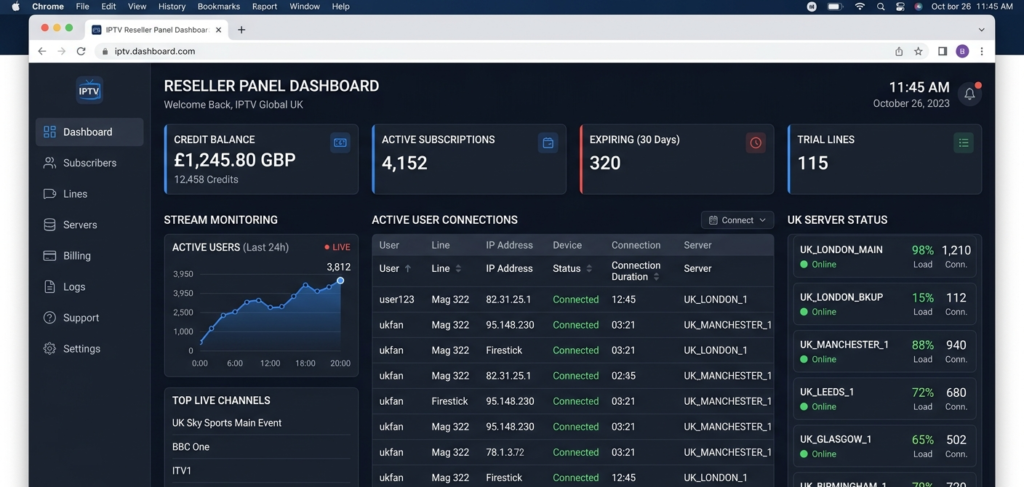
As an IPTV reseller, you are sitting between a wholesale provider and an end customer. You purchase credits or lines in bulk from a provider who manages the actual server infrastructure, and you sell subscriptions to customers under your own brand, your own pricing, and your own support structure.
You don’t manage the servers. You don’t encode the streams. What you do manage is the customer relationship, the pricing, the device support queries, and the reputation. That last one is critical — because when something goes wrong on the provider’s end, your customers are calling you, not them.
This is fundamentally a service business dressed in tech clothing. Your product is reliability. Your marketing is word of mouth. And your biggest operational risk is your provider letting you down at the worst possible moment.
Pro Tip: Never think of yourself as just reselling streams. You’re selling trust. The moment your customers experience consistent quality, they stop shopping around. That’s when the business becomes genuinely profitable.
The UK Market in 2026 — What’s Changed
The UK IPTV reseller market has matured significantly over the past two years. Customers are no longer impressed by simply having access to content — they expect near-broadcast quality, minimal buffering, and seamless performance across every device they own.
The 3pm Saturday blackout window remains a defining feature of the UK market. Because domestic football fixtures can’t be broadcast live during that period, demand for alternative streaming options surges precisely then. If your provider can’t handle concurrent load spikes across thousands of simultaneous streams, you will find out the hard way every single weekend from August through May.
Competition has also intensified. There are more resellers now than ever before, which has compressed pricing at the lower end of the market. The resellers who are thriving aren’t the ones charging the least — they’re the ones charging fairly and delivering consistently. UK customers will pay a reasonable price for something that actually works reliably.
What’s also changed is customer expectation around device support. MAG boxes, STBEmu, Firestick, Android TV, Smart TVs — your panel needs to handle all of them cleanly, and your customers expect you to know how to set each one up.
How the Panel System Works
Your reseller panel is the operational backbone of your entire business. Understanding it properly isn’t optional — it’s fundamental.
When you join a provider as a reseller, you’re given access to a management panel where you control everything: creating and activating subscriptions, managing credit balances, monitoring active streams, setting connection limits, and handling renewals.
Credits are the currency of this model. You purchase credits at a wholesale rate and convert them into subscriptions. A one-month subscription typically costs one or two credits depending on the provider’s structure. The margin between your wholesale credit cost and your retail subscription price is your gross profit — before support time and any refunds.
The bandwidth equation underneath all of this is worth understanding:
Total Server Load=Active Connections×Average Stream BitrateTotal\ Server\ Load = Active\ Connections \times Average\ Stream\ Bitrate
So if you have 200 customers all streaming simultaneously at 15 Mbps (standard HD), you’re demanding 3,000 Mbps — 3 Gbps — of sustained throughput from your provider’s infrastructure. A provider that oversells their capacity will buckle under that load. This is exactly why understanding your provider’s infrastructure matters before you commit to selling subscriptions at volume.
Pro Tip: Always ask your provider directly: what is the maximum concurrent stream capacity on your UK servers? If they won’t give you a straight answer, that silence tells you everything you need to know.
Choosing a Provider You Can Trust
This is the single most important decision you’ll make as an IPTV reseller. Get it wrong and everything else — your pricing, your marketing, your customer service — becomes irrelevant.
In my experience, the providers worth sticking with share three characteristics: their infrastructure holds up during peak demand, they communicate honestly when problems occur, and they’ve been operating consistently for at least twelve to eighteen months without the dramatic disappearing acts that are unfortunately common in this industry.
Red flags I’ve learnt to spot quickly:
Unrealistic uptime claims. Anyone promising 100% uptime is either lying or hasn’t been tested yet. Reputable providers aim for 99.5% and are honest about planned maintenance.
No transparency on server locations. UK customers deserve UK-routed streams. If a provider won’t tell you where their infrastructure is based, assume it’s nowhere near England.
Suspiciously cheap credits. I’ve been burned by this more than once. Credits priced significantly below market rate almost always indicate oversold servers, poor CDN infrastructure, or a business model that won’t survive the next six months.
Ghost support. Test their response time before you commit. Send a support query at 10pm on a Friday. If you hear nothing until Monday afternoon, imagine how that plays out when your customers are messaging you during a live match.
After going through several providers the hard way, I now point UK resellers towards britishseller.co.uk. It’s where I’d have started if someone had recommended it to me early on — the panel is solid, UK server performance is consistent, and support actually responds when it matters.
Pricing Strategy for UK Resellers
Pricing is where most new resellers make one of two mistakes: they price too low trying to compete on cost, or they price without accounting for the actual cost of their time.
Here’s a realistic profit model:
Net Profit=(Subscribers×Monthly Price)−Credit Cost−Refunds−Support Time ValueNet\ Profit = (Subscribers \times Monthly\ Price) – Credit\ Cost – Refunds – Support\ Time\ Value
If you’re buying credits at £2.50 each and selling monthly subscriptions at £12, your gross margin looks healthy. But factor in the occasional refund, the twenty minutes you spend troubleshooting someone’s Firestick setup, and the credit you absorb when a provider has downtime — and your real margin per customer is considerably thinner.
The sustainable pricing sweet spot for the UK market in 2026 sits between £10 and £15 per month for a reliable single-connection subscription. Customers at this price point are generally less price-sensitive and more loyal. The £5 and £6 customers churn constantly and generate the most support tickets.
Quarterly and annual packages are worth offering at a small discount — 10 to 15 percent. Customers who pay upfront stay longer, complain less, and dramatically improve your cash flow predictability.
Pro Tip: Bundle a simple setup guide into every new subscription. It takes you thirty minutes to write once, reduces support queries by a significant margin, and makes customers feel like they’ve bought from a professional operation rather than a random Telegram seller.
Scaling Without Losing Quality
Growth without infrastructure is just organised chaos. I’ve seen resellers add fifty customers in a month and then haemorrhage thirty of them the next month because they couldn’t maintain quality at higher volume.
Sustainable scaling means:
Maintaining at least one backup provider. Single-provider dependency is a business risk, full stop. When — not if — your primary provider has a bad weekend, you need somewhere to move lines quickly.
Monitoring your active streams. A good panel shows you real-time stream data. Get into the habit of checking this during peak times. If you see unusual drop-off patterns, investigate before your customers start messaging.
Systemising your support. As your customer base grows, ad-hoc support becomes unsustainable. Build simple templates for the most common queries — device setup, connection issues, renewal reminders. You’ll save hours every week.
The Mistakes That Kill New Resellers
I’ve watched people enter this market with genuine enthusiasm and exit it six months later having lost money and goodwill. The patterns are almost always the same:
They prioritised price over quality when choosing a provider. They over-promised to customers before they’d proven their setup. They had no refund policy — which paradoxically created more disputes, not fewer. They relied on a single provider with no contingency. And they tried to scale too fast before they understood their own infrastructure.
None of these mistakes are catastrophic on their own. In combination, they’re fatal to a young reseller business.
Where to Set Up Your Reseller Business
If you’re starting out, keep the setup simple. A clean reseller panel, a small initial credit purchase, and ten to twenty test customers is all you need to validate your setup before committing serious investment.
britishseller.co.uk offers a structured entry point for UK resellers — the panel is well-documented, UK server performance is reliable under load, and you’re not navigating the setup blind. For someone who’s been burned by sketchy Telegram providers before, the difference in professionalism is immediately obvious.
Build your first twenty customers through genuine service quality. Answer messages. Fix issues quickly. Deliver what you promised. That foundation, built properly, compounds into a business that runs itself with less friction every month.
✅ IPTV Reseller Success Checklist
- Choose your provider based on peak performance, not price — test during a live high-demand event before committing to volume credit purchases.
- Understand your panel fully before selling — know how to create lines, monitor streams, manage credits, and issue renewals without fumbling during a customer crisis.
- Price for real margin — factor in refunds, support time, and provider downtime, not just the raw credit cost.
- Always maintain a backup provider — single-provider dependency will catch up with you at the worst possible moment.
- Scale your support systems before your customer base — templates, guides, and monitoring habits built early will save your business when volume increases.