A customer messaged me on a Tuesday evening, furious. He’d specifically asked me before subscribing whether my service supported 4K. I said yes — because technically, the provider I was using at the time claimed to offer it. What I hadn’t done was actually test it properly. He’d bought a brand new 65-inch 4K television, set everything up, and was getting a pixelated, constantly buffering mess that looked worse than standard definition. He wanted a full refund and made sure to tell me exactly what he thought of my service in the process.
That was the moment I stopped taking provider marketing claims at face value and started actually understanding what 4K IPTV delivery requires — technically, infrastructurally, and from a reseller’s perspective. It’s not a simple upgrade. It’s a different tier of service entirely, and selling it without understanding it is a fast track to refund disputes and damaged reputation.
Here’s everything I know about 4K IPTV in the UK market — the real version, not the sales pitch.
Table of Contents
- What 4K IPTV Actually Means (Not the Marketing Version)
- Why 4K Puts Unique Pressure on UK Infrastructure
- Device Compatibility — What Your Customers Actually Need
- How to Evaluate Whether Your Provider Can Deliver 4K
- Pricing 4K IPTV Subscriptions for the UK Market
- The Bandwidth Maths Every Reseller Should Understand
- Common 4K IPTV Failures and How to Avoid Them
- Should You Offer 4K IPTV Right Now?
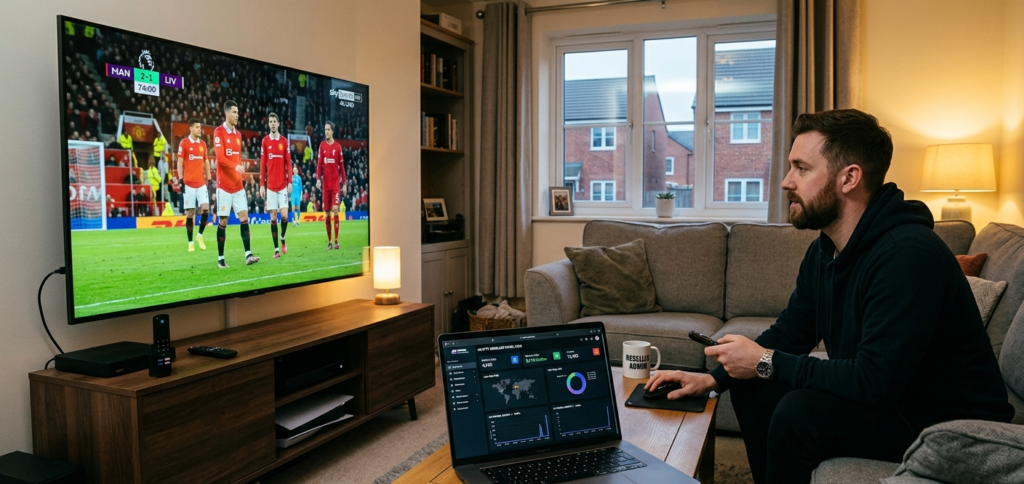
What 4K IPTV Actually Means (Not the Marketing Version)
Let’s start with something a lot of resellers gloss over: not all 4K is equal, and providers who slap “4K” on their panel listings aren’t always delivering what that label implies.
True 4K content — also called Ultra High Definition or UHD — operates at a resolution of 3840 x 2160 pixels. That’s four times the pixel count of standard 1080p HD. To stream it cleanly without compression artefacts or buffering, you need significantly higher bitrates, better CDN infrastructure, and customers who have both a 4K-capable device and a sufficiently fast internet connection on their end.
What some providers actually deliver when they say “4K” is upscaled HD content — standard 1080p that’s been stretched to fill a 4K resolution. It looks marginally better on large screens but it is not true 4K. If you’re selling a premium-priced subscription on the basis of 4K quality, your customers with high-end televisions will notice the difference immediately.
In my experience, the honest question to ask any provider isn’t “do you offer 4K?” It’s “what is the source bitrate of your 4K streams, and where is the content encoded?” Those two questions will tell you far more than any marketing claim.
Pro Tip: Request a 4K test line from your provider and play it on an actual 4K television — not a laptop screen or a 1080p monitor. What looks acceptable on a smaller screen becomes obviously inadequate on a 55-inch or larger display where your customers will actually be watching.
Why 4K Puts Unique Pressure on UK Infrastructure
The UK IPTV market already has a stress problem. Premier League weekends, major European football nights, boxing events — these create simultaneous demand spikes that expose every weakness in a provider’s infrastructure. Now layer 4K on top of that, and the pressure multiplies significantly.
A standard HD stream typically runs at 8 to 10 Mbps. A genuine 4K stream with HDR encoding runs at 25 Mbps or higher. That’s roughly three times the bandwidth per connection. So if a provider’s UK servers can handle 1,000 simultaneous HD streams comfortably, that same infrastructure can realistically only support around 300 to 350 simultaneous 4K streams before performance degrades.
This is why the 3pm Saturday blackout window is a particularly dangerous testing ground for 4K. Every customer who can’t access official broadcast coverage during that period and is streaming a 4K alternative is hammering your provider’s CDN simultaneously. Providers who haven’t specifically built their UK server capacity for 4K concurrent load will buckle — and you’ll be the one handling the complaints.
The fibre broadband picture in the UK also matters here. While full-fibre coverage has expanded considerably, a meaningful portion of UK households — particularly in rural areas — are still on ADSL or part-fibre connections that struggle to sustain 25 Mbps consistently. If your customer base includes anyone outside major urban centres, 4K may genuinely not be a suitable product for them regardless of your provider’s capabilities.
Device Compatibility — What Your Customers Actually Need
This is where a significant chunk of 4K-related support queries originate, in my experience. Customers assume that because their television is 4K, everything else in the chain is automatically compatible. It rarely is.
For genuine 4K IPTV playback, your customer needs:
A 4K-capable streaming device. A standard Firestick will not output 4K. They need a Firestick 4K, Firestick 4K Max, or equivalent Android TV box with 4K output capability. MAG boxes need to be a 4K-compatible model — older MAG 254 or 256 units are not suitable.
An HDMI 2.0 or higher cable. The stream can be perfect and the device can support 4K, but an old HDMI 1.4 cable creates a bottleneck that prevents proper 4K output. This is a support query I’ve received more than once from frustrated customers.
STBEmu Pro or a capable media player. The free version of STBEmu has limitations that affect 4K playback quality. STBEmu Pro handles higher bitrate streams considerably better, and it’s worth recommending this to customers specifically purchasing 4K subscriptions.
Sufficient broadband speed. As a minimum, 30 Mbps download speed for reliable 4K streaming. For households with multiple simultaneous users, 50 Mbps or above is a more realistic recommendation.
Pro Tip: Build a simple 4K compatibility checklist that you send to every customer purchasing a 4K subscription. It takes five minutes to create and eliminates a majority of the support queries you’d otherwise receive in the first week.
How to Evaluate Whether Your Provider Can Deliver 4K
Most providers will say yes when you ask if they support 4K. That answer is functionally meaningless without further investigation. Here’s what I actually look for:
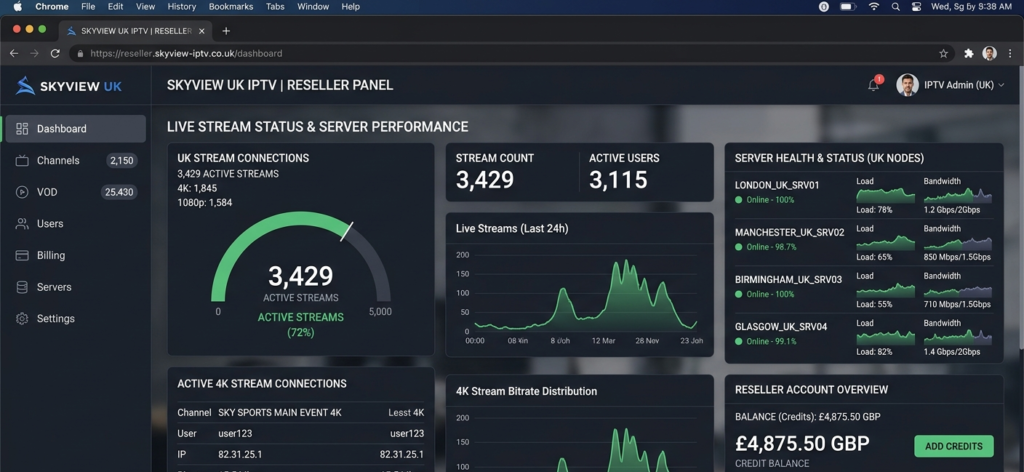
Dedicated 4K server infrastructure. Quality providers separate their 4K content delivery from standard HD streams. If a provider is running 4K content through the same servers and CDN as their HD streams without differentiation, the 4K quality will be inconsistent at best.
Consistent bitrate under load. This is the critical test. Request a 4K test line and monitor it during a high-demand period — a weekend evening, or ideally during a major live event. If the stream holds 25 Mbps or above consistently without dropping to compensated lower quality, the infrastructure is credible.
Anti-freeze capability on 4K streams. Anti-freeze technology is more important for 4K than for HD because the consequences of a stream stall are more visible and more disruptive at higher resolutions. Ask specifically whether their anti-freeze system operates on 4K streams.
Honest answers to direct questions. In my experience, providers who actually have solid 4K infrastructure will answer technical questions confidently and specifically. Vague responses about “premium servers” and “next-generation CDN” without actual numbers are a warning sign.
Pricing 4K IPTV Subscriptions for the UK Market
4K should command a price premium — and here’s how to think about the margin structure:
4K Margin=(4K Subscription Price−Credit Cost)−(Expected Refund Rate×Subscription Price)4K\ Margin = (4K\ Subscription\ Price – Credit\ Cost) – (Expected\ Refund\ Rate \times Subscription\ Price)
If you’re paying 20 to 30 percent more per credit for 4K lines and pricing your subscriptions at £15 to £18 per month (versus £10 to £12 for HD), your gross margin should remain healthy. The mistake is pricing 4K identically to HD — you’re delivering more bandwidth, more infrastructure cost, and potentially more support overhead. The pricing should reflect that.
Customers willing to pay for 4K are generally less price-sensitive than the bottom-of-market HD crowd. They’ve invested in good hardware and they expect good service. That’s actually a better customer profile for a reseller — they stay longer, complain less about price, and are more likely to refer others who share similar expectations.
Pro Tip: If you’re offering both HD and 4K tiers, make the upgrade price feel reasonable rather than punishing. A £3 to £5 monthly difference between HD and 4K is easy for customers to justify. A £10 difference makes them question whether 4K is worth it at all.
The Bandwidth Maths Every Reseller Should Understand
Understanding the numbers behind 4K delivery makes you a more credible operator and helps you have honest conversations with both providers and customers:
Required Bandwidth=Active 4K Streams×25 Mbps per StreamRequired\ Bandwidth = Active\ 4K\ Streams \times 25\ Mbps\ per\ Stream
So 50 simultaneous 4K customers requires 1,250 Mbps — 1.25 Gbps — of dedicated 4K bandwidth from your provider. Scale that to 200 customers and you’re looking at 5 Gbps. These are serious infrastructure numbers, and any provider unable to articulate how they handle this capacity shouldn’t be trusted with your 4K reseller business.
Common 4K IPTV Failures and How to Avoid Them
The failure patterns I see repeatedly among resellers who’ve attempted 4K without proper preparation:
Overselling before testing. Promoting 4K subscriptions before stress-testing the provider during peak demand. The result is always the same — complaints during the first major live event.
Ignoring device limitations. Not verifying customer device compatibility upfront. A customer with an incompatible streaming device will blame the service, not their hardware.
No separate 4K pricing tier. Absorbing higher infrastructure costs without adjusting pricing, which erodes margins and makes 4K unsustainable to offer long-term.
Trusting provider uptime claims without verification. A provider claiming 99.9% uptime on 4K streams should be able to show you monitoring data. If they can’t, the claim is decorative.
Should You Offer 4K IPTV Right Now?
Honestly? Only if your provider can genuinely deliver it and your customers have the hardware to receive it properly. Offering 4K as a marketing differentiator when the underlying infrastructure can’t support it is worse than not offering it at all — you’re actively creating disappointed customers.
If you want to test the waters, britishseller.co.uk is a solid starting point for UK resellers exploring 4K. The panel structure supports tiered subscription management, the UK server performance is consistent enough to handle higher bitrate streams, and you’re not going in blind on the infrastructure side.
Start with a small cohort of technically capable customers — people you know have good broadband and appropriate 4K devices. Prove the delivery chain works before scaling it as a product line.
✅ IPTV Reseller Success Checklist
- Test 4K streams on an actual 4K television during peak traffic — not on a laptop, not during a quiet weekday. Real conditions only.
- Verify customer device and broadband compatibility before activation — a short checklist shared at signup eliminates most first-week support queries.
- Price 4K at a genuine premium — factor in higher credit costs, increased support overhead, and expected refund rates.
- Ask providers specific technical questions — source bitrate, CDN structure, anti-freeze capability on 4K streams. Vague answers are disqualifying.
- Start small and validate before scaling — ten happy 4K customers who renew monthly are worth more than fifty who refund after the first weekend.