It was a Champions League knockout night. My subscriber count had just crossed 200 — a milestone I’d been quietly proud of — and everything was ticking along nicely. Then, at roughly the 70-minute mark of a genuinely gripping match, my WhatsApp erupted. Streams were buffering. Not for one or two customers — for nearly a third of my base simultaneously. The provider I’d been using for four months had oversold their server capacity, and on the biggest viewing night of the week, the entire thing buckled.
That night taught me more about IPTV stream infrastructure than any forum post or YouTube tutorial ever could. Because when a stream fails, it doesn’t matter how good your pricing is, how slick your panel looks, or how responsive your support is. The customer experience is defined entirely by what comes out of their screen — and if that experience is a spinning buffer icon, you’re losing them.
Table of Contents
- What Actually Determines IPTV Stream Quality
- Server Infrastructure — The Foundation Everything Else Sits On
- Anti-Freeze Technology — Why It’s No Longer Optional
- Stream Formats, Protocols, and Device Compatibility
- Diagnosing Buffering — Yours or Theirs?
- Building a Stream-Reliable Reseller Business
- What to Look for in a Panel That Protects Your Streams
1. What Actually Determines IPTV Stream Quality
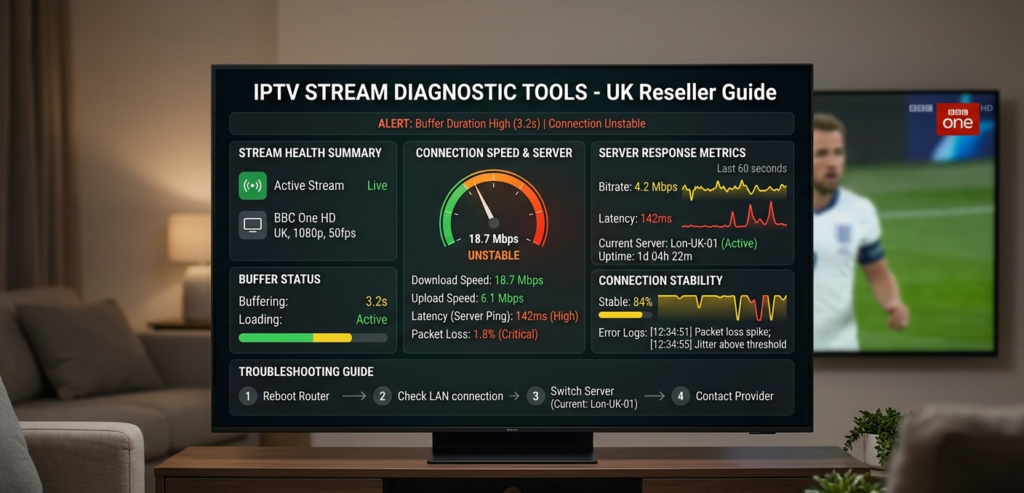
Most resellers, when they first get into this business, assume stream quality is purely a content issue — something that sits entirely on the provider’s side. In reality, IPTV stream quality is the product of at least four distinct variables, and as a reseller, you’re accountable for all of them in your customer’s eyes.
Server capacity and load is the primary factor. A server handling 500 concurrent streams comfortably will degrade noticeably when pushed to 700. Providers who oversell their infrastructure — and many do, because it’s profitable until it isn’t — create exactly this scenario during peak demand.
Routing and latency determines how efficiently the stream travels from origin to viewer. A UK-based subscriber pulling an IPTV stream through poorly optimised routing adds unnecessary hops to the delivery chain, each one introducing potential delay and packet loss.
Encoding quality affects how much bandwidth a stream requires to deliver acceptable picture quality. Poorly encoded streams either look terrible at moderate bitrates or demand excessive bandwidth to look acceptable.
End-user connection quality is the variable you control least, but need to understand best — because you’ll be the one explaining it when customers report issues that have nothing to do with your panel.
Pro Tip: When a customer reports buffering, your first diagnostic question should always be about their internet connection speed and whether the issue occurs on all devices or just one. This one question will save you hours of unnecessary troubleshooting on your end.
2. Server Infrastructure — The Foundation Everything lse Sits On
I’ll be direct: the single most important decision you make as an IPTV reseller is which provider’s server infrastructure you stake your business on. Everything else — panel features, credit pricing, customer support tools — is secondary.
UK viewers are extraordinarily demanding by the standards of the global IPTV market. The concentration of live sport, particularly Premier League football, creates demand spikes unlike almost any other market. During a full round of Saturday fixtures, concurrent stream numbers can jump three to four times their midweek baseline within minutes of kick-off. Servers that aren’t architected for this kind of elastic demand will fail — not occasionally, but repeatedly and predictably.
What separates robust infrastructure from inadequate infrastructure comes down to a few specific characteristics:
Geographic distribution — Quality IPTV stream providers run multiple server clusters across different locations, allowing traffic to be distributed intelligently based on demand and proximity to the viewer.
Dedicated bandwidth allocation — Shared bandwidth arrangements, where your provider’s IPTV streams compete with other traffic types on the same pipe, are a serious red flag. Dedicated uplinks ensure your streams aren’t deprioritised during peak periods.
Scalable capacity — The ability to bring additional server resources online quickly in response to demand spikes is what separates providers who handle major fixture weekends gracefully from those who buckle under them.
Pro Tip: Ask any prospective panel provider what their busiest concurrent stream count was in the last 90 days, and what their server capacity ceiling is. The ratio between those two numbers tells you exactly how much headroom you have before things start degrading.
3. Anti-Freeze Technology — Why It’s No Longer Optioal
Two years ago, anti-freeze was a differentiating feature. In 2026, it’s the baseline expectation of any IPTV stream platform worth using in the UK market.
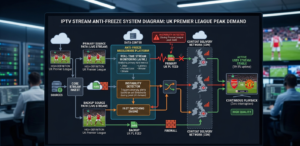
The technology works by continuously monitoring stream health at the delivery level. When a stream shows early signs of instability — packet loss, rising latency, source server instability — the system automatically switches to a backup stream source before the viewer experiences any visible interruption. Done properly, the viewer never knows it happened.
Without anti-freeze, stream recovery depends on the player app detecting the failure, attempting to reconnect, and the source server responding — a process that typically takes five to fifteen seconds of visible buffering. During a penalty shootout or a last-minute goal, that’s not a technical inconvenience. It’s a customer you’re losing.
The implementation quality varies significantly between providers. Some anti-freeze systems are genuinely seamless. Others introduce a brief visible stutter during the source switch that, while better than full buffering, still creates moments of frustration. When evaluating a panel, test specifically for anti-freeze performance during simulated high-demand scenarios.
4. Stream Formats, Protocols, and Device CompatibilityThe UK IPTV market runs across a genuinely diverse range of devices, and your stream delivery needs to accommodate all of them without compromise.
HLS (HTTP Live Streaming) is the most widely supported protocol, compatible with virtually every Smart TV, mobile device, and browser-based player. It’s reliable and broadly compatible but introduces slightly more latency than alternatives due to its segmented delivery approach.
MPEG-TS over UDP offers lower latency and is preferred by many MAG box setups and dedicated IPTV players. It requires more stable network conditions but delivers a tighter, more responsive stream experience when those conditions are met.
Xtream Codes API has become the universal connection standard for app-based IPTV players including TiviMate, IPTV Smarters, and GSE Smart IPTV. Any panel you use must support Xtream Codes natively — without it, you’re excluding the majority of your potential customer base.
M3U playlist support remains essential for customers running certain Smart TV apps, computer-based players, and setups that don’t support Xtream Codes directly.
MAG and STBEmu portal support handles the set-top box and emulator customer segment — a meaningful portion of the UK market, particularly among customers who’ve been using IPTV services for several years.
The profit impact of device compatibility is straightforward to model:
Addressable Market=Total Potential Subscribers×Device Compatibility Rate\text{Addressable Market} = \text{Total Potential Subscribers} \times \text{Device Compatibility Rate}
A panel supporting only two of the five major device categories is functionally cutting your addressable market in half. Every compatibility gap is direct revenue you’re leaving on the table.
5. Diagnosing Buffering — Yours or Theirs?
This is a skill that separates experienced resellers from those constantly drowning in support requests. Not all buffering is your problem — but until you can prove that clearly and quickly, your customer assumes it is.
Provider-side buffering typically affects multiple customers simultaneously, appears during peak viewing hours, and correlates with high-demand events. If your panel has any form of stream monitoring, you’ll often see latency or error metrics spike before customer complaints begin arriving.
Customer-side buffering is usually isolated to a single subscriber, affects only certain devices, and persists outside of peak hours. Common causes include weak Wi-Fi signal, ISP throttling of streaming traffic, or an underpowered device struggling to decode higher-bitrate streams.
VPN interference is increasingly common as some ISPs have begun throttling traffic patterns associated with IPTV streaming. A customer adding a VPN to their setup can either resolve the issue or create new ones depending on the VPN’s server quality and routing.
Pro Tip: Build a simple two-question diagnostic into your support process: “Does this happen on all your devices, or just one?” and “Does it happen at all times of day or mainly during evenings and weekends?” These two answers will resolve 80% of your support cases faster than any technical investigation.
6. Building a Stream-Reliable Reseller Business
The resellers building genuinely durable businesses in 2026 have made peace with one truth: you cannot compete on price alone in a market where stream quality is the deciding factor for every customer renewal decision.
Reliability commands premium pricing. Customers who’ve experienced consistent, buffer-free IPTV stream quality don’t shop around on price — they renew quietly and, if you’re lucky, refer people. Customers on unreliable panels shop constantly, churn constantly, and leave negative feedback wherever they can find an audience.
The economics of reliability are clear:
Annual Revenue per Subscriber=Monthly Price×Average Retention Months\text{Annual Revenue per Subscriber} = \text{Monthly Price} \times \text{Average Retention Months}
A subscriber paying £10/month who stays for 14 months generates £140. A subscriber paying £8/month who churns after 3 months generates £24. The maths isn’t complicated — but it does require that your stream quality is good enough to justify the retention.
7. What to Look for in a Panel That Protects Your Streams
After testing more panels than I care to count over the years, the checklist for stream-reliable infrastructure has become fairly consistent for me.
You need anti-freeze as a native feature, not an add-on. You need UK or EU server infrastructure with verifiable latency to British ISPs. You need full protocol support across Xtream Codes, M3U, and MAG/STBEmu. And you need a provider willing to be transparent about their capacity, their uptime record, and their failover architecture.
Britishseller.co.uk ticks those boxes in a way that most panels in this space simply don’t. It’s built specifically for the UK reseller market, the infrastructure is designed for the demand profile that Premier League seasons create, and the panel gives you proper control over your subscriber base without the opacity that plagues so many providers. If stream reliability is your priority — and it should be — it’s where I’d point you first.
✅ IPTV Reseller Success Checklist
- Verify anti-freeze capability before committing — Test specifically during live sport, not during off-peak hours when any server performs adequately.
- Confirm full protocol support — Your panel must handle Xtream Codes API, M3U playlists, and MAG/STBEmu portal connections without workarounds or limitations.
- Build a two-question support diagnostic — Distinguish provider-side stream issues from customer-side issues quickly to protect your time and your reputation.
- Calculate retention economics before setting your price — A slightly higher price with strong retention will always outperform a lower price with high churn over any 12-month period.
- Stress-test during peak demand — Run your trial evaluation during a Premier League fixture weekend. That’s the only honest test of whether a panel will hold up when it actually matters.