Three years into running my IPTV reseller operation, I made the mistake of switching providers mid-season. The new panel looked slicker, the credits were cheaper, and the salesperson on Telegram was incredibly convincing. Two weekends later, during a particularly high-stakes Premier League fixture, streams across my entire subscriber base froze simultaneously. My phone didn’t stop for four hours. I lost eleven customers that week and spent the next month rebuilding trust I’d spent a year earning.
That’s the reality of working with IPTV services in the UK. The decisions you make about infrastructure don’t just affect your revenue — they define your reputation. And in this market, reputation is everything.
Table of Contents
- What UK Resellers Actually Mean by “IPTV Services”
- The Infrastructure Behind Every Subscription You Sell
- How to Evaluate an IPTV Service Before Committing
- Pricing, Credits, and Building Real Profit Margins
- The Technical Side You Can’t Afford to Ignore
- Mistakes That Kill IPTV Reseller Businesses
- Building a Sustainable IPTV Service Business in 2026
1. What UK Resellers Actually Mean by “IPTV Services”
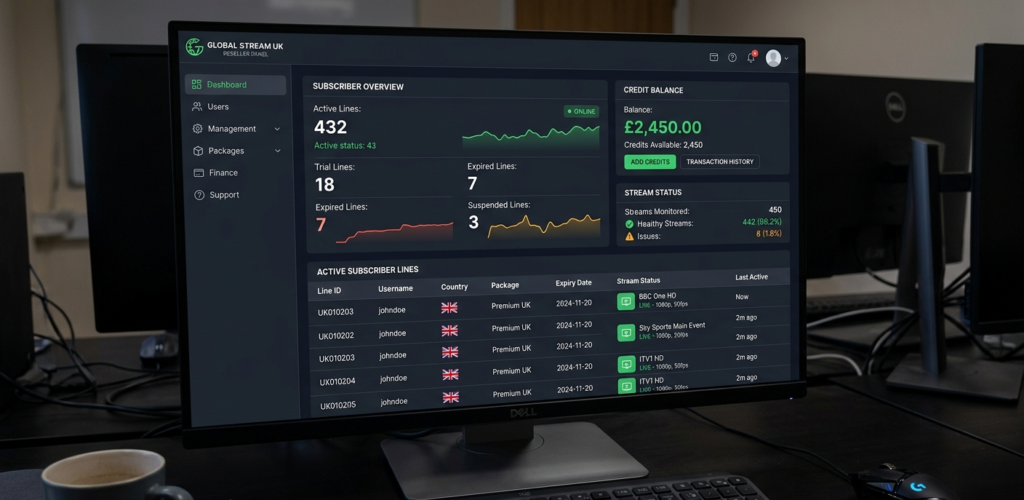
When someone types “IPTV services” into Google, they’re usually a consumer looking for something to watch. But when a reseller uses that phrase, they mean something far more layered — the entire ecosystem of panels, middleware, stream delivery, device compatibility, and customer management tools that sits between an upstream provider and a paying subscriber.
You are not just reselling a stream. You are operating a service business. That means support, reliability, uptime guarantees, and consistent quality — especially during the moments when it matters most. In the UK, those moments are almost entirely tied to live sport. The appetite for football, in particular, drives the peaks and valleys of this entire industry.
I’ve seen resellers treat IPTV services like a pure arbitrage play — buy cheap, sell higher, pocket the difference. That approach works fine until the first major match weekend. Then it collapses spectacularly.
Pro Tip: Think of your IPTV service offering like a mobile network contract. Your customers expect it to work every time, without excuses. The moment reliability becomes inconsistent, they start looking elsewhere — and they won’t tell you they’re leaving.
2. The Infrastructure Behind Every Subscription You Sell
Understanding what sits behind IPTV services isn’t optional knowledge — it’s essential for anyone serious about building a sustainable reseller business.
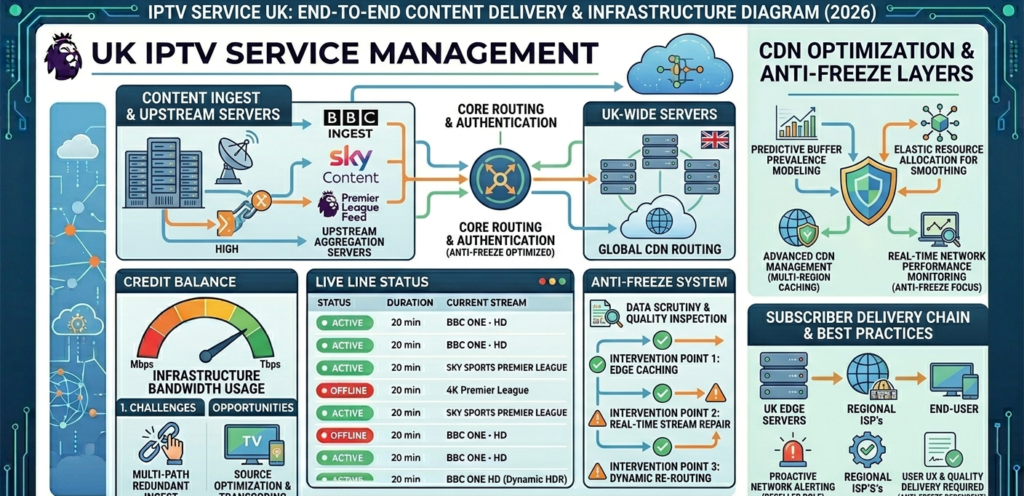
Content Delivery Networks (CDNs) are the backbone of any quality IPTV service. A provider using a properly distributed CDN can route traffic intelligently, balancing load across multiple servers to prevent any single point of failure. Providers without this are essentially running everything through one or two servers — which is fine on a quiet Tuesday, and catastrophic on a Saturday afternoon with multiple fixtures running simultaneously.
UK-based or EU-hosted servers make an enormous difference to your customers’ experience. Latency between a viewer in Birmingham and a server in London is negligible. Latency between that same viewer and a server in Southeast Asia is not. Buffering, pixelation, and stream drops are often not content problems — they’re routing problems. And routing problems are almost always a consequence of poor server geography.
Anti-freeze systems have become a genuine differentiator among IPTV services in 2026. The technology works by monitoring stream health in real time and switching to a backup source before the viewer even registers a problem. Panels without anti-freeze rely on the stream recovering on its own — which during high-demand moments, it simply won’t.
3. How to Evaluate an IPTV Service Before Committing
This is where most new resellers get it badly wrong. They evaluate based on price and channel count — neither of which tells you anything meaningful about reliability.
Here’s the framework I use whenever I’m assessing a new IPTV service or panel provider:
Uptime commitment and track record. Any serious provider should be able to tell you their uptime percentage over the past 90 days. Anything below 99% is worth scrutinising carefully. At 97% uptime, you’re looking at roughly 22 hours of downtime per month — distributed across weekends, evenings, and match days, that’s a service that will generate complaints constantly.
Failover capability. What happens when a server goes down? Does traffic automatically reroute to a backup, and how quickly? A provider without a clear failover answer doesn’t have one.
Trial conditions. Legitimate IPTV service providers at the panel level will allow you to test properly — not a 30-minute window, but a proper evaluation period covering at least one live sporting event. If they won’t allow that, they know what you’d discover.
Concurrent connection limits. Some panels artificially restrict how many streams can run simultaneously per line. If your customers share accounts or try to watch on multiple devices, this creates friction and support headaches.
Pro Tip: Run your trial test during a Friday evening or Saturday afternoon when Premier League fixtures are live. That’s your real stress test. A panel that performs well at 2pm on a Wednesday tells you almost nothing about how it’ll handle peak demand.
4. Pricing, Credits, and Building Real Profit Margins
Credits are the currency of the IPTV reseller world, and understanding their economics is fundamental to running a profitable operation.
The basic profit model looks like this:
Monthly Profit=(Active Lines×Subscription Price)−(Credits Used×Cost Per Credit)−Operational Costs\text{Monthly Profit} = (\text{Active Lines} \times \text{Subscription Price}) – (\text{Credits Used} \times \text{Cost Per Credit}) – \text{Operational Costs}
To make that concrete — say you’re running 150 active subscribers at £12/month per line, using 2 credits per line at £1.80 per credit:
Profit=(150×£12)−(300×£1.80)−£100=£1800−£540−£100=£1160/month\text{Profit} = (150 \times £12) – (300 \times £1.80) – £100 = £1800 – £540 – £100 = £1160/\text{month}
That’s a reasonable margin — but it assumes near-zero churn. The moment you start losing customers due to service quality issues, your active line count drops while your fixed overheads remain. Profitability erodes faster than most new resellers anticipate.
Bulk credit purchasing also affects your margins significantly. Most IPTV service panels offer tiered pricing — the more credits you buy upfront, the lower the per-credit cost. This is worth modelling carefully because buying in bulk before you have the subscriber base to justify it ties up capital unnecessarily. Buy incrementally until your subscriber count stabilises.
Pro Tip: Always maintain a credit reserve equivalent to at least one full month of renewals. Running dry on credits when customers are due for renewal is embarrassing, disruptive, and entirely avoidable.
5. The Technical Side You Can’t Afford to Ignore
Let’s talk device compatibility, because this is where I’ve watched resellers lose customers silently — customers who never complained, just quietly didn’t renew.
The UK IPTV market runs across a wide variety of devices. MAG boxes remain popular with older customers who prefer a set-top box experience. Android boxes running STBEmu or similar apps are common among more tech-comfortable users. Smart TV apps, Fire Stick setups, and M3U-based players like TiviMate round out the majority of use cases.
A quality IPTV service panel needs to support all of these through a combination of Xtream Codes API (for app-based players), M3U playlist generation, and MAC-address-based portal URLs for MAG and STBEmu devices. If your panel only handles one or two of these, you’re either turning away customers at the door or creating unnecessary friction during onboarding.
Bandwidth considerations also matter when advising your customers. HD streams typically consume 4–8 Mbps per stream. 4K, where supported, runs closer to 25 Mbps. A customer on a fibre connection with decent speeds will rarely have issues. A customer on a congested or underperforming broadband package will blame your service for problems that originate entirely at their end — and you need to be able to diagnose that quickly and clearly.
6. Mistakes That Kill IPTV Reseller Businesses
In my years working in this space, the failure patterns repeat themselves with depressing consistency.
Overselling before infrastructure is proven. Building a customer base faster than your panel can reliably support is the fastest route to mass refund requests and a destroyed reputation. Scale gradually and test at every stage.
No customer onboarding process. Customers who can’t set up their service correctly will blame the service, not themselves. A simple setup guide — covering their specific device, your panel’s connection method, and basic troubleshooting steps — reduces support volume dramatically and improves retention.
Ignoring the 3pm blackout opportunity. The Saturday afternoon blackout window drives significant demand from viewers who can’t access certain fixtures through standard broadcast. Resellers who position their service clearly for this audience capture customers with strong intent and high willingness to pay.
Single-provider dependency. Relying entirely on one upstream IPTV service is a business risk. If that provider has a major outage, your entire customer base is affected simultaneously. Where possible, having access to a backup panel or provider relationship is worth the extra overhead.
7. Building a Sustainable IPTV Service Business in 2026
The resellers who are genuinely thriving in 2026 aren’t the ones offering the cheapest subscriptions. They’re the ones who invested in understanding their infrastructure, chose their panel carefully, and treat customer experience as a competitive advantage rather than an afterthought.
For anyone serious about operating in the UK market, the starting point is a panel built specifically for this environment — one with proper UK server infrastructure, anti-freeze capability, full device compatibility, and a credit system transparent enough that you can model your margins with confidence before spending anything.
Britishseller.co.uk is the platform I’d recommend without hesitation to any reseller operating in the UK. It’s designed for this market, the panel infrastructure is solid, and the credit system is clean and predictable. If you’re migrating from a problematic provider or just getting started, it’s the kind of setup that lets you build confidently rather than constantly firefighting.
✅ IPTV Reseller Success Checklist
- Audit your provider’s infrastructure — Confirm CDN setup, UK server locations, anti-freeze capability, and failover systems before signing up or migrating.
- Model your margins before buying credits — Use the profit formula above with your real target subscriber numbers and credit costs to validate your business case.
- Test during live sport — Never commit to a panel without stress-testing it during a Premier League fixture or similarly high-demand event.
- Support every major device type — Ensure your panel handles Xtream Codes, M3U playlists, and MAG/STBEmu portal URLs without workarounds.
- Prioritise retention over acquisition — One retained subscriber over 12 months is worth far more than three new sign-ups with high churn. Invest in onboarding, support quality, and service consistency from day one.