Three months into reselling, I thought I had it figured out. Thirty-two active IPTV subscriptions, decent margins, a Telegram group with genuine engagement. Then February hit. A Champions League knockout round, three simultaneous fixtures across different time zones, and a provider server that clearly hadn’t been stress-tested for anything beyond a quiet Tuesday evening.
Twelve subscribers messaged within the same hour. Buffering. Freezing. Complete drop-outs. I spent that entire evening firefighting — issuing credit extensions, apologising, manually migrating lines to a backup provider I’d luckily set up two weeks earlier out of sheer paranoia. Kept most of them. Lost four permanently.
The lesson wasn’t about having a backup provider, though that saved me. The real lesson was that selling an IPTV subscription in the UK isn’t a passive income side hustle — it’s a service business. And service businesses survive or fail on reliability, not on how cheaply you can buy credits.
If you’re serious about building a sustainable IPTV subscription reseller operation in the UK market in 2026, this is the guide I wish I’d had at the start.
Table of Contents
- What the UK IPTV Subscription Market Actually Looks Like in 2026
- Understanding the Reseller Model: Credits, Lines, and Margins
- Pricing Your IPTV Subscription — Without Destroying Your Business
- Panel Quality: The Foundation Everything Else Sits On
- Managing Renewals Without Losing Your Mind
- The Mistakes That Kill Reseller Businesses Quietly
- Scaling Past 100 Active Subscriptions
- Why the Right Panel Partner Changes Everything
What the UK IPTV Subscription Market Actually Looks Like in 2026
The UK is a mature IPTV subscription market now. That’s both an opportunity and a challenge.
The opportunity: demand is consistent and substantial. British households have a deep appetite for live sport content, and the price differential between a premium IPTV subscription and traditional broadcast packages remains significant enough to make the value proposition compelling. Premier League seasons, international tournaments, boxing events — there’s a permanent demand cycle that doesn’t slow down.
The challenge: the market has memory. UK subscribers in 2026 have almost universally had at least one bad experience with an IPTV subscription — a provider that disappeared, a panel that collapsed during a major fixture, or a reseller who went quiet after taking payment. That accumulated scepticism means trust is harder to establish than it was two or three years ago, and it’s lost faster when something goes wrong.
The 3pm Saturday blackout window continues to be the defining pressure point for UK IPTV infrastructure. Every serious reseller knows it. Every serious provider should have built for it. If yours hasn’t, you’ll find out at the worst possible moment.
Pro Tip: When evaluating a new provider for your IPTV subscription reseller operation, ask them directly what their peak concurrent connection capacity is and how they handle load during major Premier League fixtures. Any provider worth trusting will answer this specifically. Vague responses about “robust infrastructure” without numbers is a red flag you should take seriously.
Understanding the Reseller Model: Credits, Lines, and Margins
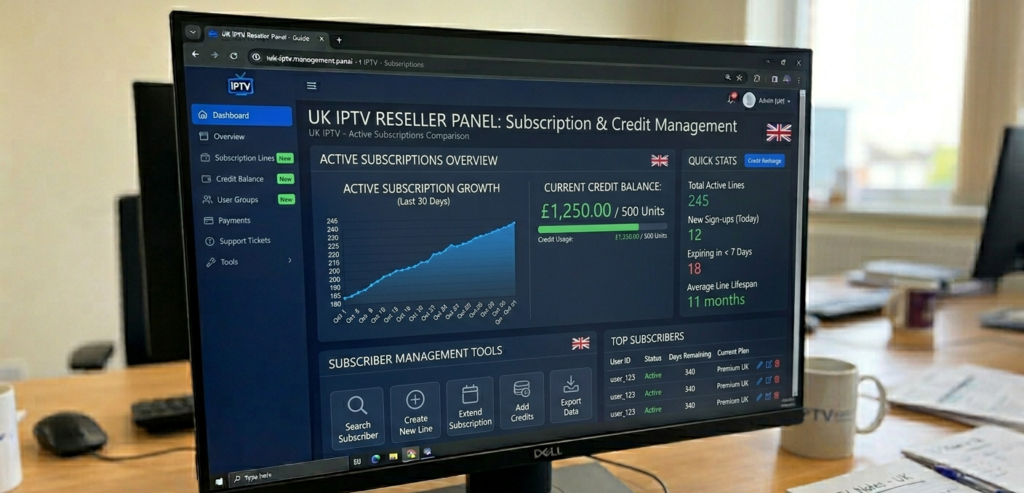
The reseller model for IPTV subscriptions works on a straightforward principle. You purchase access to a reseller panel and buy credits at wholesale rates. Each credit activates a subscriber line for a defined period — typically 30 days for a monthly IPTV subscription. You sell that line to your end customer at retail price. The spread between wholesale and retail is your margin.
What the model glosses over in its simple description is the operational reality sitting underneath it.
Credits represent your working capital. Every credit you buy and don’t convert into a paying subscriber is money sitting idle or wasted. Buying in bulk to access volume discounts only makes sense when your subscriber base is large enough to absorb that volume within a reasonable timeframe. When I first started, I bought a 200-credit bulk pack to get a better per-credit rate and took nearly three months to use them. The discount saved me about £18. The cash flow impact of tying up that capital cost me more in opportunity terms.
Line duration affects your cash flow rhythm. Monthly IPTV subscriptions create a predictable renewal cycle — every 30 days you have a natural touchpoint with every subscriber. Quarterly or annual lines improve your average revenue per user but make it harder to identify churn early. In the UK market, monthly tends to work best for building an initial subscriber base because the lower entry price reduces commitment friction.
Churn is the variable that determines everything. A reseller with 80 subscribers and 6% monthly churn is growing meaningfully. A reseller with 80 subscribers and 22% monthly churn is running to stand still regardless of acquisition rate.
The core margin formula every UK IPTV subscription reseller should know:
Monthly Net Margin=(Active Lines×Retail Price)−(Credits Used×Wholesale Cost)−Fixed Costs\text{Monthly Net Margin} = (\text{Active Lines} \times \text{Retail Price}) – (\text{Credits Used} \times \text{Wholesale Cost}) – \text{Fixed Costs}
At 75 active monthly subscriptions retailing at £10, wholesale credit cost of £2.80, and £35 in fixed overheads: net monthly margin sits around £538. Push active lines to 150 with the same parameters and you’re above £1,100 — without changing your pricing, improving your margin, or reducing costs. Volume is the lever.
Pricing Your IPTV Subscription — Without Destroying Your Business
Pricing is where I’ve watched more UK resellers make expensive mistakes than anywhere else.
The instinct for new resellers is to undercut. Find out what other resellers are charging, go slightly lower, and compete on price. This is a fast route to thin margins, high-maintenance subscribers, and a business that can’t absorb a single bad month.
British subscribers paying £5 or £6 per month for an IPTV subscription have, in my experience, the lowest tolerance for any service imperfection and the highest tendency to request refunds at the slightest buffering issue. They’ve optimised for price, which means they’ll optimise for a different price the moment they find one.
Subscribers paying £10 to £13 per month — which is where serious UK resellers should be pricing for a quality monthly IPTV subscription — tend to be more patient, more loyal, and more likely to refer others. They’ve made a considered purchase rather than a bargain hunt. That’s the customer base worth building.
Pro Tip: If you’re currently pricing below £8 per month for a single-connection IPTV subscription in the UK market, you’re not being competitive — you’re being undersold. Raise your price, improve your onboarding and support process to justify it, and watch your churn rate drop. Lower-priced subscribers churn faster than higher-priced ones. This is consistent across the market.
Panel Quality: The Foundation Everything Else Sits On
!["IPTV subscription stream stability comparison showing anti-freeze performance on UK servers during peak load"]](https://preimium.com/wp-content/uploads/2026/04/Gemini_Generated_Image_ujjm89ujjm89ujjm-1024x493.png)
Every IPTV subscription you sell is only as good as the panel delivering the streams. This sounds obvious. It apparently isn’t, given how many resellers discover it the hard way.
What UK-Specific Infrastructure Actually Means
A panel claiming UK servers isn’t automatically one with UK-optimised infrastructure. There’s a meaningful difference between a server physically located in the UK and one that’s been properly configured for UK residential broadband characteristics — including traffic routing on networks like Virgin Media’s cable infrastructure, which handles packet delivery differently to standard FTTC connections.
UK subscribers on Virgin Media represent a substantial portion of the broadband market. A panel that performs reliably on FTTC but struggles on Virgin’s network will generate a disproportionate share of your support tickets.
Anti-Freeze: What It Actually Does
Anti-freeze technology in a properly implemented IPTV panel means adaptive bitrate management — when the delivery path encounters congestion, the stream degrades gracefully rather than freezing solid. For a UK subscriber watching live sport, a brief quality dip is tolerable. A frozen image mid-match is not.
Not every panel that claims anti-freeze has meaningfully implemented it. The test is simple: during a high-load period, do streams freeze or do they momentarily drop quality then recover? The answer tells you everything about whether the technology is real or just a marketing term on the feature list.
MAG Boxes, STBEmu, and Device Compatibility
The UK IPTV subscription market runs on a diverse device ecosystem. MAG boxes remain popular with older subscribers. Firesticks with IPTV Smarters Pro dominate the mainstream. Android TV boxes running TiviMate have a strong following among more technically engaged users. STBEmu covers a range of Android devices that don’t run native smart TV interfaces.
Your panel’s Xtream Codes API needs to generate credentials that work reliably across all of these without manual configuration. If you’re spending time troubleshooting device-specific login issues regularly, the problem is the panel — not the device.
Managing Renewals Without Losing Your Mind
Renewal management is the operational task most resellers handle worst when they’re starting out, and it’s the one with the most direct impact on revenue consistency.
A subscriber whose IPTV subscription lapses because nobody reminded them isn’t a cancelled subscriber — they’re a temporarily inactive one who will likely go to a different reseller rather than come back unprompted. That’s avoidable revenue loss.
Build a simple renewal notification process: message subscribers three days before expiry, the day before, and on the day itself if they haven’t renewed. Not pushy — just a practical reminder. Something like “Your subscription renews tomorrow — let me know if you want to continue and I’ll sort it straight away” is professional, helpful, and converts.
Resellers who automate this process through their panel’s built-in management tools — subscriber alerts, expiry notifications, line status tracking — retain meaningfully more subscribers at renewal than those managing it manually through memory.
Pro Tip: Offer a modest discount for subscribers who commit to a 3-month or 6-month IPTV subscription upfront. You improve cash flow, lock in revenue, and reduce the monthly renewal admin. Even a 10–15% reduction on the per-month equivalent is worth the improved predictability and reduced churn risk.
The Mistakes That Kill Reseller Businesses Quietly
Some reseller mistakes are dramatic — the provider disappears, the panel crashes during a major event. Others are slow and quiet, bleeding revenue without an obvious single cause.
Not tracking churn by source. If you’re acquiring subscribers through multiple channels — Telegram, word of mouth, social media — you need to know which sources produce the lowest-churn subscribers. In my experience, referrals from existing subscribers churn at roughly half the rate of cold acquisition. That information should be driving your marketing decisions.
Overselling a single connection tier. Some subscribers watch on multiple devices simultaneously. If you’ve sold them a single-connection IPTV subscription and they’re sharing credentials across the household, you’ll see unexplained stream quality issues and complaints that are genuinely hard to diagnose without knowing the cause. Be clear about connection limits upfront.
Ignoring subscriber feedback signals. When a subscriber messages asking why something isn’t working, they’re giving you operational intelligence about your panel. Three subscribers in a week reporting the same buffering issue on the same device type is a pattern that tells you something is wrong. Track it. Act on it. Don’t file it as individual support queries and move on.
Scaling Past 100 Active Subscriptions
The jump from 50 to 100 active IPTV subscriptions is largely a marketing challenge. The jump from 100 to 250 is an operational one.
At 100 lines, you can manage most things manually — renewals, support, credit tracking — with a few hours per week. At 250, manual management becomes a liability. You need your panel’s management tools to be doing the heavy lifting: automated expiry tracking, line status monitoring, credit consumption reporting.
This is also the scale at which your choice of provider starts having material financial consequences. A 2% improvement in uptime across 250 active subscriptions during peak weekend viewing hours translates directly into retention and renewal rates. The infrastructure quality that was acceptable at 40 subscribers becomes a bottleneck at 250.
Resellers who scale successfully past 100 active lines consistently share two characteristics: they’re operating on panels with genuine UK-grade infrastructure, and they’ve built systematic renewal and support processes rather than handling everything reactively.
Why the Right Panel Partner Changes Everything
After years in this market, I’m consistently direct about this: the single most important decision a UK IPTV subscription reseller makes is which panel they build on. Everything else — pricing, marketing, customer service — operates within the constraints that decision creates.
britishseller.co.uk represents the kind of panel infrastructure that makes the rest of the business manageable. UK-optimised servers, genuine anti-freeze performance, broad device compatibility, a management dashboard that gives you the operational visibility you need across User Management, Credit Management, and Stream Monitor sections — these aren’t features to tick off a list. They’re the operational foundation that determines whether your IPTV subscription business grows or stalls.
I wouldn’t point resellers there if I hadn’t seen the difference it makes compared to building on inferior infrastructure. The subscriber experience is better, the support burden is lower, and the renewal rates reflect both. For anyone serious about the UK IPTV subscription market in 2026, it’s the starting point worth taking seriously.
✅ IPTV Reseller Success Checklist (5 Points)
- Price your monthly IPTV subscription at £10 or above — lower pricing attracts high-churn subscribers and compresses margins to the point where one bad month wipes your profit.
- Implement a structured 3-message renewal reminder sequence — three days out, one day out, and day of expiry — to capture the subscribers who intend to renew but need a prompt.
- Test your panel’s anti-freeze performance during a live high-load event before putting paying subscribers on it — not after your first complaint.
- Track churn by acquisition source monthly — identify which channels produce loyal subscribers and redirect your marketing effort accordingly.
- Maintain a secondary panel relationship with enough credits to migrate your entire subscriber base within 24 hours — because the question isn’t whether your primary provider will have a serious incident, it’s when.