I remember the exact moment I realised IPTV reselling was either going to be a proper business or an expensive lesson. It was a Saturday evening — not even a major fixture, just a routine Premier League match. My provider’s panel went unresponsive at 4:47pm. No warning. No status update. Just silence, and seventeen subscribers suddenly unable to load a single stream.
I hadn’t done anything wrong. My marketing was working, my pricing was reasonable, my subscribers had been perfectly happy for six weeks. But I’d made the foundational mistake that trips up nearly every new IPTV reseller: I’d confused having a panel with having a business. They’re not the same thing.
A panel is infrastructure. A business is what you build on top of reliable infrastructure, with systems, processes, and enough operational awareness to survive the inevitable bad days. This guide is about building the second thing — not just acquiring the first.
Table of Contents
- What IPTV Actually Is (And What Resellers Are Really Selling)
- The UK IPTV Market in 2026: Opportunity and Reality
- How the Reseller Model Works in Practice
- Choosing an IPTV Panel That Won’t Let You Down
- Pricing, Margins, and the Maths That Actually Matter
- The Technical Layer Most Resellers Ignore
- Building Subscriber Trust in a Sceptical Market
- Scaling Without Breaking What Works
- The Panel Infrastructure Behind Serious UK Resellers
What IPTV Actually Is (And What Resellers Are Really Selling)
IPTV — Internet Protocol Television — is the delivery of television content over internet infrastructure rather than traditional broadcast or cable systems. Streams are delivered through internet connections to devices that decode and display them: smart TVs, Firesticks, Android boxes, MAG boxes, iPhones, laptops.
As a reseller, you’re not operating the streaming infrastructure itself. You’re purchasing access to a reseller panel — a management system that allows you to create and administer subscriber lines. Those lines connect end users to an upstream provider’s server network. Your role sits between the wholesale infrastructure and the end subscriber.
What you’re actually selling, when you strip it back, is reliability and trust. The technical product — streams, EPG data, device compatibility — comes from your provider. What comes from you is the relationship, the support, the consistency, and the confidence that if something goes wrong, someone will actually respond.
That distinction matters more than most new resellers appreciate. It’s also why choosing the right panel is the most consequential decision in the entire business.
Pro Tip: Before you think about marketing your IPTV service to a single subscriber, spend a full week as your own test subscriber. Use your trial line on every device you expect your customers to use. Watch live content during peak hours. Try it on a Saturday afternoon during a major fixture. If you find a problem during that week, you’ve found it before it becomes a customer complaint.
The UK IPTV Market in 2026: Opportunity and Reality
![IPTV reseller panel showing active UK subscriber lines and stream monitor during Premier League peak traffic"]](https://preimium.com/wp-content/uploads/2026/04/Gemini_Generated_Image_njssmmnjssmmnjss-1024x515.png)
The United Kingdom remains one of the most active IPTV markets globally, and 2026 has done nothing to change that. British households have a deeply ingrained appetite for live sport that traditional broadcast packages struggle to satisfy affordably. The value gap between a well-run IPTV subscription and conventional alternatives remains significant enough to sustain consistent demand.
What has changed is the sophistication of that demand. UK subscribers in 2026 are not naive newcomers to IPTV. Most have had at least one previous subscription — and at least one previous disappointment. They know what buffering looks like. They know what a frozen stream during an important match feels like. They know the difference between a reseller who responds to support messages and one who goes quiet when something breaks.
This market history creates both a challenge and an opportunity. The challenge: trust is harder to establish than it was three years ago. The opportunity: resellers who actually operate professionally stand out sharply against a backdrop of unreliable operators. The bar for being considered good is lower than you’d expect, because so many in this space are genuinely poor.
The 3pm Saturday blackout window — that roughly two-and-a-half-hour period when terrestrial broadcasters don’t show live domestic football — continues to generate the highest concurrent IPTV connection demand of any point in the weekly schedule. If your infrastructure can handle 3pm Saturday comfortably, the rest of the week is relatively straightforward. If it can’t, your churn rate will tell the story every Monday morning.
How the Reseller Model Works in Practice
The IPTV reseller model operates on a credit system. You purchase credits from a wholesale provider at a bulk rate, then use those credits to activate subscriber lines through your reseller panel. Each line represents an individual IPTV subscription you’re selling to an end customer.
The panel itself — typically accessible through a web-based dashboard — gives you the management infrastructure to run your operation. Core sections include User Management for creating and administering subscriber accounts, Credit Management for tracking your wholesale inventory, and Stream Monitor for assessing the live performance of active connections.
Your margin is the spread between what you pay per credit and what you charge per subscription. But raw margin is only part of the story. The number that actually determines whether your business grows is lifetime subscriber value — how long the average subscriber stays with you multiplied by their monthly payment.
Lifetime Subscriber Value=Monthly Retail Price×Average Subscriber Duration (months)\text{Lifetime Subscriber Value} = \text{Monthly Retail Price} \times \text{Average Subscriber Duration (months)}
A subscriber paying £11 per month who stays for eight months is worth £88 in lifetime revenue. Acquire that subscriber for £3 in trial credits and support time, and the return is substantial. Lose them after month two because your panel buffered through a big match, and you’ve made £19 before churn — barely worth the effort of onboarding them.
Churn is the variable that determines everything. In my experience, UK IPTV resellers with churn above 18% per month are essentially running a retention treadmill — constantly replacing lost subscribers rather than building a growing base. Below 8% monthly churn and the compounding effect of subscriber retention starts working significantly in your favour.
Pro Tip: Calculate your churn rate every single month without fail. Divide the number of subscribers who didn’t renew by your total subscriber count at the start of that month. That percentage is the single most honest indicator of how your business is actually performing — more honest than new subscriber acquisition, more honest than gross revenue.
Choosing an IPTV Panel That Won’t Let You Down
This is the decision that determines everything downstream, so it deserves more than a checklist.
What UK-Grade Infrastructure Actually Means
An IPTV panel advertising UK servers isn’t automatically one with infrastructure built for the UK market. There’s a meaningful technical difference between servers physically located in the UK and servers that have been configured and optimised for UK residential broadband traffic patterns.
Virgin Media’s cable network — used by a substantial portion of UK broadband subscribers — handles packet delivery differently to standard FTTC connections. A panel that performs reliably across FTTC but struggles with Virgin Media connections will generate a disproportionate share of your support tickets from one segment of your subscriber base, and you may spend weeks trying to diagnose what looks like a device or configuration issue but is actually a routing problem.
Anti-Freeze Technology: Real vs Marketing
Anti-freeze is one of the most misused terms in the IPTV panel industry. Used correctly, it refers to adaptive bitrate management — technology that allows a stream to degrade gracefully under congestion rather than freezing solid. During peak periods on a busy server, the difference between genuine anti-freeze implementation and basic delivery infrastructure is visible to subscribers instantly.
The test isn’t asking your provider whether they have anti-freeze. It’s watching streams during a high-load event and observing whether quality dips momentarily before recovering, or whether the picture locks and stays locked until you restart the stream. One is anti-freeze working. The other is anti-freeze as a marketing bullet point.
Device Compatibility Across the UK Ecosystem
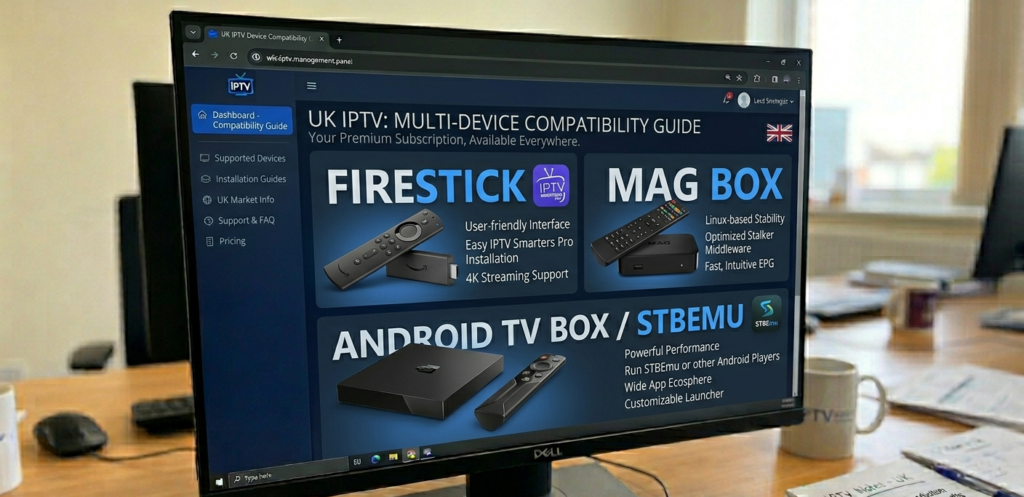
The UK IPTV subscriber base uses a genuinely diverse range of devices. Firesticks running IPTV Smarters Pro represent the largest single segment. MAG boxes remain common among subscribers who’ve been using IPTV for several years. Android TV boxes running TiviMate have a strong and growing following among technically engaged users. STBEmu covers various Android devices. iPhones using GSE Smart IPTV or similar apps represent a meaningful minority.
Your panel’s Xtream Codes API output needs to generate credentials that work reliably across all of these without requiring manual workarounds. If your trial testing reveals that any of these device types requires troubleshooting before it connects, expect that troubleshooting to become a recurring support burden at scale.
Pricing, Margins, and the Maths That Actually Matter
New resellers almost universally underprice. It’s understandable — the instinct is to make the offer as attractive as possible to overcome the trust deficit with new subscribers. The problem is that underpricing attracts exactly the wrong type of subscriber.
In my experience across the UK IPTV market, subscribers who choose a provider primarily on price are the most likely to leave for a cheaper option, the least patient when technical issues occur, and the most likely to request refunds at the first sign of any problem. They are, in other words, the subscribers most likely to maximise your operational headache while minimising your revenue.
Pricing an IPTV subscription at £10 to £13 per month for a single connection — which is where quality-positioned UK resellers should be operating — attracts subscribers who’ve made a considered purchase decision. They’ve weighed up cost against perceived quality and chosen to pay more for something they expect to work properly. Those subscribers churn at a meaningfully lower rate and refer others more frequently.
The full margin picture for a mid-scale UK IPTV reseller operation:
Annual Reseller Profit=[(Avg. Active Lines×Monthly Retail Price)−(Monthly Credits×Credit Cost)−Monthly Overheads]×12\text{Annual Reseller Profit} = [(\text{Avg. Active Lines} \times \text{Monthly Retail Price}) – (\text{Monthly Credits} \times \text{Credit Cost}) – \text{Monthly Overheads}] \times 12
At 120 average active lines across the year, £11 retail, £2.90 credit cost, and £50 monthly overheads: annual profit is approximately £9,720. The same model at 200 average active lines exceeds £16,000 annually — from what remains, at that scale, a manageable part-time operational commitment.
Pro Tip: Introduce a quarterly subscription option at a modest per-month discount — perhaps £30 for three months versus £11 monthly. Subscribers who take quarterly plans churn at roughly half the rate of monthly subscribers, and the upfront cash improves your credit purchasing position. Even if 20% of your base shifts to quarterly, the retention improvement more than compensates for the slight margin reduction.
The Technical Layer Most Resellers Ignore
Beyond panel selection and pricing, there are operational technical considerations that separate resellers who scale from those who stall.
EPG accuracy for the UK market. British subscribers expect programme guide information that reflects actual UK broadcast scheduling. When the EPG shows incorrect or misaligned programme data — particularly for live sport — subscribers interpret it as evidence of a poorly maintained service. A panel that pushes accurate, properly mapped UK EPG data is worth prioritising specifically because this is a visible quality signal to every subscriber, every day.
Bandwidth and connection limit management. Every server node has a realistic concurrent connection ceiling. Responsible providers stay comfortably below that ceiling. Operators who oversell — cramming more concurrent connections onto a server than it can genuinely support — create peak-period degradation that is particularly destructive in the UK market, where the peaks are sharp and the subscriber expectations during those peaks are highest.
DNS configuration support for UK ISPs. Certain UK ISPs apply traffic filtering that can interfere with IPTV stream delivery. Subscribers on these networks sometimes need specific DNS configuration to achieve stable connections. Resellers who can provide clear, accurate guidance for common UK ISP configurations reduce their support ticket volume substantially and build a reputation for genuine technical competence.
Building Subscriber Trust in a Sceptical Market
The UK IPTV market’s accumulated experience of unreliable operators has created a subscriber base that is genuinely difficult to impress initially and relatively easy to retain once trust is established. The gap between those two states — sceptical prospect to loyal subscriber — is bridged almost entirely by your behaviour in the first two to four weeks of the relationship.
Respond to support messages quickly. Not necessarily with an immediate solution — sometimes problems take time to diagnose — but with fast acknowledgement. A subscriber who messages about a stream issue and receives a response within fifteen minutes, even if that response is “I’m looking into this right now,” is far more likely to stay than one who waits two hours in silence.
Offer trial lines genuinely. A 24-hour trial on the same infrastructure your paying subscribers use — not a throttled version — demonstrates confidence in your product. Subscribers who’ve tested and been satisfied with the actual service convert at significantly higher rates than those who’ve committed on faith.
Be honest when something goes wrong. If your provider has a server issue that affects your subscribers, communicate it proactively rather than hoping nobody notices. “There’s a known issue with streams right now, my provider is working on it, I’ll update you when it’s resolved” costs you nothing and preserves more trust than silence followed by explanation.
Pro Tip: Create a simple one-page setup guide for the three or four most common devices your subscribers use — Firestick, MAG box, Android TV, iPhone. Send it automatically with every new subscriber’s credentials. This single action reduces your setup-related support messages by 60% or more and immediately signals that you’re a professional operation, not someone winging it on Telegram.
Scaling Without Breaking What Works
The jump from 50 to 100 active IPTV subscribers is primarily a marketing challenge. The jump from 100 to 300 is an operational one.
At 100 subscribers, most resellers can manage renewals, support, and credit tracking manually with a few focused hours per week. Beyond that threshold, manual management becomes a genuine risk — not just an inefficiency. Renewals missed because you forgot. Credits depleted unexpectedly because you weren’t tracking consumption. Support responses delayed because volume overwhelmed a one-person operation.
Resellers who scale successfully use their panel’s management infrastructure deliberately. Expiry tracking through the panel dashboard, credit consumption monitoring, stream quality alerts through the Stream Monitor — these tools exist precisely to replace the manual oversight that breaks down at volume. Use them from the beginning, not as an afterthought when things start slipping.
Maintaining a secondary panel relationship also becomes non-negotiable at scale. A primary provider incident that affects 50 subscribers is manageable. The same incident affecting 300 is a business-threatening event if you have no migration path. Keep a secondary panel account with enough credits to move your entire subscriber base within 24 hours. It’s operational insurance that you hope never to use and absolutely need to have.
The Panel Infrastructure Behind Serious UK Resellers
After years operating in this market and watching resellers at every stage — from first-timers to operators running hundreds of active lines — the pattern is consistent. The businesses that scale, retain subscribers, and generate meaningful income are almost always built on panel infrastructure that was chosen deliberately for quality rather than grabbed opportunistically for cheapness.
britishseller.co.uk represents the kind of vetted, UK-market-focused panel infrastructure that makes the rest of the business manageable. UK-optimised server routing, genuine anti-freeze implementation, broad device compatibility across the full range of UK subscriber hardware, and management tools that give you the operational visibility to run a professional operation — these aren’t features to tick off before moving on. They’re the foundation that determines whether an IPTV reseller business grows into something substantial or stalls and fades.
I point resellers there not as a first resort but as a considered recommendation based on what I’ve seen work in this market. For anyone building a serious UK IPTV reseller operation in 2026, it’s the starting point worth evaluating before committing elsewhere.
✅ IPTV Reseller Success Checklist (5 Points)
- Spend a full week as your own test subscriber before acquiring a single paying customer — test every device, test during peak hours, test on a Saturday afternoon, and fix what you find before it becomes a complaint.
- Price at £10 or above for a monthly single-connection subscription — lower pricing attracts high-churn subscribers who cost more in support and replacement than they generate in revenue.
- Calculate your churn rate every month without exception — it’s the single most honest metric for how your IPTV reseller business is actually performing, and ignoring it is how resellers stay stuck.
- Build a secondary panel relationship with live credit balance before you hit 80 active subscribers — not after you need it, because when you need it you’ll need it immediately.
- Create and send a device setup guide automatically with every new subscriber’s credentials — it reduces support volume, sets professional expectations, and signals immediately that you’re an operator worth staying with.