I’ve changed IPTV suppliers twice in my reselling career. The first time was planned — a deliberate upgrade to better infrastructure as my subscriber base grew. The second time was an emergency. My supplier at the time went silent on a Friday evening with no warning, no explanation, and no response to any message across any platform. I had 180 active subscribers heading into a full weekend of Premier League fixtures, and the panel I’d built my business on had simply stopped working.
The migration took 72 hours. I lost 23 subscribers permanently, issued more refunds than I care to total up, and spent an entire weekend doing damage control instead of enjoying what should have been peak revenue days. All of it — every bit of that chaos — was a direct consequence of choosing an IPTV supplier based on price and a convincing Telegram pitch rather than verifiable infrastructure and a track record I could actually trust.
If you’re evaluating IPTV suppliers for the first time, or questioning whether your current supplier is the right long-term partner, this guide is written from the scars of experience.
Table of Contents
- What IPTV Suppliers Actually Provide — and What They Don’t Tell You
- The UK Supplier Landscape in 2026
- How to Vet an IPTV Supplier Before Committing
- Red Flags That Predict Supplier Failure
- Infrastructure Questions Every Supplier Must Answer
- Pricing, Credits, and Supplier Negotiation
- Building Supplier Redundancy Into Your Business Model
!["IPTV suppliers UK comparison showing server infrastructure, uptime records, anti-freeze capability, and credit pricing for reseller panel selection"]](https://preimium.com/wp-content/uploads/2026/04/Gemini_Generated_Image_cch16acch16acch1-1024x490.png)
1. What IPTV Suppliers Actually Provide — and What They Don’t Tell You
The term “IPTV supplier” covers a remarkably wide range of operations — from large, well-capitalised infrastructure businesses running their own server networks, down to individuals reselling someone else’s panel with an extra markup and a professional-sounding Telegram username.
Understanding where your potential supplier sits on that spectrum is the most important piece of due diligence you can do. Because the risks are very different depending on who you’re actually dealing with.
A genuine IPTV supplier at the infrastructure level owns or leases dedicated server capacity, manages their own CDN relationships, employs technical staff who monitor uptime around the clock, and has meaningful financial investment in keeping their service operational. These suppliers have reputational and financial skin in the game. When problems occur — and they will, with any supplier — these are the operations with the capability and motivation to resolve them quickly.
A reseller-posing-as-supplier has none of those characteristics. They’re buying access from someone upstream and selling it to you at a margin. Their ability to resolve any technical issue is entirely dependent on whoever is above them in the chain — a chain you have no visibility into and no relationship with. When that upstream provider has problems, your supplier has no levers to pull.
In my experience, a significant proportion of IPTV suppliers operating in the UK reseller market via Telegram and WhatsApp fall into this second category. Which isn’t automatically disqualifying — but it does mean the vetting process needs to probe further than surface-level claims.
Pro Tip: Ask any prospective IPTV supplier directly: “Do you own your own servers or are you reselling upstream access?” A genuine infrastructure operator will answer this confidently and specifically. Evasion, deflection, or a vague answer about “partnerships” is a meaningful signal about what you’re actually buying.
2. The UK Supplier Landscape in 2026
The UK IPTV supplier market in 2026 is more crowded than it’s ever been, which sounds like good news for resellers — more competition, better pricing, more options. In practice, the proliferation of suppliers has made genuine quality harder to identify, not easier.
The barriers to entry for presenting yourself as an IPTV supplier are extraordinarily low. A Telegram account, a basic website, some reseller credits purchased from an actual provider, and you’re in business. The result is a market where the quality variance between suppliers is enormous but the marketing language is virtually identical — every supplier claims “premium streams,” “99.9% uptime,” “anti-freeze technology,” and “UK servers.”
What separates the UK market from others is the specific demand profile created by live sport. Premier League seasons run August through May and create predictable, severe demand spikes every weekend. The 3pm Saturday blackout window, where certain fixtures aren’t available through standard broadcast channels, drives concentrated demand during specific time slots. Suppliers whose infrastructure isn’t specifically architected for this profile will fail during exactly these moments — when your customers are watching, when they’re judging your service, and when the damage to your reputation is most acute.
The suppliers worth working with in the UK market are the ones who understand this demand profile intimately and have built their infrastructure accordingly. Not the ones who’ve imported a generic IPTV operation and pointed it at British customers.
3. How to Vet an IPTV Supplier Before Committing
This is the process I now follow with any new supplier relationship, regardless of how convincing the initial pitch. Some of it takes time. All of it is worth it.
Stage one: Identity and longevity verification. How long has this supplier been operating? Can you find any independent references from other resellers — not testimonials on their own website, but conversations in forums, groups, or communities where resellers talk candidly? A supplier who’s been operating reliably for two or more years in the UK market carries meaningfully less risk than one who launched six months ago.
Stage two: Infrastructure interrogation. Where are the servers located? What CDN relationships does the supplier maintain? What is their failover setup when a primary server goes offline? What anti-freeze technology do they use, and how does it work specifically? These questions have clear, specific answers if the supplier has genuine technical depth. Vague or evasive responses indicate either a lack of knowledge or a lack of infrastructure worth claiming.
Stage three: Live stress testing. Request a trial that includes at least one full Premier League fixture weekend. Test streams across every device type your customers use. Monitor for buffering, freezing, stream drops, and recovery time after interruptions. A supplier whose infrastructure holds up through a Saturday afternoon of simultaneous fixtures is demonstrating exactly the capability that matters most for the UK market.
Stage four: Support responsiveness. Raise a deliberate support query during the trial — something that requires an actual technical response rather than a canned answer. How quickly do they respond? How knowledgeable is the response? How are you treated as a customer? This is a direct preview of how they’ll behave when you have a genuine crisis at 9pm on a Sunday.
Pro Tip: Search for the supplier’s domain name or Telegram handle in IPTV reseller forums and groups before committing to anything. Resellers talk about bad experiences far more readily than good ones. Silence in those communities is neutral — complaints are a serious warning signal.
4. Red Flags That Predict Supplier Failure
I’ve watched enough IPTV supplier relationships collapse to recognise the warning signs that almost always precede a major problem. These aren’t guarantees of failure — but in my experience, they’re reliable predictors.
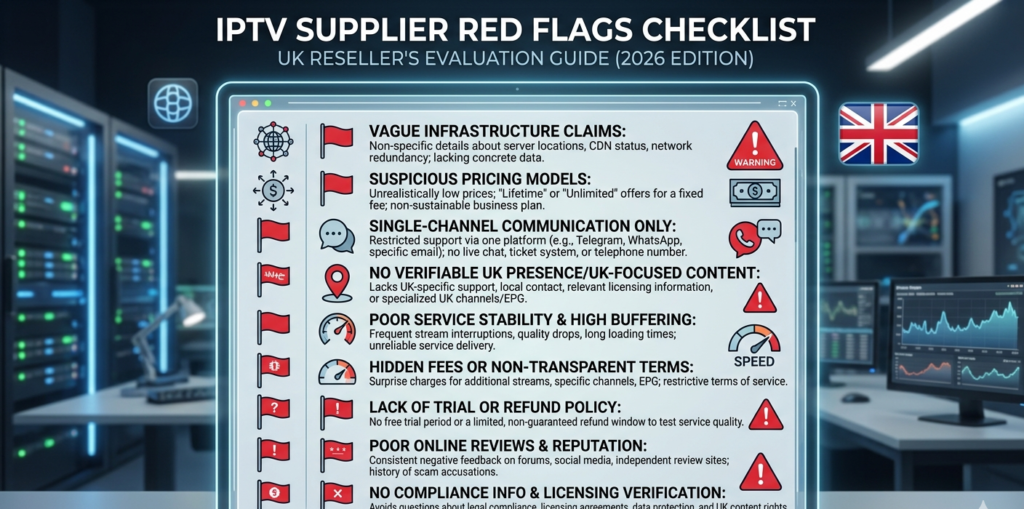
Unwillingness to discuss infrastructure specifics. Any legitimate supplier is comfortable talking about their server setup, CDN configuration, and failover architecture. Suppliers who deflect these questions with claims about “proprietary systems” or “security reasons” are almost always hiding the absence of proper infrastructure.
Pricing that seems implausibly low. The economics of running quality IPTV infrastructure have hard floors. Server capacity, bandwidth, CDN fees, and technical staff cost real money. Suppliers offering credits at prices that don’t make mathematical sense relative to those costs are either operating at a loss temporarily to acquire customers, or cutting corners on infrastructure quality that you’ll discover during your first peak weekend.
No clear refund or compensation policy. Reliable suppliers stand behind their service with clear terms. Suppliers who avoid discussing what happens when their service fails are telling you exactly how they’ll behave when it does.
Communication through a single channel. Suppliers who only communicate via a personal Telegram account, with no support ticket system, no secondary contact method, and no business infrastructure around them, are one personal crisis away from being completely unreachable.
Recent panel migration without explanation. If a supplier has changed their panel URL, server configuration, or branding recently without a clear technical explanation, it often indicates upstream provider problems — problems that may recur.
5. Infrastructure Questions Every Supplier Must Answer
After years of supplier evaluations, I’ve distilled the essential technical questions down to five. These aren’t designed to catch anyone out — they’re designed to give a reliable supplier the opportunity to demonstrate their credibility clearly.
Where are your primary servers located, and do you have UK or EU-based infrastructure? Latency to British viewers from well-located European servers is negligible. From poorly routed offshore infrastructure, it’s the primary cause of buffering complaints.
What is your maximum concurrent stream capacity, and what percentage is currently utilised? The gap between these two numbers is your headroom. A supplier running at 90% capacity has almost no room to absorb demand spikes. A supplier at 60% capacity has meaningful buffer.
How does your anti-freeze system work, and what is the average failover time? The answer should be specific — milliseconds, not “instantly.” If they can’t quantify it, they may not have a proper system.
What happens during a primary server failure? The answer should describe an automatic failover process with a specific recovery window. Manual intervention answers are inadequate for a service where failures tend to occur during peak demand.
What uptime have you maintained over the last 90 days, and can you provide verification? Legitimate suppliers track this. 99% uptime means roughly 7 hours of downtime per month — acceptable but worth scrutinising. Anything below 98.5% is a serious concern for the UK market.
6. Pricing, Credits, and Supplier Negotiation
Credit pricing from IPTV suppliers varies significantly and is almost always negotiable beyond a certain volume threshold. Understanding the economics helps you negotiate from a position of knowledge rather than hope.
The fundamental reseller profit model:
Net Margin=(Subscription Price−(Credits per Line×Cost per Credit))Subscription Price×100\text{Net Margin} = \frac{(\text{Subscription Price} – (\text{Credits per Line} \times \text{Cost per Credit}))}{\text{Subscription Price}} \times 100
At £12/month subscription price, 2 credits per line at £1.50 per credit:
Net Margin=(£12−£3)£12×100=75%\text{Net Margin} = \frac{(£12 – £3)}{£12} \times 100 = 75\%
At the same subscription price but £2.20 per credit from a more expensive supplier:
Net Margin=(£12−£4.40)£12×100=63.3%\text{Net Margin} = \frac{(£12 – £4.40)}{£12} \times 100 = 63.3\%
That 11.7 percentage point difference compounds dramatically across a subscriber base. On 200 active lines at £12/month, the difference between those two credit costs is £1,408 per month in net profit — nearly £17,000 annually. Credit pricing negotiation is not a peripheral concern. It’s a central one.
Most suppliers offer tiered pricing — lower per-credit costs at higher volume commitments. The optimal entry point is typically the lowest tier that gives you meaningful pricing improvement without tying up capital in credits you won’t use within 60 days.
Pro Tip: When negotiating credit pricing with a supplier, lead with your subscriber growth projection rather than your current volume. Suppliers selling future capacity are more motivated to offer favourable pricing than those simply transacting on current demand. Come with a credible 6-month growth plan and you’ll almost always achieve better terms than the standard rate card.
7. Building Supplier Redundancy Into Your Business Model
The Sunday evening my primary supplier went dark taught me a lesson I’ve never forgotten: single-supplier dependency is a business risk that no amount of due diligence entirely eliminates.
The solution isn’t complicated, but it does require accepting some operational overhead. Maintaining an active relationship with a secondary IPTV supplier — even if that relationship is minimal, a small credit balance and a tested panel integration — gives you an emergency failover option when your primary supplier experiences problems.
This isn’t about distrust of your primary supplier. It’s about acknowledging that any business can experience unexpected outages, and that the cost of a 72-hour migration under emergency conditions is vastly higher than the cost of maintaining a backup relationship proactively.
For resellers building on a primary platform in the UK market, britishseller.co.uk represents the kind of supplier foundation worth considering seriously. The infrastructure is built for UK demand patterns, the panel gives proper reseller control, and the credit system is transparent enough to plan around with confidence. Whether you’re starting fresh or assessing a migration from a supplier relationship that’s been causing anxiety, it’s the conversation I’d recommend having first.
✅ IPTV Reseller Success Checklist
- Verify infrastructure ownership — Confirm whether your supplier owns servers or is reselling upstream access. The answer determines your actual risk profile and your leverage when problems occur.
- Stress-test during Premier League fixtures — Never commit to a supplier without evaluating their performance during a full weekend of live fixtures. That’s the only honest test of UK-market readiness.
- Ask the five infrastructure questions — Server location, capacity utilisation, anti-freeze specifics, failover process, and uptime verification. Treat evasive answers as disqualifying.
- Model your margin at different credit price points — Use the net margin formula above to understand exactly how credit pricing affects your annual profitability before negotiating or committing.
- Maintain a secondary supplier relationship — Keep a minimal active account with a backup panel at all times. The cost is negligible. The insurance value during a primary supplier crisis is enormous