A reseller I’d been mentoring for about six months sent me a message out of nowhere one Tuesday morning. No greeting, just: “Mate, I’ve had a letter.” He’d been operating for less than a year, had built a decent subscriber base, was genuinely proud of what he’d put together — and now he was sitting with a legal notice that had arrived completely without warning.
He wasn’t the first person I’d seen in that position. He won’t be the last. And in almost every case I’ve encountered, the situation was entirely avoidable — not because the person was reckless, but because they’d never properly understood the legal landscape they were operating in. They’d seen others doing it, assumed that meant it was fine, and got on with building their business without asking the question that should have come first.
Is IPTV legal in the UK? It’s the question every reseller needs to answer honestly before they take a single subscription payment — and the answer is considerably more layered than most guides in this space are willing to admit.
Table of Contents
- The Honest Answer — IPTV Legality Is Not Black and White
- What Makes an IPTV Service Legal vs Illegal
- The Legal Risk for UK Resellers Specifically
- How UK Enforcement Has Evolved in 2026
- What Resellers Get Wrong About Legal Cover
- Operating Responsibly in the UK IPTV Market
- Building a Sustainable Business Within Legal Boundaries
1. The Honest Answer — IPTV Legality Is Not Black and White
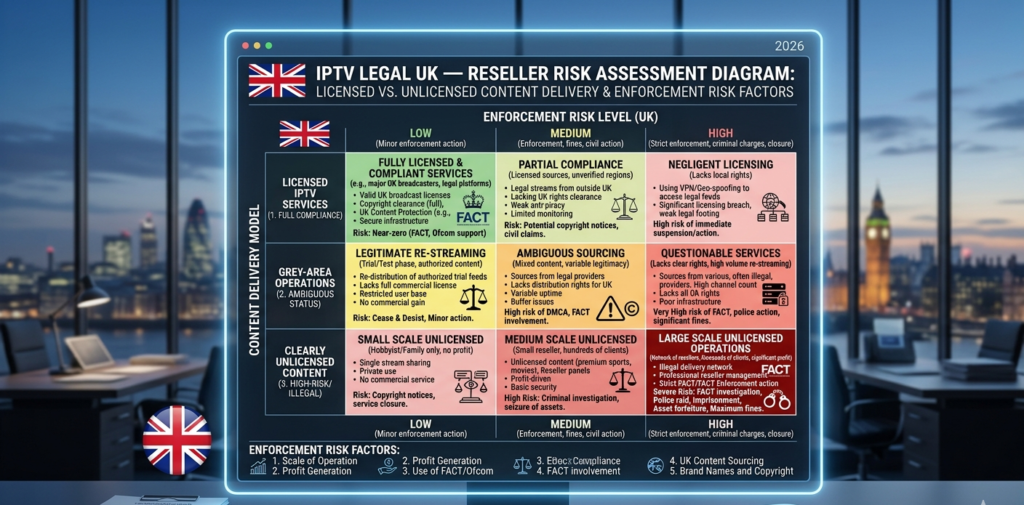
Let me be direct with you in a way that many guides in this space aren’t: IPTV as a technology is entirely legal. It’s simply a method of delivering video content over an internet connection rather than through a traditional broadcast signal. The BBC iPlayer, Netflix, Disney+, and every other legitimate streaming platform you’ve ever used is technically an IPTV service.
The legality question isn’t about the technology. It’s about the content being delivered through it, and whether the entity delivering that content holds the appropriate licences to do so.
In the UK, content licensing is an extremely serious legal matter. Broadcasters and rights holders invest enormous sums — we’re talking billions of pounds annually across the industry — in acquiring the rights to distribute specific content to specific territories. When an IPTV service delivers that content without the appropriate licences, it’s not a grey area. It’s copyright infringement on a commercial scale.
The question “is IPTV legal” therefore has a clean answer: legal IPTV services exist and are perfectly lawful. Unlicensed IPTV services delivering copyrighted content without rights holder permission are not legal, regardless of how many people use them or how openly they operate.
Pro Tip: Never assume that because something is widely available or commonly used, it carries legal protection. Enforcement in the UK IPTV space has become significantly more sophisticated since 2023, and scale of operation is no longer a barrier to prosecution — individual resellers with modest subscriber counts have faced serious legal consequences.
2. What Makes an IPTV Service Legal vs Illegal
The distinction comes down to a single question: does the service hold valid licences for the content it delivers to its subscribers?
A fully licensed IPTV service has negotiated distribution agreements with every rights holder whose content appears on the platform. For a UK-focused service, this means agreements with sports rights bodies, film studios, television production companies, and broadcast networks. These agreements are expensive, complex, and territorial — a licence to distribute content in the UK does not automatically extend to other markets.
The services most UK IPTV resellers are actually dealing with sit in a different category entirely. They aggregate content from multiple sources — often without the rights holder’s knowledge or permission — and deliver it to subscribers at a fraction of the cost that legitimate licensing would require. The low credit prices that make the reseller business model attractive exist precisely because the upstream provider isn’t paying for the content they’re distributing.
This creates a legal exposure that runs the entire length of the supply chain. The upstream provider is infringing copyright at scale. The reseller is commercially distributing that infringing content to paying subscribers. The subscriber is accessing content they have no licence to receive through that channel.
In terms of legal risk, the reseller position is particularly exposed. Unlike the upstream provider — who may be operating from a jurisdiction where UK enforcement is difficult — and unlike the individual subscriber — whose personal use makes prosecution resource-intensive — the UK-based reseller is a visible commercial operator, taking payments, managing customers, and building a business on the back of unlicensed content. That profile is exactly what UK enforcement bodies have been targeting with increasing focus.
3. The Legal Risk for UK Resellers Specifically
I want to be clear about something that gets glossed over in most discussions of this topic: the legal risk for a UK-based IPTV reseller is real, documented, and increasing. This isn’t theoretical. People have been prosecuted, fined, and imprisoned.
The legal framework that applies to UK resellers operating unlicensed IPTV services spans several pieces of legislation. The Copyright, Designs and Patents Act 1988 covers the infringement of copyright in broadcast content. The Digital Economy Act 2017 strengthened enforcement mechanisms significantly. The Serious Crime Act 2007 can apply in cases where commercial-scale infringement is deemed to involve organised criminal activity.
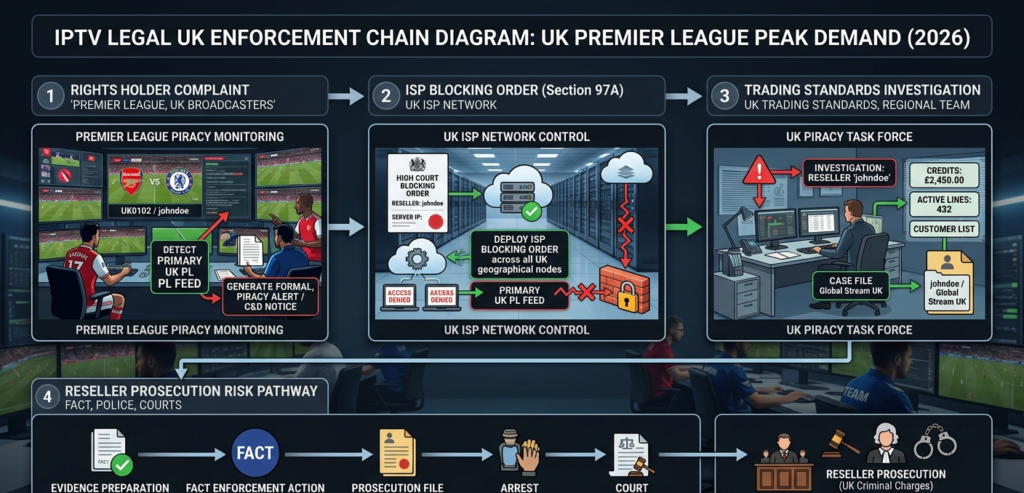
Enforcement typically begins with rights holders — primarily sports bodies and their representatives — identifying infringing services through technical monitoring. That intelligence is passed to relevant authorities including Police Intellectual Property Crime Unit (PIPCU), Trading Standards, and in serious cases the National Crime Agency. ISP blocking orders under the Digital Economy Act can be obtained relatively quickly and are increasingly used to disrupt services at the network level.
For individual resellers, the pathway to prosecution usually involves a paper trail: payment records, subscriber lists, communication logs, and credit purchase history. All of this is recoverable from devices and accounts during a search. Resellers who’ve operated for even 12 months accumulate substantial documentary evidence of commercial-scale infringement.
The penalties upon conviction range from substantial fines to custodial sentences of up to ten years under serious cases. Confiscation of proceeds under the Proceeds of Crime Act is also increasingly common — meaning income earned through infringing activity can be recovered regardless of how it’s been spent.
Pro Tip: “Everyone’s doing it” has never been a legal defence and is becoming an increasingly poor risk calculation. UK enforcement capacity and rights holder investment in identifying resellers has grown substantially since 2022. The risk profile in 2026 is materially different from what it was three years ago.
4. How UK Enforcement Has Evolved in 2026
When I first started paying serious attention to the legal landscape around IPTV in the UK, enforcement was largely reactive and focused on the largest, most visible operations. Resellers with modest subscriber counts operated below the threshold of meaningful enforcement attention.
That’s changed considerably. Several developments have shifted the enforcement picture significantly.
Rights holder investment in detection has increased dramatically, particularly from sports rights bodies who’ve seen direct revenue impact from unlicensed streaming. The technical tools used to identify infringing services and trace them back to individual resellers have become substantially more sophisticated.
ISP cooperation has expanded through court-obtained blocking orders that now extend to dynamic IP addresses and domain-hopping services. What was once a cat-and-mouse game that services could win through technical agility has become considerably harder to sustain.
Payment processor action has disrupted the financial infrastructure of many unlicensed IPTV operations. Resellers relying on mainstream payment processors have found accounts frozen or terminated as processors themselves face pressure around facilitating infringement.
Trading Standards and Police collaboration has produced a visible increase in successful prosecutions at the individual reseller level. Cases that would previously have been considered too small to pursue are now being investigated and prosecuted as part of coordinated enforcement programmes.
The trajectory is clear. Enforcement is becoming more capable, more targeted, and more willing to pursue resellers who would previously have considered themselves below the radar.
5. What Resellers Get Wrong About Legal Cover
Several misconceptions circulate persistently in the UK IPTV reseller community, and each one creates false comfort that can have serious consequences.
“I’m just reselling — the provider is responsible.” This is incorrect. UK law treats commercial distribution of infringing content as infringement regardless of where in the supply chain it occurs. Resellers are not insulated by the upstream provider’s actions.
“I don’t know what content they’re carrying — ignorance is a defence.” Also incorrect. Operating a commercial IPTV reseller business without making reasonable enquiry into the legitimacy of the content being delivered is not a defence to infringement. Commercial operators are expected to exercise due diligence.
“The panel is overseas so UK law doesn’t apply.” The panel may be overseas. You are not. If you are based in the UK, taking payments from UK customers, UK law applies to your activity regardless of where the technical infrastructure is located.
“I only have a small number of subscribers — they won’t bother with me.” Enforcement targeting has become more granular. Resellers with as few as 50–100 subscribers have been subject to investigation when identified through rights holder monitoring or as part of broader network takedowns.
Pro Tip: If you’re currently operating in the IPTV reseller space and you’re uncertain about your legal position, seeking proper legal advice from a solicitor experienced in intellectual property law is genuinely worthwhile. The cost of a consultation is trivial compared to the cost of enforcement action.
6. Operating Responsibly in the UK IPTV Market
None of this means the IPTV reseller opportunity disappears. It means the opportunity needs to be approached with a clear understanding of what you’re actually building and what the risks genuinely are.
There are legitimate pathways in the IPTV reseller space. Platforms built on licensed content — catch-up services, VOD libraries with appropriate agreements, international content channels with legitimate distribution rights — exist and can be resold. The margins are different from unlicensed operations, but the risk profile is entirely different too.
For resellers who choose to operate in the grey and unlicensed parts of this market with full awareness of the risks, the practical risk mitigation steps are well understood within the industry: not operating under your own name, not using personal payment processors, maintaining minimal documentation, and being genuinely prepared for the possibility of enforcement. I’m not recommending this path — I’m acknowledging that people make informed choices and deserve accurate information rather than naive reassurance.
What I am recommending unreservedly is that nobody enters or continues in this space under the illusion that it carries no legal risk. That illusion has cost people far more than their subscriber revenue.
7. Building a Sustainable Business Within Legal Boundaries
The resellers building genuinely durable, long-term businesses in 2026 are increasingly those who’ve made deliberate choices about the legal foundation they’re building on. That might mean accepting lower initial margins in exchange for a business model that doesn’t carry existential legal risk. It might mean specialising in legitimate content categories. It might mean operating as a technical consultant helping customers set up legal streaming services rather than supplying subscriptions directly.
Whatever path makes sense for your situation, the starting point is an honest assessment of where you are and what you’re building toward. For resellers looking for a panel and infrastructure partner who operates transparently and gives you the tools to run a professional operation, britishseller.co.uk is where I’d point you. The platform is built for serious UK resellers who want proper control, proper infrastructure, and a supplier relationship that doesn’t require you to operate in the dark.
The question “is IPTV legal” deserves an honest answer. And the honest answer is: it depends entirely on what you build, who you build it with, and whether you’ve made genuinely informed decisions about the risks involved.
✅ IPTV Reseller Success Checklist
- Understand your actual legal position — Don’t rely on community reassurance or competitor behaviour to assess your risk. Seek proper legal advice if you’re uncertain about what you’re operating.
- Know where your content comes from — Due diligence on your upstream supplier’s licensing position isn’t optional for responsible operation. Ignorance is not a legal defence for commercial operators.
- Separate technology risk from content risk — IPTV as a delivery technology is legal. The legal question is always about the content being delivered and whether appropriate rights exist.
- Monitor enforcement developments actively — The UK enforcement landscape in 2026 is materially different from 2022. Staying informed about prosecutions, ISP blocking actions, and rights holder activity is basic operational awareness.
- Build on infrastructure you can trust — Whatever your operational choices, working with a panel and supplier that operates transparently and gives you genuine visibility into your business reduces your overall risk profile significantly