A mate of mine — smart bloke, runs a small e-commerce business — messaged me last year absolutely fuming. He’d bought an IPTV subscription from someone he found through a Facebook group. Paid upfront for six months. The service worked for eleven days. Then the Telegram account went silent, the streams died, and the seller had vanished entirely. Six months’ worth of subscription money, gone. No recourse, no refund, nothing.
I hear versions of this story constantly. People who want to buy IPTV in the UK are navigating a market where legitimate, well-run services exist alongside outright scams and poorly managed operations that collapse under pressure. The gap between a good purchase and a terrible one isn’t always obvious from the outside — but there are clear signals if you know what to look for.
Whether you’re a customer looking for a reliable IPTV subscription, or a reseller trying to understand what your buyers actually care about, this guide covers what buying IPTV in the UK actually involves — the technical reality, the red flags, and how to make a decision you won’t regret.
Table of Contents
- Why Buying IPTV in the UK Is More Complicated Than It Looks
- What You’re Actually Buying When You Purchase IPTV
- The Red Flags That Should Stop You Immediately
- What Good IPTV Service Actually Looks Like
- Device Compatibility — Getting This Right Before You Buy
- Understanding Pricing: What’s Fair, What’s Suspicious
- The Technical Reality Behind Every IPTV Subscription
- How to Test Before You Commit
- Where to Buy IPTV With Confidence
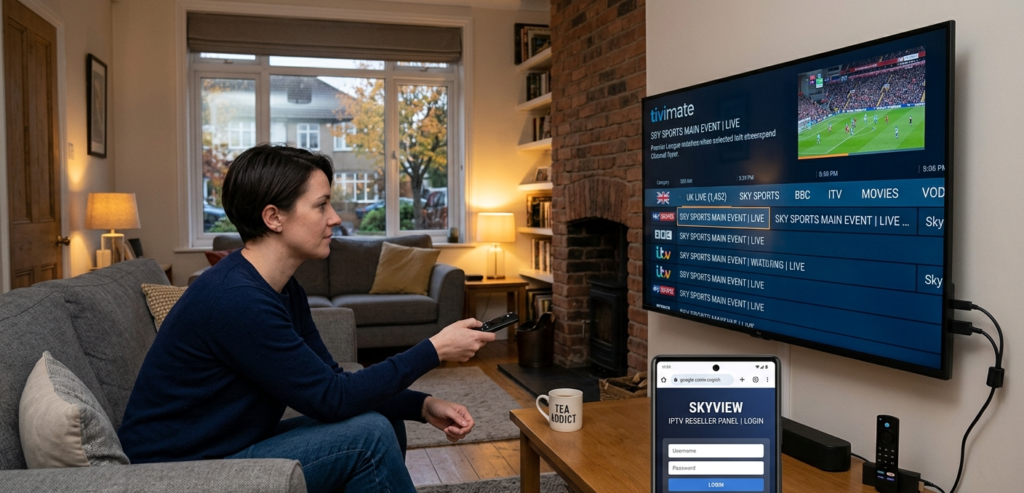
Why Buying IPTV in the UK Is More Complicated Than It Looks
The UK IPTV market in 2026 is enormous. Demand is driven by a population that watches more live sport per capita than almost anywhere in Europe, combined with increasingly expensive legitimate broadcast subscriptions that price out a significant portion of viewers.
But that demand has attracted every type of operator imaginable — from professional resellers running properly managed services with real UK server infrastructure, to individuals who bought a cheap reseller panel on a whim and are now selling subscriptions they can barely manage. And then there are the outright scammers who take payment and disappear.
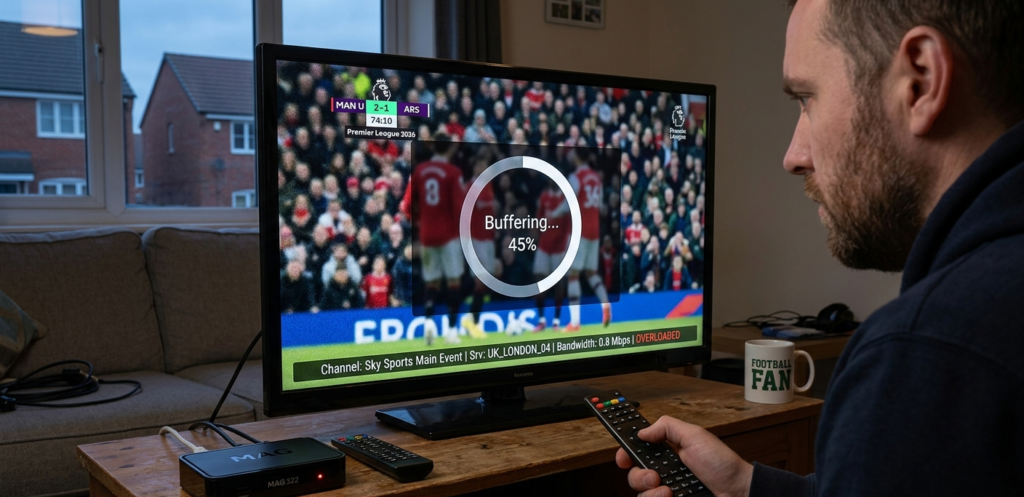
When you decide to buy IPTV, you’re not just purchasing a stream. You’re trusting that the person or service behind it has the infrastructure, the provider relationships, and the operational competence to deliver consistently — especially during the moments when demand is highest and you most want it to work. The 3pm Saturday blackout window, Premier League evenings, boxing nights — these are exactly when underpowered services fall apart.
Understanding this context is what separates a smart purchase from a frustrating one.
Pro Tip: Never buy IPTV from anyone who can’t tell you clearly which devices their service supports, how many simultaneous connections you get, and what happens if you experience consistent buffering. Vague answers to basic questions are the first red flag.
What You’re Actually Buying When You Purchase IPTV
Most people think they’re buying access to channels. What they’re actually buying is a stream delivered from a server, through a CDN, to their device — and the quality of every link in that chain determines what they experience.
Here’s the structure in plain terms:
A provider operates server infrastructure — physical or cloud-based machines that host and distribute streams. A reseller purchases access to those streams in the form of credits or lines, then sells individual subscriptions to end customers. You, as the buyer, receive login credentials — typically a username and password, or an M3U playlist URL — that connect your device to those streams.
The implication of this structure is that your experience depends entirely on the provider’s infrastructure quality and the reseller’s competence in managing their service. A reseller using a weak provider will deliver a poor experience regardless of how professional their website looks. A reseller using solid UK server infrastructure with proper anti-freeze systems will deliver a noticeably better experience even if their branding is minimal.
This is why the cheapest option is rarely the best option. Infrastructure costs money. Reliable UK servers cost more than offshore alternatives. Providers who invest in proper CDN architecture charge more per credit — and resellers using them price accordingly.
The Red Flags That Should Stop You Immediately
In my experience advising people who’ve had bad IPTV purchases, the warning signs were almost always visible in advance. Here’s what to watch for:
No trial option whatsoever. Any legitimate, confident IPTV service will offer a short trial — typically 24 to 48 hours — before asking for a full payment commitment. A seller who refuses trials entirely is either hiding performance problems or running a volume-based operation where they’d rather take your money before you discover the quality.
Payment only via untraceable methods. Cryptocurrency-only payment with no alternatives, or requests for bank transfers to personal accounts, significantly reduce your ability to dispute a charge if the service fails. Not every crypto-accepting service is a scam, but it’s worth noting the risk profile.
Unrealistic pricing. A full IPTV subscription in the UK — one that actually works reliably, supports multiple devices, and holds up during live events — cannot sustainably be priced at £3 or £4 per month. At that price point, either the infrastructure is genuinely poor, the service is massively oversold, or the operator is planning a short-term exit. Sustainable UK IPTV pricing reflects real costs.
No clear support channel. If you can’t find out how to contact the seller with a problem before you purchase, imagine how accessible they’ll be when your stream drops at 4:45pm on a Sunday during a match.
Disappearing Telegram sellers. The UK IPTV market has an unfortunate abundance of sellers who operate exclusively through anonymous Telegram accounts with no website, no verifiable presence, and no accountability. Some are legitimate. Many are not. The risk-reward calculation rarely favours this route.
Pro Tip: Search the seller’s name or domain alongside the word “review” or “scam” before purchasing. UK IPTV forums and Reddit communities have candid, unfiltered feedback about specific services. Five minutes of research can save you months of frustration.
What Good IPTV Service Actually Looks Like
Having been on both sides of this market — as someone who has tested dozens of providers and dealt with the full range of service quality — here’s what a properly runhttps://preimium.com/ IPTV service delivers:
Consistent stream quality during peak hours. Not just on a quiet Tuesday morning, but during a 7:45pm Champions League kickoff with tens of thousands of concurrent viewers hitting the same content. If it holds up then, it’s a serious service.
Fast, honest support. Response times under a few hours for non-urgent issues, and near-immediate acknowledgement during outages. A seller who tells you there’s a known problem and gives you a realistic timeframe is infinitely more valuable than one who goes silent.
Clear subscription terms. You know exactly what you’re getting — how many connections, which device types are supported, what the renewal process looks like, and what happens if you experience persistent issues.
Anti-freeze technology. This is a technical feature that detects stream interruptions and automatically reroutes delivery before the viewer experiences a visible stall. Quality providers build this into their infrastructure. You won’t see it working — which is exactly the point.
Device flexibility. MAG boxes, STBEmu, Firestick, Smart TVs, Android boxes — a properly run service supports the full range without requiring you to jump through technical hoops.
Device Compatibility — Getting This Right Before You Buy
One of the most common sources of post-purchase frustration is device incompatibility — not because the service is bad, but because the customer’s device wasn’t suitable for the subscription type they purchased.
Before you buy IPTV, confirm the service supports your specific setup:
Firestick users need to know whether the service provides an M3U URL, Xtream Codes credentials, or a dedicated app. Different players — IPTV Smarters Pro, TiviMate, GSE Smart IPTV — work better with different credential formats.
MAG box users need their specific MAC address recognised by the provider’s panel, and the service needs to support STB (Set-Top Box) portal connections. Not all IPTV services do.
STBEmu users — particularly those using STBEmu Pro on Android devices — need Xtream Codes or portal-style credentials. The free version of STBEmu has limitations that affect stream quality at higher bitrates.
Smart TV users without a separate streaming device are the most limited. Confirm specifically which Smart TV brands and models are supported before purchasing.
Understanding Pricing: What’s Fair, What’s Suspicious
Here’s a realistic pricing framework for the UK market in 2026:
Fair Price=Infrastructure Cost+Support Overhead+Reasonable MarginFair\ Price = Infrastructure\ Cost + Support\ Overhead + Reasonable\ Margin
In practice, this means:
A single-connection monthly IPTV subscription from a reputable UK reseller should sit between £8 and £15. At the lower end of that range you’re getting a functional service with decent infrastructure. At the higher end you’re getting premium server quality, responsive support, and multi-device compatibility.
Anything below £6 per month should trigger immediate scepticism. Anything above £20 for a standard subscription without clear justification — dedicated servers, guaranteed uptime SLA, white-glove support — is likely overpriced for what’s being delivered.
Annual subscriptions at a 10 to 20 percent discount are standard practice and worth considering if you’ve tested the service and are satisfied. Paying twelve months upfront to an unproven seller is a different matter entirely.
Pro Tip: Always start with a monthly subscription — even if the annual price looks attractive. Prove the service quality through at least one full month, covering at minimum two or three major live events, before committing to a longer term.
The Technical Reality Behind Every IPTV Subscription
Understanding the numbers behind what you’re buying makes you a more informed customer — and if you’re a reseller, it makes you more credible when explaining your service to buyers:
Minimum Broadband Required=Stream Bitrate+20% Buffer HeadroomMinimum\ Broadband\ Required = Stream\ Bitrate + 20\%\ Buffer\ Headroom
For HD streams at 8 Mbps, you need a reliable 10 Mbps connection. For 4K at 25 Mbps, you need at least 30 Mbps of stable throughput. On UK ADSL connections or congested part-fibre, this is worth checking before attributing buffering to the IPTV service.
Server load during peak events is the other variable customers rarely consider. A provider with strong infrastructure running at 70% capacity during a major live event will deliver clean streams. One running at 95% will buffer, stall, and frustrate — regardless of what their marketing claims.
How to Test Before You Commit
Any service worth buying will give you a trial. Here’s how to use it properly:
Test during a live event, not passive on-demand viewing. Live streams are where infrastructure weaknesses show up — the simultaneous concurrent load is categorically different from someone watching a film at their own pace.
Test on the actual device you intend to use daily. Performance can vary between devices and players. A stream that works perfectly on a laptop may behave differently through STBEmu on an Android box.
Test your connection stability independently. Run a speed test during peak evening hours — 7pm to 10pm — not at 2am when your local exchange is quiet. If your broadband is inconsistent, some buffering may be a connection issue rather than a provider issue.
Where to Buy IPTV With Confidence
After everything I’ve described — the red flags, the technical requirements, the pricing realities — the practical question is where to actually find a service that meets these standards.
For UK buyers, britishseller.co.uk is the panel I consistently point people towards when they ask for a vetted recommendation. It’s not a flashy operation with aggressive marketing — which is part of why I trust it. The infrastructure holds up during peak demand, device support is comprehensive, and the resellers operating through it are running proper services rather than fly-by-night Telegram accounts.
If you’re a reseller reading this and wondering where to anchor your own business, the same applies. A panel built on reliable UK server infrastructure is the foundation everything else sits on. Get that right and the customer experience follows.
✅ IPTV Buyer’s Success Checklist
- Always take a trial before paying for a full subscription — test specifically during a live event, not quiet daytime hours, to expose any infrastructure weaknesses.
- Verify device compatibility before purchasing — confirm your specific device and player setup is supported, not just assumed to work.
- Check the seller’s support response time — send a pre-purchase query and measure how long it takes to get a useful response.
- Match pricing to realistic expectations — under £6 per month signals compromised infrastructure; over £15 without clear justification signals overpricing.
- Start monthly, not annually — prove the service across at least one month of real usage before committing to a longer payment term.