I’ll never forget the Saturday afternoon a client rang me furious — match had just kicked off, streams were frozen solid, and my WhatsApp was lighting up like a Christmas tree. That was the day I learned that selling an IPTV service in the UK isn’t just about finding a cheap panel and flipping credits. It’s about understanding the entire chain — from server infrastructure right down to the device your end user is watching on.
If you’re considering getting into the UK IPTV reseller space, or you’re already in it and wondering why your retention rate is terrible, this guide is written for you.
Table of Contents
- What Is an IPTV Service (From a Reseller’s Perspective)
- How the UK IPTV Market Actually Works
- Choosing the Right IPTV Panel
- Understanding Credits, Costs, and Profit Margins
- Technical Factors That Make or Break Your Service
- Common Mistakes UK Resellers Make
- How to Build a Reliable IPTV Business in 2026
1. What Is an IPTV Service — From a Reseller’s Perspective
Most guides will tell you IPTV stands for Internet Protocol Television and leave it at that. But that definition means nothing when you’re the one fielding support messages at 10pm on a match night.
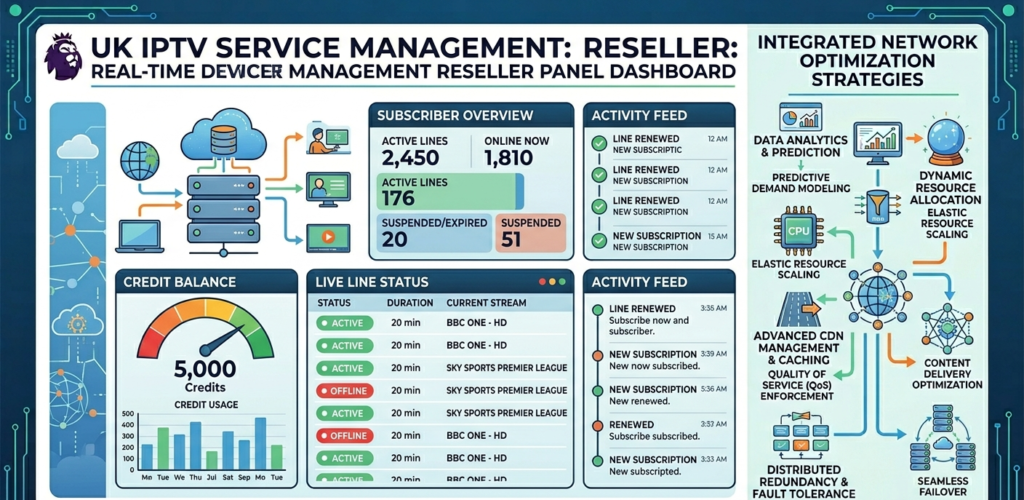
From a reseller’s standpoint, an IPTV service is a chain of dependencies. You have an upstream provider with servers and content, a middleware panel that manages your subscribers, and then your customers with their MAG boxes, STBEmu setups, or Smart TVs. Every link in that chain can fail — and when it does, you’re the one who takes the blame.
In my experience, most new resellers focus entirely on price and completely ignore infrastructure. That’s the number one reason businesses in this space collapse within three months.
Pro Tip: Before committing to any IPTV panel, ask your provider specifically about their CDN setup and UK server locations. If they can’t answer that clearly, walk away.
2. How the UK IPTV Market Actually Works
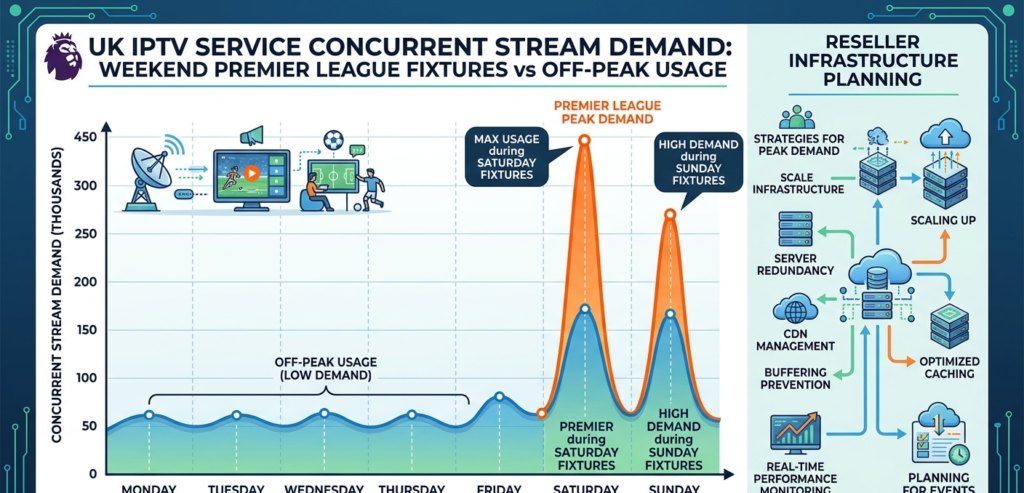
The UK market is one of the most demanding in the world for IPTV service. Why? Because the viewing habits here are incredibly peak-heavy. Weekends between August and May, you’ve got Premier League fixtures driving enormous concurrent stream numbers. Add in mid-week European matches and you’ve got a market where your panel needs to handle serious traffic spikes.
The 3pm blackout rule also means certain afternoon fixtures aren’t broadcast on standard TV — which drives a significant portion of IPTV demand during those exact windows. If your servers can’t handle that load, you’ll be issuing refunds every single weekend.
I’ve spoken with resellers who built decent customer bases, then watched everything fall apart because their provider oversold server capacity. During peak hours, quality tanks, clients leave, and the damage to your reputation is near impossible to repair.
The UK market rewards reliability above everything else. Price matters, but uptime matters more.
3. Choosing the Right IPTV Panel
Your panel is your business. It’s the interface through which you create lines, manage subscribers, issue trials, and track your revenue. A poor panel will cost you more than a poor provider — because panel failures affect every single one of your customers simultaneously.
What to look for in a solid IPTV panel:
Stability under load — Can it handle 200+ active connections without slowing your dashboard?
Anti-freeze technology — This is non-negotiable in 2026. Panels without buffer management and anti-freeze systems will get you destroyed on match days.
Xtream Codes compatibility — The majority of IPTV apps (TiviMate, IPTV Smarters, GSE) rely on Xtream Codes API. If your panel doesn’t support it, you’re limiting your customer base significantly.
M3U and MAG/STBEmu support — Different customers use different devices. A good panel lets you generate M3U playlists as well as portal URLs for MAG boxes, all from one place.
Pro Tip: Always test a panel with at least 20–30 active lines before scaling. Stress-test it during a live match. If it wobbles then, it’ll collapse when you have 300 subscribers.
4. Understanding Credits, Costs, and Profit Margins
This is where most resellers either build a proper business or slowly haemorrhage money without realising why.
Credits are the currency of the IPTV reseller world. You buy them in bulk from your panel provider and spend them to create subscriber lines. The profit comes from the margin between what you pay per credit and what you charge your customers per subscription.
Here’s a straightforward way to think about it:
Monthly Profit=(Active Lines×Subscription Price)−(Credits Used×Cost per Credit)−Fixed Overheads\text{Monthly Profit} = (\text{Active Lines} \times \text{Subscription Price}) – (\text{Credits Used} \times \text{Cost per Credit}) – \text{Fixed Overheads}
Let’s put real numbers to that. If you’re running 100 active subscribers at £10/month, charging 2 credits per line at £1.50 per credit:
Profit=(100×£10)−(200×£1.50)=£1000−£300=£700/month\text{Profit} = (100 \times £10) – (200 \times £1.50) = £1000 – £300 = £700/month
That’s before any support time, hosting costs, or payment processing fees. The margin looks good — but it compresses fast if your churn rate is high. Keeping subscribers is far more profitable than constantly replacing them.
Uptime percentage also directly affects your earnings. A provider running at 97% uptime sounds acceptable — but that’s roughly 22 hours of downtime per month. In a market where half your customers are watching live sport, that’s catastrophic.
5. Technical Factors That Make or Break Your Service
Let me be blunt: if you don’t understand the basics of what makes an IPTV service work technically, you will be exploited — by bad providers, by angry clients, and by your own ignorance.
Server location matters enormously. UK-based or EU-based servers with low latency to British ISPs will always outperform offshore servers routed through multiple hops. When a customer in Manchester is pulling a stream through servers in Asia, you’re introducing unnecessary latency and buffering risk.
Anti-freeze is not a gimmick. Proper anti-freeze systems detect stream stalls before the viewer notices and reroute the signal. Without it, your clients experience that dreaded spinning circle — and they’ll blame you regardless of where the problem originated.
Bandwidth overhead. HD streams typically run at 4–8 Mbps, 4K closer to 25 Mbps. If your provider’s uplink is undersized relative to their subscriber count, you’ll see quality degradation at peak hours.
Pro Tip: Ask your panel provider what happens during a server failover. Do streams automatically switch to a backup? How long does it take? If there’s no clear answer, they don’t have a proper failover setup.
6. Common Mistakes UK Resellers Make
I’ve seen resellers lose serious money — sometimes thousands — for completely avoidable reasons. Here are the patterns I’ve watched repeat themselves:
Choosing based on price alone. The cheapest panel is almost never the most profitable one. When your provider’s servers go down on a Saturday afternoon, no amount of savings compensates for the refunds and lost customers.
No trial system. Giving a 24-hour trial before a customer commits is standard practice and builds trust. Resellers who refuse trials come across as untrustworthy — and in this market, trust is everything.
Ignoring device compatibility. Some customers run MAG boxes, others use STBEmu on an Android box, others want an M3U link for TiviMate. If your panel can’t support all of these, you’re turning away business constantly.
No buffer room in their credit stock. Running out of credits when you’ve got customers wanting renewals is embarrassing and damaging. Always keep a reserve.
7. How to Build a Reliable IPTV Business in 2026
The resellers making consistent money in 2026 aren’t the ones with the lowest prices. They’re the ones who invested in a proper panel, understand their infrastructure, and treat this like a real business.
After everything I’ve worked through — bad providers, panel migrations, angry customers during major fixtures — my honest recommendation for UK resellers is to start with a platform that gives you control, transparency, and proper UK-focused infrastructure from day one.
Britishseller.co.uk is where I’d point any serious reseller getting started or looking to migrate. It’s built specifically for the UK market, gives you a clean reseller panel with Xtream Codes support, and the credit system is straightforward enough that you can model your profits before you spend a penny. No hidden surprises, no vague answers about server locations.
✅ IPTV Reseller Success Checklist
- Verify server infrastructure — Confirm UK or EU-based servers with anti-freeze and failover support before committing to any panel.
- Model your margins first — Use the profit formula above with real credit costs and target subscriber numbers before investing.
- Test under live conditions — Always run a stress test during a live sporting event before scaling your customer base.
- Support all major device types — Ensure your panel supports Xtream Codes, M3U, and MAG/STBEmu portal URLs.
- Build retention, not just acquisition — Focus on uptime, fast support response, and trial quality. A retained subscriber is worth three new sign-ups.